
Disclosure: This post contains affiliate links. If you buy through them, BloomBabe may earn a small commission at no extra cost to you. As an Amazon Associate, I earn from qualifying purchases. We only recommend gear we’d use on our own plants.
Syngonium is the plant that quietly wins people over. You bring one home from the grocery store for six dollars, stick it on a shelf, and three months later it’s spilling over the side of the pot in a soft pink-and-green waterfall. No drama, no crispy tantrums, no expensive humidifier required.
It’s also one of the few houseplants that genuinely changes as it grows — and once you know why, a lot of the confusing advice online suddenly makes sense. Here’s everything we’ve learned keeping arrowheads alive in real apartments with real radiators.
1. Meet the Arrowhead Plant
Syngonium podophyllum goes by a pile of names: arrowhead plant, arrowhead vine, goosefoot, nephthytis. It’s an aroid — same family as pothos, monstera, and philodendron — native to the rainforest floors of Central and South America, where it starts life creeping along the ground and then climbs whatever tree it bumps into.
That climbing habit is the key to understanding it. A young Syngonium has compact, spade-shaped leaves on short stems and sits in a tidy mound. As it matures (or as soon as it finds something to climb), the stems elongate, the plant starts to vine, and the leaves change shape entirely — splitting into three, five, even seven lobes. People often think their plant is sick or “reverting.” It isn’t. It’s just growing up.
A few varieties worth knowing:
- White Butterfly — the classic. Pale creamy-green centers, very forgiving, sold everywhere.
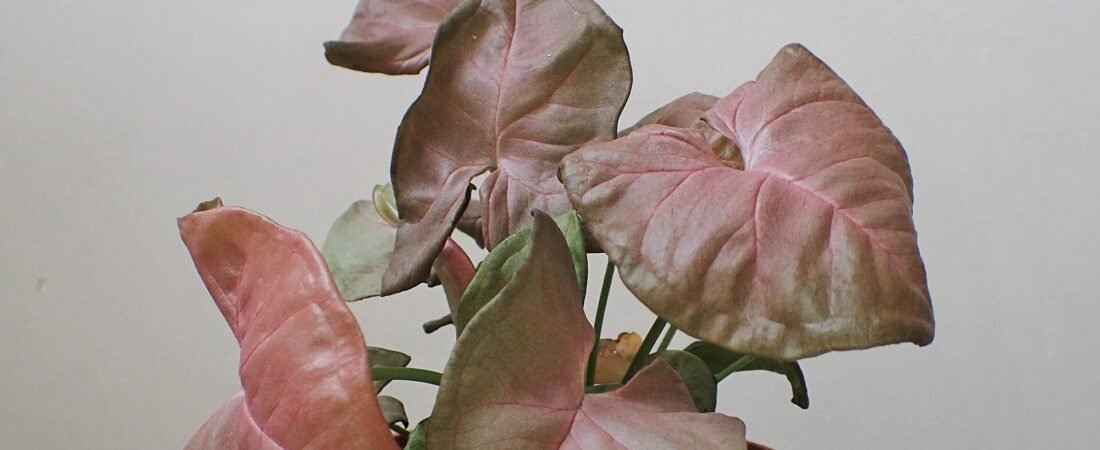
- Pink Allusion / Neon Robusta — soft blush to bubblegum pink. The pink deepens in bright light and washes out in dim corners.
- Berry Allusion — green leaves with pink veining and a slightly peachy cast.
- Albo Variegatum — the collector one, with dramatic white splashes. Slower, pickier, pricier.
- Mini Pixie — a genuinely tiny cultivar that stays small on a desk or shelf.
2. Light
Syngonium is a medium-to-bright indirect light plant, and it’s flexible enough to look good in a lot of spots.
- Ideal: a few feet back from an east or north window, or behind a sheer curtain in a west/south window.
- Tolerates: genuinely low light, though growth slows way down and colored varieties fade toward plain green.
- Avoid: hours of direct midday sun. The leaves are thin and scorch into bleached, papery patches.
If you’re growing a pink or variegated cultivar, light is the whole game — the color is a light response, not a fixed trait. A Pink Allusion in a dark hallway will slowly turn green, and no amount of fertilizer will bring it back. Move it brighter, and the new leaves come in pink again.
For a dim apartment, a small LED grow light on a timer makes a bigger difference here than almost anywhere else in your collection.
3. Water
Arrowheads like to stay lightly moist — not soggy, not bone dry. They’re thirstier than a snake plant and more forgiving than a calathea.
The method that works: water thoroughly when the top 1–2 inches of soil feel dry. Take it to the sink, water until it runs freely from the drainage hole, let it finish dripping, then put it back. No sitting in a saucer of water.
In practice that’s roughly once a week in spring and summer, stretching to every 10–14 days in winter when growth slows. But please check the soil rather than the calendar — a plant in a small terracotta pot in a sunny window dries out three times faster than the same plant in a big plastic pot in a corner.
Reading your plant:
- Drooping, limp stems that perk back up after watering — it got too dry. Not fatal, but try not to make a habit of it; repeated wilting causes crispy edges later.
- Yellowing lower leaves, soil still damp — you’re watering too often.
- Small brown crispy tips — usually inconsistent watering, sometimes dry air.
If you tend to overwater, a soil moisture meter is a cheap way to break the habit.
4. Soil
Standard potting soil straight from the bag holds too much water for an aroid. You want something chunky that drains fast but still holds a little moisture.
An easy mix that works:
- 2 parts quality indoor potting mix
- 1 part perlite for aeration
- 1 part orchid bark for structure
- A handful of horticultural charcoal if you have it
Don’t want to mix your own? A pre-blended aroid potting mix does the same job out of the bag.
Whatever you use, the pot needs a drainage hole. That’s non-negotiable — most Syngonium deaths trace back to a cute cachepot with no way out for the water.
5. Fertilizer
Syngoniums grow fast, and fast growth burns through nutrients.
Feed with a diluted balanced liquid houseplant fertilizer every 3–4 weeks during spring and summer, at half the strength on the label. Taper off in fall and stop over winter unless your plant is under grow lights and actively pushing new leaves.
Signs you’re overdoing it: a white crust on the soil surface and brown leaf edges. Flush the pot with plain water a few times and skip a couple of feedings.
6. Temperature & Humidity
Comfortable room temperature is right: 65–80°F. Keep it above 60°F, and away from cold drafts, drafty entryways, and the blast of a heating vent.
Humidity is where Syngonium earns its beginner reputation. It prefers 50–60% but genuinely does fine in average household air, unlike its fussier cousins. If your winter heating drops the room to desert levels and you’re seeing crispy edges, group your plants together, move it to the bathroom, or run a small cool-mist humidifier nearby.
Skip the misting. It raises humidity for about four minutes and mostly just encourages leaf spot.
7. Repotting
Repot every 1–2 years, or when you see roots circling the surface or poking out the drainage hole. Spring is the best time.
Go up just one pot size — an inch or two wider. Oversized pots hold a huge reservoir of wet soil around a small root ball, which is a direct path to root rot. A nursery pot with drainage tucked inside a decorative cover is the easiest setup: you get drainage plus the look you want.
While the plant is out of its pot, take a look at the roots. Healthy Syngonium roots are firm and pale. Brown, mushy, or smelly roots should be trimmed off with clean pruning shears before you repot into fresh mix.
8. Propagation
This is the fun part, because arrowheads root almost embarrassingly easily.
- Find a node. Look for the small bump where a leaf meets the stem, often with a stubby aerial root already forming.
- Cut just below it with clean shears. Your cutting should have the node plus one or two leaves.
- Root it. Put it in a jar of water on a bright windowsill, or straight into damp mix. Water is slower to establish but far more satisfying to watch. Change the water weekly.
- Pot it up once roots are 1–2 inches long. Keep it a little moister than usual for the first couple of weeks while it adjusts.
Roots usually show in 2–3 weeks. Put three or four rooted cuttings back into the mother plant’s pot and you’ll get a much fuller, bushier plant than you started with.
9. Common Problems
- Long, leggy stems with big gaps between leaves. Not enough light, or the plant is simply maturing into its vining stage. Pinch the tips back to force branching, or give it a moss pole and let it climb — climbing plants produce bigger, more dramatic leaves.
- Pink or variegated leaves turning plain green. Light. Move it brighter and prune off the fully green growth.
- Yellow leaves. If the soil is wet, it’s overwatering. If the soil is dry and the yellowing is on old lower leaves only, that’s normal aging.
- Brown crispy edges. Dry air, inconsistent watering, or fertilizer buildup — in that order of likelihood.
- Spider mites. The most common pest, especially in dry winter air. Look for fine webbing in the leaf joints and stippled, dusty-looking leaves. Shower the plant off, then treat with neem oil every 5–7 days for three rounds.
- Fungus gnats. Annoying, not dangerous. Let the top layer dry more between waterings and put out a few yellow sticky traps.
Frequently Asked Questions
Is Syngonium toxic to pets? Yes. Like all aroids, it contains insoluble calcium oxalate crystals that cause mouth irritation, drooling, and vomiting if chewed. Keep it on a high shelf or in a hanging planter if you have cats or a curious dog.
Why did my compact plant suddenly start vining? It matured. Young arrowheads grow in a mound; adults vine and produce lobed leaves. If you want to keep the bushy look, pinch the growing tips regularly and it’ll stay compact for years.
Can I grow it in just water? Yes, semi-permanently — Syngonium does well in water culture or LECA. Change the water weekly and add a few drops of hydroponic nutrients, since plain water has nothing to feed on.
Will it grow in a bathroom with no window? No plant grows in true darkness, but a bathroom with even a small frosted window is a great spot — the humidity suits it perfectly.
Why are the new leaves smaller than the old ones? Usually light or nutrients. It can also mean the plant is root-bound and ready for a bigger pot.
Quick-Start Gear Checklist
- 🪴 Aroid potting mix or potting soil + perlite
- 🕳️ Nursery pot with drainage
- 💧 Soil moisture meter
- 🌿 Balanced liquid fertilizer
- ✂️ Pruning shears
- 🧗 Moss pole for climbing growth
- 🐛 Neem oil
Give a Syngonium decent light, water it when the top inch dries, and pinch it back when it gets leggy — that’s genuinely the whole job. It grows fast enough to feel rewarding, roots easily enough to fill your whole apartment for free, and forgives the occasional missed week. If you’ve killed something fussy lately and want a win, this is the plant. Happy growing, from all of us at BloomBabe. 🌱