
Disclosure: This post contains affiliate links. If you buy through them, BloomBabe may earn a small commission at no extra cost to you. As an Amazon Associate, I earn from qualifying purchases. We only recommend gear we’d use on our own plants.
Most of us start our plant life with a drinking glass. Then a mug. Then, one day, you pour a little too fast into a tightly packed calathea, half of it runs across the shelf, and the other half drowns the crown. That’s usually the day people start shopping for a real watering can.
A good indoor can isn’t decoration (though it can be lovely). It changes where the water goes. A long, thin spout puts water on the soil instead of the leaves, lets you reach the back of a crowded shelf, and slows the pour so the mix actually soaks it up instead of channeling straight out the drainage hole.
We’ve watered a lot of plants with a lot of vessels. Here’s what genuinely matters, and the type of can we’d reach for in each situation.
What to Look For in an Indoor Watering Can
1. A long, narrow spout
This is the single biggest upgrade. A spout that’s long relative to the body gives you reach (hanging pots, the back row of a plant shelf, the inside of an IKEA greenhouse cabinet) and control. Narrow spouts pour slowly, which matters more than people think: fast water tends to tunnel down one side of the pot and leave dry pockets in the root ball.
2. Where the spout attaches
Look at the side of the can. If the spout joins low on the body, near the base, the can pours smoothly from the very first tilt and empties fully. Spouts that attach high up make you tip the whole can sideways before anything comes out, and then it gushes.
3. Capacity that matches your collection
Bigger isn’t better indoors. Water weighs a little over eight pounds per gallon, and you’ll be holding the can at arm’s length over furniture.
- Under 1 liter: a handful of plants, desks, terrariums, seedlings.
- 1–2 liters: the sweet spot for most apartments. One fill covers a shelf.
- Over 2 liters: big floor plants or large collections, as long as you’re comfortable with the weight.
4. A rose you can remove (or no rose at all)
The “rose” is the sprinkler head on the end of a spout. It’s great outdoors and for gently settling seed-starting trays. For most houseplants, you want it off, because wetting the foliage on calatheas, African violets and fuzzy-leaved plants invites spots and rot. A removable rose gives you both options.
5. Material
- Plastic: light, cheap to replace, won’t dent. The best everyday choice.
- Galvanized steel or powder-coated metal: sturdy and good-looking; check that the seams are sealed.
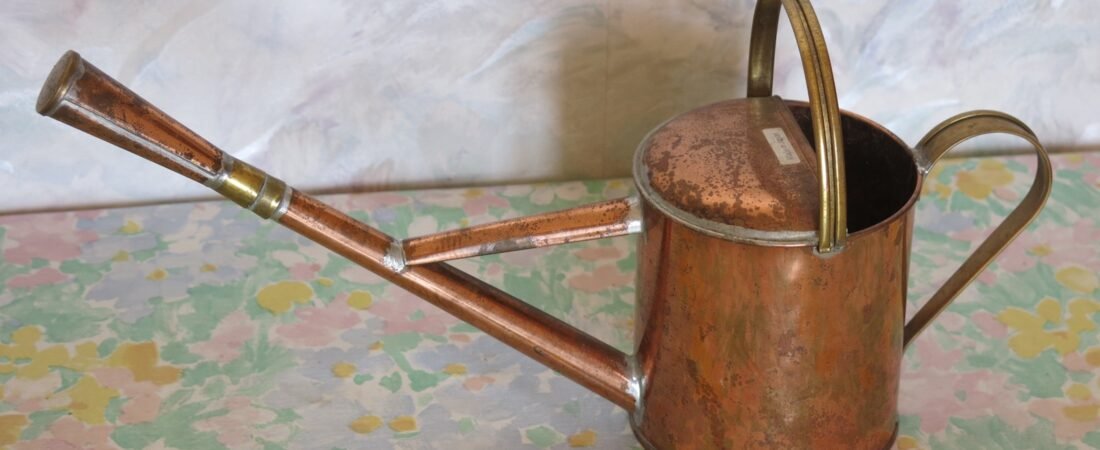
- Brass and copper: beautiful enough to leave out, heavier, and they patina over time. Treat them as a long-term piece.
- Glass and ceramic: gorgeous on a shelf, but fragile and often short-spouted.
6. Balance and grip
Fill it and hold it out at arm’s length before you commit. A well-designed can has a handle that lets your wrist stay straight and doesn’t feel nose-heavy when the spout is full.
Our Picks by Situation
Rather than crown one “best” can, we’ve matched the type of can to the way you water. Every link below opens an Amazon search so you can compare current options, colors and reviews side by side.
Best All-Rounder: A Long-Spout Plastic Can (1–2 L)
If you only buy one, make it this. A long spout indoor watering can in the one-to-two-liter range is light enough to carry around the house, reaches the back of a shelf, and pours slowly enough for even fussy plants. Look for a low-mounted spout and a handle that wraps over the top. This is the can that lives on our counter.
Best for Shelves, Cabinets and Hanging Pots: A Gooseneck Can
Gooseneck spouts curve up and over before they angle down, so you can water a hanging pothos from below or slip into a greenhouse cabinet without touching the leaves on the top shelf. A gooseneck watering can is the one we use for anything at or above eye level. If your collection is mostly trailing plants, start here.
Best for Small Collections and Desks: A Mini Can or Squeeze Bottle
For three or four plants, a full-size can is overkill. A small mini watering can tucks onto a bookshelf and is just right for succulents and small pots. For tiny pots, terrariums and propagation stations, a squeeze bottle with a bent nozzle gives you pinpoint control, so water lands at the soil line and never pools in a rosette.
Best to Leave on Display: Brass, Copper or Stainless Steel
If your can is going to live in the living room, it might as well be pretty. A brass indoor watering can or stainless steel watering can reads as decor, not a chore. Haws, the British maker that has been making long-reach cans for more than a century, is the name you’ll see most in this style. Whatever brand you choose, the same rules apply: low spout, long neck, comfortable weight when full.
Best for Large Collections: A Bigger Can and a Refill Station
Once you’re past twenty or thirty plants, the trick isn’t a bigger can, it’s fewer trips. A 2 liter long spout watering can is about as large as most people want to carry indoors. Pair it with a lidded water storage jug kept near your plant area so refills take seconds instead of a walk to the kitchen.
Best for Gentle Seedlings and Moss: A Fine-Rose Can
Seed trays, freshly sown pots and sheet moss get washed out by a single spout. A small can with a fine rose watering can breaks the stream into a soft shower that settles soil without moving the seeds. Pop the rose off afterwards and it doubles as your regular can.
How to Use Your Watering Can (So the Water Actually Reaches the Roots)
A great can won’t help if the technique is off. A few habits that make a real difference:
- Water the soil, not the plant. Aim the spout at the soil line, close to the rim, and work around the pot in a slow circle.
- Go slowly, then pause. Pour until water starts to appear in the saucer, wait a minute for the mix to absorb, then add a little more. Bone-dry mix sheds water at first; the pause lets it rehydrate.
- Check before you pour. Push a finger two inches into the soil, or use a soil moisture meter. The can is for watering when the plant needs it, not on a fixed day.
- Let tap water sit if your plants are sensitive. Leaving the can filled overnight lets it reach room temperature (cold water can shock tropicals). It also lets some chlorine dissipate, though not chloramine. For calatheas and other fussy growers, filtered or rain water is the gentler option.
- Empty the saucer. After 15–20 minutes, tip out anything left in the plant saucer. Roots sitting in standing water are the fastest route to rot.
- Rinse the can now and then. A can that’s always half full grows algae. Rinse it out every couple of weeks and let it dry upside down.
FAQ
What size watering can is best for indoor plants?
For most homes, one to two liters. It’s enough to water a full shelf in one trip and still light enough to hold steady over furniture.
Should I use a watering can with a rose for houseplants?
Usually not. A rose wets the leaves, which many houseplants dislike. Keep one for seedlings, seed trays and settling new soil, and pour through the open spout the rest of the time.
Is a long spout really better?
Yes, for two reasons: reach and control. A long, narrow spout delivers water exactly where you want it, at a speed the soil can absorb.
Can I just use a pitcher or a cup?
You can, and plenty of thriving collections are watered from a measuring jug. The trade-off is precision: wide lips pour fast and wide, which splashes leaves and crowns and tends to channel water down the side of the pot.
Is bottom watering better than using a can?
They’re tools for different jobs. Bottom watering is great for evenly rehydrating a very dry root ball and for plants that hate wet leaves. Top watering with a can flushes out mineral and fertilizer buildup. Most of us do both.
How do I stop my watering can from getting slimy?
Don’t store water in it for days in a warm room. Empty it, rinse it, and let it dry with the spout pointing down.
Quick Buying Checklist
- [ ] Long, narrow spout (gooseneck if you have hanging or high plants)
- [ ] Spout attached low on the body for a smooth, controlled pour
- [ ] Capacity that suits your collection: under 1 L, 1–2 L, or larger
- [ ] Removable rose, or no rose at all
- [ ] Comfortable to hold at arm’s length when full
- [ ] Material that suits where it lives: plastic for everyday, metal for display
- [ ] Optional extras: a squeeze bottle for tiny pots and a moisture meter for knowing when to water
The Bottom Line
The right watering can is a small thing that quietly makes everything easier. Water lands where it should, you stop splashing the shelf, and the fussy plants finally stop sulking. Start with a light, long-spout can in the one-to-two-liter range, add a gooseneck if you’ve got plants up high, and let your collection tell you what you need next.
Happy watering, and from all of us at BloomBabe, may every pour go exactly where you aimed it. 🌿