
Disclosure: This post contains affiliate links. If you buy through them, BloomBabe may earn a small commission at no extra cost to you. As an Amazon Associate, I earn from qualifying purchases. We only recommend gear we’d use on our own plants.
Let’s be honest about the number one way houseplants die: it isn’t neglect, it’s love. Overwatering — the well-meaning, “it looked a little dry so I gave it a splash” kind — quietly rots more roots than any pest or dark corner ever will. The tricky part is that the top of the soil dries out days before the root zone does, so your finger poking the surface is basically lying to you.
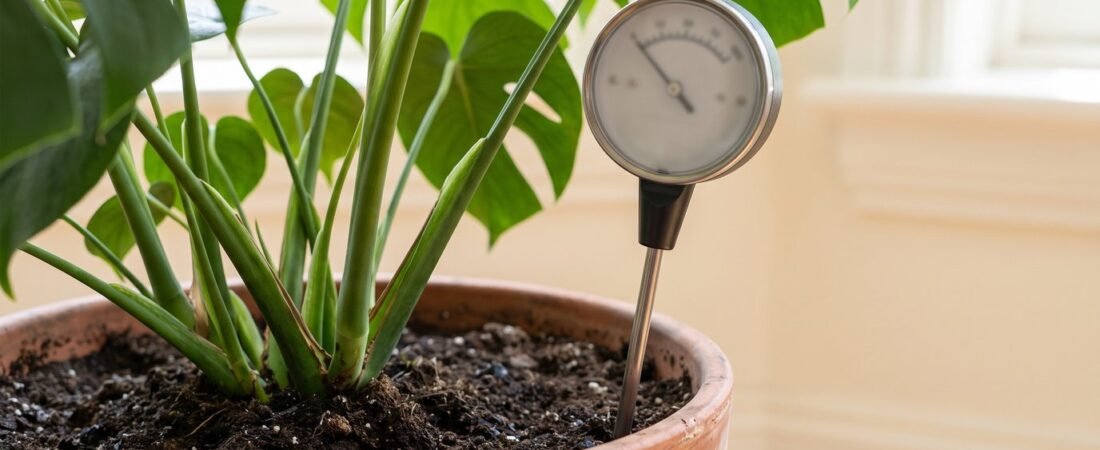
That’s the whole reason a soil moisture meter exists. It’s a cheap little probe that reads moisture down where the roots actually live, takes the guesswork out of “should I water today?”, and pays for itself the first time it stops you from drowning a fussy Calathea. We’ve tested a pile of them across our own collection, and here’s how to choose the right one — plus our favorite picks by situation.
What to Look For in a Soil Moisture Meter
Before you shop, a few things matter far more than the brand name on the box:
- A long enough probe. You want the sensor to reach the middle-to-lower root zone, not just the top inch. For most 6–8″ pots, a probe around 7–8 inches is the sweet spot. Deep floor planters may want a longer one.
- Analog vs. digital. The classic analog soil moisture meter needs no batteries, costs almost nothing, and is honestly all most people need. A digital soil moisture meter gives you a precise number and often adds light and pH readings.
- A readable scale. A clear 1–10 dial (dry / moist / wet) beats a cramped, ambiguous gauge. You’re going to glance at this thing, not study it.
- Build quality that survives dense mix. Chunky aroid soil and bark can bend flimsy probes. A sturdier stainless probe lasts longer if you repot often.
- No batteries required (usually a plus). Most quality analog meters are powered by the soil moisture itself. Fewer things to replace, and nothing to die on you mid-watering.
A quick myth-buster: the cheap 3-in-1 meters that also claim to read pH are fine for the moisture and light functions, but treat the pH number as a loose hint, not gospel. For real soil pH, you want a dedicated kit — more on that below.
Our Picks by Situation
Best All-Around: Classic Analog Moisture Meter
For nine out of ten plant parents, a simple analog soil moisture meter is the answer. No batteries, no fuss — you push it into the soil, read the needle, and pull it out. Keep one in each room or just carry it on watering day. This is the single cheapest upgrade that will genuinely save your plants.
Best for Data Lovers: Digital Moisture Meter
If you like a precise number and a backlit screen, a digital soil moisture meter gives you an exact reading and takes the interpretation out of a wiggly analog needle. Great for anyone dialing in a fussy plant’s routine, or who just finds numbers more reassuring than dials.
Best 3-in-1: Moisture, Light & pH Combo
Newer to plants and not sure if that corner is bright enough or if you’re overwatering? A 3 in 1 soil moisture meter reads moisture, light level, and rough pH from one probe. It’s a fantastic learning tool — use the moisture and light functions with confidence and take the pH reading with a grain of salt.
Best for Big Floor Plants: Long-Probe Meter
Fiddle Leaf Figs, Bird of Paradise, and other floor giants live in deep pots where the top four inches tell you nothing. A long probe soil moisture meter reaches down to the real root zone so you know what’s happening where it counts.
Best High-Tech Option: Bluetooth Plant Sensor
Want your phone to nag you before things go wrong? A bluetooth plant soil sensor parks permanently in the pot and streams moisture (and often light and temperature) to an app, complete with alerts. It’s overkill for a pothos, but genuinely useful for a prized specimen or when you travel a lot.
Best for Serious pH Testing: Dedicated Soil pH Kit
If you actually need trustworthy pH — say you’re troubleshooting nutrient lockout or growing acid-loving plants — skip the combo dial and grab a proper soil ph test kit. It’s the honest tool for that job.
How to Actually Use a Moisture Meter
Buying it is step one; using it well is where the magic happens.
- Push it in slowly to about two-thirds of the pot’s depth, near the root ball but not jammed against the drainage hole. Give it 30–60 seconds to settle, then read.
- Learn your plant’s number, not a universal one. Most foliage plants like to be watered when the meter reads around 3–4 (“dry”) in the root zone. Thirsty tropicals such as ferns prefer you to water at 4–5; drought-lovers like a snake plant or succulent want to hit a true 1–2 before you even think about it.
- Test in a couple of spots in larger pots — soil moisture isn’t always even.
- Wipe and dry the probe after each use, especially analog ones. Leaving it stuck in wet soil permanently can corrode the metal and throw off readings.
- Pair it with good soil and drainage. A meter tells you when; the right well draining potting mix and a pot with holes make sure “wet” doesn’t turn into “rot.” A little perlite stirred into a heavy mix works wonders.
Think of the meter as training wheels for your intuition. After a month of checking it against how the pot feels by weight and how the plant looks, you’ll start to just know — and that’s the real goal.
Frequently Asked Questions
Are cheap soil moisture meters accurate? For relative moisture — dry vs. moist vs. wet — yes, surprisingly so. They’re not lab instruments, but they’re plenty accurate to tell you whether the root zone still holds water, which is the only question that matters for watering.
Why does my meter always read wet (or always dry)? Two usual culprits: a very dense or very chunky mix can confuse the probe, and a dirty or corroded analog tip stops reading properly. Clean and dry the probe, test in a couple of spots, and if it’s still stuck, the meter may be worn out — they’re cheap to replace.
Do moisture meters work in chunky aroid mix? Mostly, but big bark chunks and airy mixes can give slightly erratic readings. Push the probe into a denser pocket of soil and take two readings. For very chunky mixes, honestly, the pot-weight method (lift it — light means dry) is a great companion technique.
Can I leave the meter in the pot all the time? Skip it with analog meters — constant moisture corrodes them. If you want an always-in sensor, that’s exactly what a bluetooth plant soil sensor is designed for.
Is a moisture meter better than the finger test? For shallow pots and hardy plants, your finger is fine. For deep pots, dense root balls, and drama queens like Calatheas and ferns, a meter reads far below where your finger reaches — which is exactly where overwatering does its damage.
The Quick Buying Checklist
- 🌡️ Analog soil moisture meter — best all-around, no batteries
- 🔢 Digital soil moisture meter — precise numbers, backlit screen
- ☀️ 3-in-1 moisture/light/pH meter — great starter learning tool
- 📏 Long-probe meter — deep pots & floor plants
- 📱 Bluetooth plant sensor — app alerts, set-and-forget
- 🧪 Soil pH test kit — when you need real pH numbers
A moisture meter is the rare plant gadget that’s cheap, foolproof, and genuinely life-changing for your collection — it turns “I hope I’m watering right” into “I know I am.” Grab one, learn your plants’ happy numbers, and watch the sad, soggy-root days disappear for good. Happy (and confident) watering, from all of us at BloomBabe. 🌿💧