
Disclosure: This post contains affiliate links. If you buy through them, BloomBabe may earn a small commission at no extra cost to you. As an Amazon Associate, I earn from qualifying purchases. We only recommend gear we’d use on our own plants.
Most of us prune our houseplants with whatever’s within reach. Kitchen scissors. Nail clippers. That one pair of craft scissors that lives in the junk drawer and has cut tape, cardboard, and at least one Amazon box.
Here’s the thing nobody tells you: dull, wide-jawed scissors don’t cut a stem, they crush it. The tissue gets pinched flat, the cells rupture, and instead of a clean wound that seals over in a day or two, you get a mushy stub that browns backward into healthy growth. On a Pothos you’ll get away with it. On a Fiddle Leaf Fig or a Hoya you’re paying for that shortcut for weeks.
Good shears fix this for about the cost of one mid-size nursery plant, and they last for years. Here’s how to pick a pair, and our favorites depending on what you actually grow.
What to Look For in Pruning Shears
Four things separate a pair you’ll love from a pair that ends up in the drawer.
Bypass, not anvil. This is the single most important call. Bypass shears work like scissors: two curved blades slide past each other and slice cleanly through the stem. Anvil shears have one blade that comes down against a flat metal plate, which crushes the stem against it. Anvil pruners are fine for deadwood in the garden. For living green tissue on a houseplant, bypass wins every time. If a listing doesn’t say, look at the photo. Two blades that pass each other, or one blade meeting a flat bar?
Blade size that matches your plants. A big pair of loppers is useless six inches deep into a Monstera, and a tiny snip will bend and struggle on a woody Ficus branch. Most indoor collections need two tools, honestly: something small and pointed for precision, something sturdier for anything with real wood in it.
Stainless steel with a non-stick coating. Plant sap is sticky, and dried sap on a blade is what gums up the pivot and turns a smooth cut into a chewy one. Coated stainless resists both sap and rust, and it rinses clean instead of needing a scrub. Carbon steel holds an edge a bit longer, but it will rust on you if you’re the kind of person who puts tools away damp. (I am that person.)
A spring and a lock you can operate one-handed. You will often be holding a leaf steady with one hand while cutting with the other. A spring that reopens the blades for you makes that possible. A safety lock keeps the blades closed in a drawer, and the good ones flick with a thumb rather than requiring both hands and a plan.
One more thing worth saying out loud: comfort matters more than specs. If the handles are too wide for your hand, you’ll squeeze from an awkward angle, the cut will be sloppy, and your thumb will hate you by plant number six.
Our Picks by Situation
Best All-Around: Classic Bypass Pruning Shears
If you buy exactly one tool, make it a pair of bypass pruning shears. They handle everything from a leggy Pothos vine to a pencil-thick Rubber Plant stem, they’re comfortable for long sessions, and the spring-and-lock design is genuinely pleasant to use. Look for a replaceable blade if you plan to keep them a decade, and a sap groove along the blade so gunk has somewhere to go.
Best for Delicate Work: Micro-Tip Snips
For String of Pearls, Pilea pups, spent Calathea leaves, and any cut you need to make between two leaves without nicking either of them, nothing beats micro tip pruning snips. The needle-fine points let you see exactly where the blade will land. These are the shears that live on my plant shelf and get used four times a week. They aren’t strong enough for woody stems, and that’s fine, they aren’t trying to be.
Best for Woody Stems: Ratchet Pruners
An older Ficus, a mature Rubber Plant, a Bird of Paradise stalk at the base, these get genuinely tough. Ratchet pruning shears cut in stages, so instead of one hard squeeze you get three easy ones and the mechanism does the work. They’re slower, which is exactly the point, and they’re a real kindness if you have weak grip strength or sore hands.
Best for Tight Spaces: Curved-Tip Bonsai Scissors
Reaching into the middle of a dense Boston Fern or a full greenhouse cabinet shelf is a geometry problem. Curved tip bonsai scissors solve it with a bent tip and long, slim handles that let you get the blade where your hand can’t follow. They’re also lovely for trimming a stem flush against a node without leaving a stub.
Best for Hand Comfort: Lightweight Ergonomic Pruners
If arthritis, carpal tunnel, or just small hands make standard shears a chore, look for lightweight ergonomic pruning shears with a narrow handle span and a rotating lower grip. The rotating handle sounds like a gimmick and absolutely is not. It lets your fingers roll through the cut instead of gripping through it, and the difference over twenty cuts is dramatic.
Best Value: A Multi-Pack Garden Snips Set
Want a pair in the plant room, a pair in the kitchen window, and a pair that lives with your propagation setup? A garden snips set gets you there cheaply. The steel usually isn’t as good and they’ll dull sooner, but having sharp shears within arm’s reach beats having excellent shears in another room. That’s not a compromise, that’s just how habits work.
How to Actually Use Them
Sterilize between plants. Every time. This is the step people skip and the reason a fungal problem spreads across a whole shelf in a week. Wipe the blades with 70% isopropyl alcohol on a cloth, or keep a tub of alcohol prep pads right next to your tools. It takes four seconds. If you’re cutting into something you already suspect is diseased, sterilize between every single cut, not just between plants.
Cut just above a node, at a slight angle. The node is the little bump where a leaf or aerial root emerges, and it’s where new growth will come from. Leave about a quarter inch above it. Cut too far above and you get a bare stub that dies back; cut into the node itself and you lose the growth point entirely.
Don’t take more than a quarter of the plant at once. Leaves are how the plant eats. Strip too many and it has nothing left to fund the regrowth you’re pruning for. If a plant needs a big overhaul, do it across two or three sessions a month apart.
Prune in spring and summer when you can. Active growing season means the plant seals the wound faster and pushes new growth quickly. Winter pruning isn’t forbidden, the plant just sits there looking cut for a while.
Save the cuttings. Most of what you trim off a vining plant is a free new plant. A stem with a node and a leaf or two, dropped into a glass propagation station, will root on a windowsill in a few weeks. For woody or stubborn cuttings, a dip in rooting hormone powder meaningfully improves the odds.
Clean and oil them afterward. Wipe the sap off, dry the blades completely, and every couple of months put a drop of camellia oil on the pivot and blade. When cuts start feeling like they need force, they don’t need replacing, they need a pass with a garden tool sharpener.
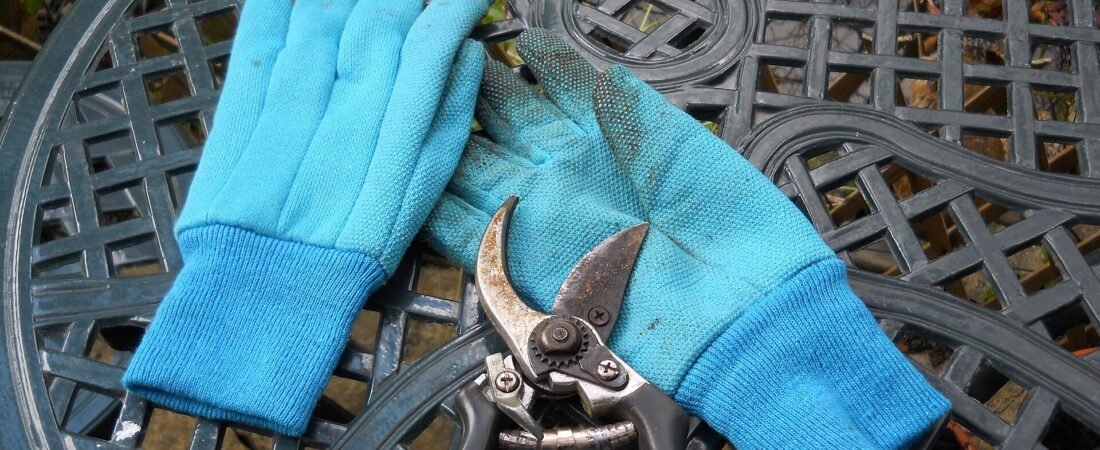
One safety note: some plants fight back. Ficus, Rubber Plants, and the whole Euphorbia family bleed a white latex sap that irritates skin and really irritates eyes. Keep a pair of gardening gloves nearby for those, and wash your hands before you touch your face.
Frequently Asked Questions
Can I just use kitchen scissors? For a soft Pothos or Tradescantia vine, sure, if they’re sharp. For anything thicker than a drinking straw, the wide blade geometry crushes more than it cuts. And kitchen scissors don’t get sterilized between plants, which is the bigger problem.
Bypass or anvil for houseplants? Bypass. Anvil pruners crush living stems against a flat plate. Save those for dead branches outdoors.
How do I sterilize my shears properly? Wipe the blades with 70% isopropyl alcohol and let them air dry for a few seconds. Diluted bleach works but corrodes steel over time. Skip the “run it through the dishwasher” advice, heat and detergent are hard on the pivot and the spring.
Should I seal the cut with anything? No. Wound sealants and cinnamon are old advice that’s largely fallen out of favor. A clean cut on a healthy plant callouses over on its own, and sealing can trap moisture against the wound.
How often should I sharpen? For typical indoor use, once or twice a year. The plant will tell you first: if you’re seeing torn, stringy edges on your cuts instead of clean ones, you’re overdue.
Are expensive shears worth it? For micro snips, not especially. For your main all-around pair, yes. Better steel holds an edge longer, better pivots don’t wobble, and a replaceable blade means one purchase instead of five over a decade.
What’s the difference between pruning and propagating cuts? Mostly intent. A pruning cut is placed for the parent plant’s benefit, just above a node. A propagation cut is placed for the cutting’s benefit, an inch or so below a node, so the piece you’re taking has a growth point to root from.
Quick Buying Checklist
- ✂️ Bypass pruning shears — the one-tool answer if you buy nothing else
- 🌿 Micro tip snips — delicate work, everyday shelf tool
- 💪 Ratchet pruners — woody stems and easier on your grip
- 🎯 Curved tip bonsai scissors — dense plants and cabinet shelves
- 🤲 Ergonomic lightweight pruners — sore hands, small hands
- 🧴 Alcohol prep pads — sterilize between plants, no excuses
- 🪴 Propagation station — turn trimmings into new plants
- 🛠️ Garden tool sharpener — makes good shears last years
Pruning feels scary until the first time you do it well. Then you watch a leggy plant push three new branches from where you made one cut, and it clicks: you’re not taking something away, you’re telling the plant where to grow. Sharp blades, a clean wipe between plants, and a cut just above the node. That’s the whole craft. Go be brave with your Pothos. Happy growing, from all of us at BloomBabe. ✂️🌿