
Disclosure: This post contains affiliate links. If you buy through them, BloomBabe may earn a small commission at no extra cost to you. As an Amazon Associate, I earn from qualifying purchases. We only recommend gear we’d use on our own plants.
You’ve seen the photos: a Philodendron in a clear glass pot full of little clay balls, roots fat and white, water pooled in the bottom. Someone always comments “wait, there’s no soil?” — and then three people argue about whether it counts as hydroponics.
Here’s the plain version. Semi-hydro isn’t hydroponics and it isn’t soil. It’s growing in an inert medium that holds air and wicks water up from a small reservoir. That’s it. No soil to compact, no guessing whether the middle of the pot is still soggy. Once you understand what the medium is doing, the whole thing stops looking intimidating and starts looking like less work.
Below: what the common mediums are, how a setup works, how to move a plant over without killing it, and the honest downsides the before-and-after photos leave out.
Why go soilless at all?
Potting soil does two jobs at once and is bad at balancing them: it has to hold water and hold air. As soil breaks down — and it always breaks down — the particles get smaller, the pockets collapse, and the air goes away. That’s the real reason a plant that was fine for a year suddenly rots. Not a watering mistake. Old soil.
Inert mediums don’t break down. A clay pebble is the same clay pebble in five years, holding the same air gap it held on day one. That buys you:
- Root rot gets much harder to cause. The roots sit in air with water below them, not in a wet sponge.
- You can see what’s happening. In a clear pot, you watch the water level and the roots directly.
- Fungus gnats lose their habitat. They breed in damp organic matter. There isn’t any.
- Watering becomes a schedule, not a judgment call. Top up the reservoir when it’s empty.
- Repotting is calm. No root ball to wrestle, no soil all over the counter.
The tradeoff, and it’s a real one: inert mediums contain zero nutrition. In soil, you can skip fertilizer for months and the plant coasts. In semi-hydro, fertilizer is the food. Skip it and the plant starves on schedule.
The mediums, one by one
LECA (clay pebbles)
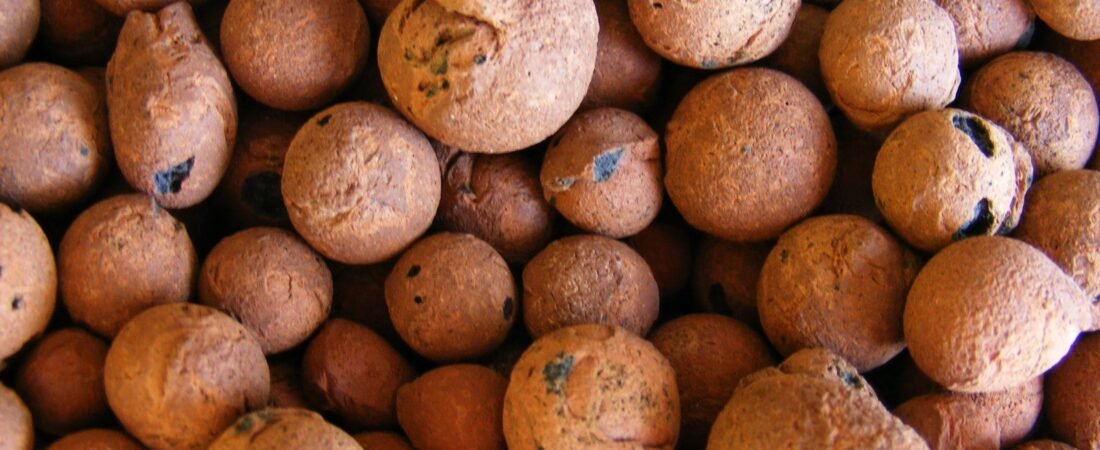
Lightweight Expanded Clay Aggregate — clay fired until it puffs up like popcorn, full of tiny sealed air pockets. It’s the icon of the semi-hydro look and the easiest place to start. LECA clay pebbles are reusable almost indefinitely: rinse, boil or soak, use again.
Two things people get wrong. First, rinse it until the water runs clear — new LECA sheds a startling amount of red dust that will clog everything. Second, soak it before planting, ideally overnight; dry pebbles pull moisture away from roots instead of giving it.
LECA’s weakness is wicking. Round pebbles only pass water up a couple of inches, so a tall pot has a dry zone in the middle. Smaller grades wick better than jumbo.
Pon (mineral mixes)
Pon is a blended mineral substrate — usually pumice, zeolite and lava rock, often with a slow-release fertilizer mixed in. Lechuza Pon is the well-known version and the most beginner-friendly of the bunch, because its mixed particle sizes wick far better than round LECA. Plenty of people run pon in a normal pot with a saucer and water it like soil, which blurs the line nicely. The zeolite also buffers nutrients — grabbing some and releasing them slowly — so it forgives an imperfect feeding routine.
Pumice
Volcanic rock, porous, sharp-edged, and genuinely excellent. Horticultural pumice holds more water than LECA, wicks better because of its irregular shape, and has enough weight to keep a top-heavy plant from tipping. It’s our quiet favorite for anything with chunky roots.
Perlite
Yes, the white stuff you already own. A pot of straight perlite is a legitimate semi-hydro medium and the cheapest entry point there is — it’s how a lot of people root cuttings. Downsides: it’s so light the pot tips over, it floats when you water from the top, and it crushes into dust over time. Use coarse grade, not the fine seed-starting kind.
Sphagnum moss
The odd one out, because it is organic — but it behaves so differently from soil that it belongs here. Long-fiber sphagnum moss holds a lot of water while staying surprisingly airy, and it’s the standard rescue medium for a plant that has lost most of its roots, plus the default for Anthuriums and other thin-rooted aroids.
Two cautions: it breaks down and compacts, so plan on replacing it yearly, and it’s very easy to overwater because the surface dries while the core stays wet. Moss is not a set-and-forget medium.
Charcoal
Rarely run alone, but horticultural charcoal earns a spot in chunky mixes — porous, slow to compact, and good at keeping stagnant-water smell down. Orchid bark does similar work but is organic, so it decomposes.
How a semi-hydro setup actually works
The mechanics are simpler than the vocabulary suggests.
- The pot holds medium; the bottom inch or two holds water. Either a cachepot system (an inner pot with holes inside a watertight outer pot) or a single watertight vessel with no drainage.
- The medium wicks that water upward by capillary action. The lower zone is wet, the upper zone damp, and the roots get to choose.
- Roots adapt. Water roots grow thinner, whiter and more branched than soil roots — which is why transitioning takes time.
- You refill when the reservoir runs dry, and crucially, you let it run dry first. That gap is what re-oxygenates the lower roots. A permanently full reservoir is how semi-hydro plants rot.
Clear pots make this obvious, which is most of why people use them. A set of clear plastic nursery pots dropped into a glass cachepot is the cheap classic. If you’d rather it look like furniture, a self-watering planter with a built-in level indicator does the same job with a reservoir window.
Fill the reservoir to about a quarter of the pot’s height, maximum, and never high enough to submerge the root mass. The roots in the water zone are fine; the whole plant sitting in water is not.
Feeding: the part you cannot skip
Inert medium means you are the entire nutrient supply. Use a hydroponic nutrient solution rather than ordinary houseplant food — hydroponic formulas include calcium and magnesium, which soil normally provides and which standard bottles often leave out. Calcium deficiency in semi-hydro shows up as deformed, crinkled new leaves, and it’s the single most common semi-hydro problem we see.
Practical routine:
- Mix nutrients into the water every time you refill, dilute — roughly a quarter to a half of the label’s hydroponic rate for most houseplants. Weak and constant beats strong and occasional.
- Flush every month or two. Run plain water through from the top until it drains freely out the bottom. That clears mineral salts, which accumulate invisibly and burn root tips. White crust at the waterline is your reminder.
- If you want precision, a TDS and EC meter reads the actual strength of your solution, and a pH test kit matters because nutrient uptake stalls outside roughly 5.5–6.5. Neither is required — they’re for when something’s wrong and you want an answer instead of a theory.
Tap water is usually fine; if yours is very hard or heavily chlorinated, let it sit out overnight or use filtered.
Moving a plant from soil to semi-hydro
This is where most failures happen, and almost always for the same reason: people do it to a plant that can’t afford it.
Pick a healthy plant in active growth, in spring or summer. A struggling plant does not have the reserves to grow a new root system. Pothos, Philodendron, Monstera, Syngonium, Hoya and most aroids transition easily. Calatheas, ferns and thin-rooted divas are a project. Succulents and cacti are generally a bad fit.
- Unpot and remove every bit of soil. Soak the root ball in lukewarm water and work gently with your fingers; leftover organic matter in an inert medium is exactly the pocket of rot you were trying to avoid.
- Trim anything mushy, brown or hollow with clean pruning snips.
- Pot into pre-soaked medium, settling it around the roots by tapping the pot rather than packing it down.
- Use plain water, no nutrients, for the first week or two. Trimmed roots are open wounds.
- Expect to lose some old roots. Soil roots die back and water roots replace them; a yellowing lower leaf or two is normal.
- Give it four to eight weeks before you judge the result, with humidity up and light bright but indirect.
The honest version: a transitioned plant often looks slightly worse for a month before it looks noticeably better.
Troubleshooting
Algae on the pebbles. Cosmetic — light hitting nutrient water. Use an opaque outer pot if it bothers you.
Stagnant smell. You’re topping up without ever letting it dry. Flush, let it go fully dry, refill less.
Crinkled or deformed new leaves. Calcium or magnesium shortfall — switch to a formula that includes both.
Brown, burnt root tips and white crust. Salt buildup. Flush thoroughly and dilute further.
Nothing growing for months. Either it’s winter, or you’re feeding plain water. Inert medium gives a plant nothing on its own.
Frequently Asked Questions
Is semi-hydro the same as hydroponics? No. True hydroponics suspends roots in circulating, aerated nutrient solution. Semi-hydro uses a static medium and a passive reservoir — no pumps, no air stones, no electricity.
Can I go back to soil? Yes, though it’s the harder direction. Water roots need to re-adapt to soil, so pot into a very chunky, airy mix and keep it evenly moist at first.
Do I ever have to repot? Only when the plant outgrows the container. The medium doesn’t expire, so the usual “refresh the soil every two years” rule disappears.
Will my plant grow faster? Often yes, because oxygen at the roots is the limiting factor in most soil pots. But light is still the real ceiling — semi-hydro will not fix a dark corner.
What about propagating cuttings? It’s the ideal use case. A cutting rooted straight into LECA or pumice never has to transition at all, which is why we recommend starting there rather than converting a mature plant.
Gear Checklist
- 🪨 LECA clay pebbles or horticultural pumice
- 🧱 Lechuza Pon for the most forgiving start
- 🥛 Clear nursery pots or a self-watering planter
- 🧪 Hydroponic nutrients with calcium and magnesium
- 📏 TDS/EC meter and a pH test kit for diagnosing problems
- 🌱 Long-fiber sphagnum moss for rescues and thin-rooted aroids
- ✂️ Pruning snips for trimming roots at transition
Our honest advice: don’t convert your favorite plant first. Root a Pothos cutting in a jar of LECA, keep it fed, and watch it for a month. Once you’ve seen those roots fill the pot you’ll understand the appeal better than any guide can explain it — and you’ll know whether the routine suits your life before you risk anything you’d miss. Happy growing, from all of us at BloomBabe. 🌱