
Disclosure: This post contains affiliate links. If you buy through them, BloomBabe may earn a small commission at no extra cost to you. As an Amazon Associate, I earn from qualifying purchases. We only recommend gear we’d use on our own plants.
Almost every “I have a black thumb” story starts the same way: someone brought home a beautiful plant, loved it very hard, watered it every few days because that felt like caring — and watched it turn to mush in six weeks.
That’s not a black thumb. That’s a mismatch. The plant needed a dry spell and got a swamp, or it needed a bright window and got a bookshelf in the hallway.
So this isn’t a list of the prettiest plants. It’s a list of the ones with the widest margin for error — plants that shrug off a missed watering, tolerate imperfect light, and tell you clearly when something’s wrong instead of dying silently. Start with two or three of these, learn what a happy plant looks like in your apartment, and the fussier ones get much easier later.
What Actually Makes a Plant “Beginner-Friendly”
Three things, and none of them is being pretty.
It tolerates drought better than overwatering. Overwatering kills far more houseplants than neglect does, because soggy soil suffocates roots and invites rot — and rot is usually fatal by the time you see it above the soil. A plant that stores water in thick leaves or fat roots can wait out your forgetfulness. A thin-leafed plant can’t.
It handles a range of light. Most homes have less light than we think. A plant that only performs in a south-facing window is a plant most beginners will slowly starve.
It complains visibly. A Peace Lily dramatically flops when it’s thirsty and perks back up within hours of a drink. That feedback loop is how you learn. Plants that decline invisibly for months teach you nothing until it’s too late.
Two honest exclusions: the Fiddle Leaf Fig and the Calathea family. Both are gorgeous and both are all over Pinterest, and both punish inconsistency — dropped leaves, crisped edges, sulking for weeks. Buy them second, not first.
The 11 Easiest Houseplants to Start With
1. Snake Plant (Dracaena trifasciata)
The one we hand to every nervous beginner. Stiff architectural leaves that store water like a succulent, so it genuinely does not care if you forget it for three weeks. Handles low light, bright light, dry air, and a cold hallway. Water every two to four weeks, less in winter, and let the soil dry out completely first. Mildly toxic to pets if chewed.
2. Pothos (Epipremnum aureum)
The trailing vine you see draped over every bookshelf on the internet, and for good reason. It grows fast enough to feel rewarding, roots in a glass of water in about two weeks, and wilts dramatically when thirsty before bouncing straight back. Golden and Marble Queen varieties handle low light well; the brighter your spot, the more variegation holds.
3. ZZ Plant (Zamioculcas zamiifolia)
Glossy, dark, almost artificial-looking leaves growing from underground rhizomes that hoard water. This is the plant for the windowless-ish office corner and the person who travels. Once a month is often plenty. The one way to kill it is kindness — it will rot before it will dry out.
4. Spider Plant (Chlorophytum comosum)
Arching striped leaves that send out little dangling plantlets on runners, which you can snip off and pot up for free plants. Very tolerant, very fast, non-toxic to cats and dogs — which matters more than people expect. Brown tips usually mean fluoride or salts in tap water, not a care mistake; try filtered or leave water out overnight.
5. Heartleaf Philodendron (Philodendron hederaceum)
Softer and more velvety than Pothos, and even more forgiving of medium light. It vines happily along a shelf or climbs a small pole. Water when the top inch or two of soil is dry, and pinch the tips occasionally to keep it full instead of leggy.
6. Peace Lily (Spathiphyllum)
The most expressive plant on this list. It wilts theatrically when thirsty and recovers within hours — which sounds alarming and is actually the best training tool a beginner can own. It also flowers indoors in medium light, which most easy plants won’t. Toxic to pets if eaten.
7. Aloe Vera
A succulent that earns its counter space twice: it looks sculptural, and the gel inside a cut leaf genuinely soothes a kitchen burn. Wants bright light and very little water — soak thoroughly, then leave it completely alone until the soil is bone dry, usually two to three weeks.
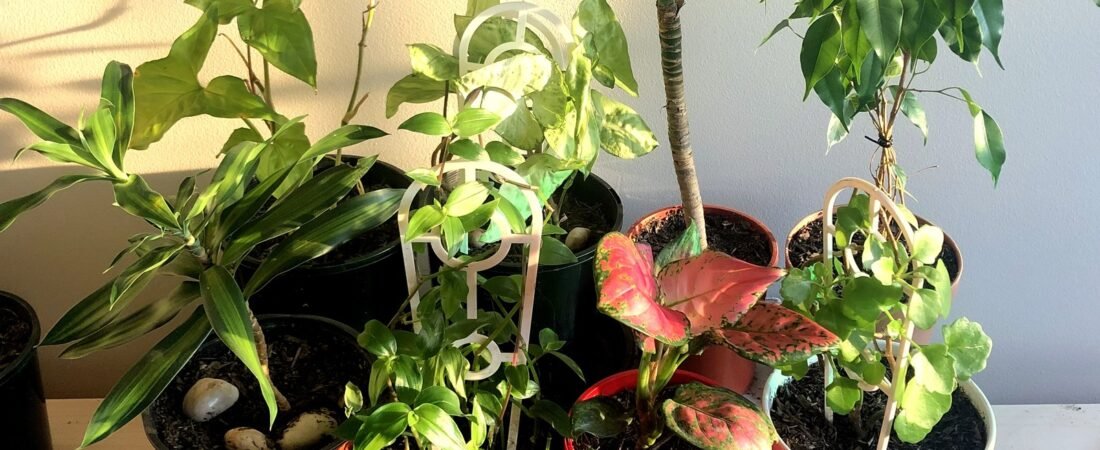
8. Chinese Evergreen (Aglaonema)
Wide patterned leaves in silver, cream, and increasingly pink and red. It’s the best-looking plant that will genuinely accept low light, and it’s slow-growing enough that it never outgrows a spot. Keep it above 60°F — it dislikes cold more than it dislikes darkness.
9. Rubber Plant (Ficus elastica)
If you want a floor plant rather than a shelf plant, this is the forgiving one. Thick burgundy or deep green leaves, upright growth, and far more patience than its cousin the Fiddle Leaf. Give it bright indirect light, let the top couple inches dry between waterings, and wipe the leaves occasionally so they can actually photosynthesize.
10. Cast Iron Plant (Aspidistra elatior)
Named for exactly the reason you’d guess. Deep green strappy leaves that tolerate dim corners, drafts, irregular water, and general indifference. It grows slowly — that’s the tradeoff — but it’s close to the hardest plant on this list to kill.
11. Hoya (Hoya carnosa)
The semi-succulent vine with waxy leaves and, eventually, clusters of small star-shaped flowers. It likes being slightly root-bound and slightly neglected, which makes it quietly one of the easiest plants here. Bright indirect light gets you blooms; medium light still gets you a healthy plant.
How to Not Kill Them: The Five Habits That Matter
Check the soil, don’t check the calendar. Push a finger two inches in. If it’s damp, wait. This single habit prevents most beginner losses. A soil moisture meter is the cheapest confidence you can buy while you’re learning what damp feels like.
Only buy pots with drainage holes. A cachepot with no hole is a bathtub your plant can’t climb out of. If you love a decorative pot, keep the plant in its plastic nursery pot and set that inside — you can lift it out to water and let it drain. A set of nursery pots with drainage makes this easy.
Water thoroughly, then stop. Small daily splashes only wet the top layer and leave the deep roots dry. Instead, water until it runs out the bottom, dump whatever collects in the saucer after ten minutes, and don’t water again until the soil says so. A long-spout watering can makes it easier to soak the soil instead of the leaves.
Be honest about your light. Stand at the plant’s spot mid-morning and look at the window. Can you see sky, or just a wall across the alley? Within three feet of an unobstructed east or north window is bright indirect light. Ten feet back from any window is low light — real low light, not “medium.” If your best spot is genuinely dim, a small LED grow light changes what you can grow more than any other purchase.
Feed lightly, and only in spring and summer. Plants growing in low light barely need fertilizer, and excess salts burn roots. A diluted balanced houseplant fertilizer once a month from about March through September is plenty. Skip it entirely in winter.
Frequently Asked Questions
How many plants should I start with? Two or three. Enough to learn from, few enough that you’ll actually notice when one is unhappy. Adding five at once means five sets of needs you haven’t learned yet.
Should I repot as soon as I bring it home? No — let it settle for a few weeks first. Nursery pots look small but plants are usually fine in them, and repotting on top of the stress of a new environment is a lot to ask. Wait until roots are circling the bottom or poking out the drainage holes, then move up one size and use fresh indoor potting mix.
Which of these are safe for cats and dogs? Spider Plant and Hoya are the reliably pet-safe picks here. Peace Lily, Pothos, Philodendron, ZZ, Snake Plant, and Aglaonema are all toxic if chewed. Aloe is toxic to pets too, despite being soothing for us.
My new plant dropped leaves in week one — did I break it? Almost certainly not. Some leaf drop after a move is normal as the plant adjusts to different light and humidity. Keep care consistent and give it a month before you change anything.
Do I need to mist my plants? Mostly no. Misting raises humidity for a few minutes and can encourage fungal spots on leaves. If you want real humidity, group plants together or run a small cool mist humidifier nearby.
What if I already killed one? Almost every plant person has a small graveyard. Cut the plant open — if the stem and roots were mushy and brown, it was too much water. If the soil was pulling away from the pot and the leaves were crispy, it was too little. That autopsy is more useful than any care guide.
Quick-Start Gear Checklist
- 💧 Soil moisture meter — removes the guesswork while you learn
- 🚿 Long-spout watering can
- 🪴 Indoor potting mix + perlite for extra drainage
- 🏺 Pots with drainage holes
- 💡 LED grow light for dim rooms
- 🌿 Balanced houseplant fertilizer
- ✂️ Pruning snips for propagating and tidying
- 🐛 Neem oil — keep a bottle before you need it
Where to Go Next
Once you’ve got a plant or two thriving, the guides that pair best with this one are Snake Plant Care 101, Pothos Care 101, and ZZ Plant Care 101 — the three we’d hand anyone on day one.
Pick two plants, put them somewhere you’ll walk past every day, and let yourself under-water them a little. Confidence comes from one plant that visibly thrives, not from a shelf full of things you’re anxious about. Happy growing — from all of us at BloomBabe. 🌱