Disclosure: This post contains affiliate links. If you buy through them, BloomBabe may earn a small commission at no extra cost to you. As an Amazon Associate, I earn from qualifying purchases. We only recommend gear we’d use on our own plants.
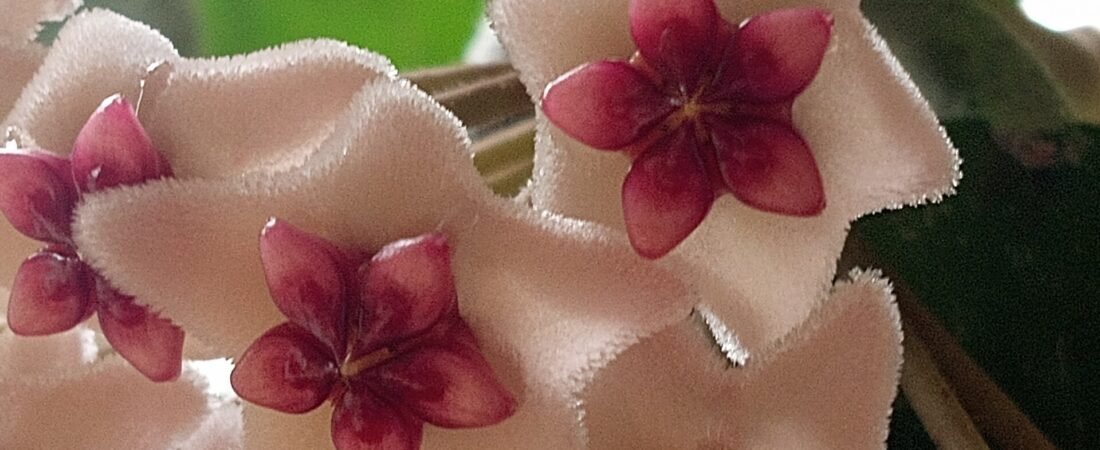
Hoyas are the plant that turns casual collectors into obsessives. The leaves look almost fake — thick, waxy, sometimes speckled with silver — and then one summer the whole thing erupts in clusters of tiny star-shaped flowers that smell like chocolate or vanilla depending on the species. They’re also genuinely low-maintenance once you understand one thing: a Hoya is not a typical leafy houseplant. It’s a semi-succulent climber that grows on tree bark in the wild, and almost every care decision follows from that.
Here’s how to keep one happy, and what it actually takes to get those famous blooms.
Meet the Hoya
Hoyas (often called wax plants or porcelain flowers) are trailing and climbing vines native to Southeast Asia, Australia, and the Pacific Islands. Most are epiphytes — they grow attached to trees rather than in the ground, with their roots gripping bark and moss where water drains away in minutes.
A few worth knowing:
- Hoya carnosa — the classic. Tough, fast, forgiving, and the one most likely to bloom for a beginner. The Krimson Queen and Krimson Princess variegated forms are everywhere for good reason.
- Hoya pubicalyx — vigorous, nearly indestructible, deep speckled leaves, blooms readily.
- Hoya kerrii — the “sweetheart plant” sold as a single heart-shaped leaf. Fair warning: a lone leaf with no node will sit there for years and never vine. Buy one with a stem if you want a real plant.
- Hoya obovata — big round leaves flecked with silver, a fast grower.
- Hoya linearis — the unusual one: soft, fuzzy, needle-like trailing strands. Prefers cooler temps and more humidity than the rest.
If this is your first Hoya, start with carnosa or pubicalyx. They’re cheap, hard to kill, and they bloom.
Light
This is where most people undershoot. Hoyas survive in medium light but only really perform — thick leaves, tight growth, flowers — in bright indirect light with a couple of hours of gentle direct sun.
- Ideal: an east-facing window, or a foot or two back from a south or west window.
- Also great: a few hours of morning sun directly on the leaves.
- Avoid: harsh unfiltered afternoon sun in summer, which can scorch leaves to papery brown patches.
- Too little light looks like: long bare stretches of vine between leaves, small new leaves, and zero flowers.
Variegated Hoyas need more light than green ones, since the white and pink sections don’t photosynthesize. If your Krimson Queen is reverting to plain green, that’s a light problem. In a dim apartment or through a long winter, a full spectrum LED grow light on a timer makes a real difference — this is the single upgrade most likely to earn you blooms.
Water
Those thick leaves are water storage. Treat a Hoya more like a succulent than a fern.
- Let the top half of the pot dry out before watering again. In a small pot, that’s often the whole thing.
- Water thoroughly until it runs from the drainage hole, then dump the saucer. Never let it sit in standing water.
- Typical rhythm: every 10–14 days in spring and summer, every 3–4 weeks in winter. Your home, pot, and light matter more than any calendar.
- Thirsty looks like: slightly soft, dimpled, or wrinkled leaves that firm up a day after watering.
- Overwatered looks like: yellowing leaves that drop while still plump, and a sour smell from the soil.
Hoyas recover from a missed watering easily. They do not recover from soggy roots. If you’re second-guessing yourself, a soil moisture meter takes the argument out of it.
Soil
Standard bagged potting mix is too dense and stays wet too long. You want something chunky and airy that drains fast — closer to what an orchid gets.
An easy mix that works for nearly every Hoya:
- 1 part orchid bark
- 1 part perlite
- 1 part quality indoor potting soil
A handful of horticultural charcoal helps keep everything sweet between waterings. If you’d rather skip the mixing, a bagged aroid or chunky houseplant mix works well straight out of the bag.
Whatever you use, the pot needs a drainage hole. No exceptions.
Fertilizer
Hoyas are modest feeders, but they do respond to regular food during the growing season.
- Feed with a diluted balanced houseplant fertilizer every 3–4 weeks from spring through early fall, at about half the label strength.
- Stop feeding in late fall and winter while growth slows.
- Chasing flowers? Switch to a high phosphorus bloom fertilizer in spring for a few feedings. Phosphorus supports flowering; heavy nitrogen pushes leaves instead.
Always water lightly before fertilizing so you’re not putting concentrated salts against dry roots.
Temperature & Humidity
Comfortable at whatever you keep your house: 60–85°F is the sweet spot. Below about 50°F they stall and sulk, so pull them away from cold window glass and drafty doors in winter.
Humidity is a nice-to-have, not a requirement. Most Hoyas do fine at normal household levels of 40–50%. Thin-leaved and fuzzy types like linearis and curtisii appreciate more — 60% or so. If your winter air runs bone dry, a small cool mist humidifier near the plant is the simplest fix. Skip the daily misting routine; it does very little and can encourage fungal spots on the leaves.
Repotting
Good news: Hoyas bloom better when slightly root-bound, so repotting is rarely urgent.
- Repot every 2–3 years, or when roots fill the pot and water races straight through.
- Go up one pot size only. A too-large pot holds a reservoir of wet soil that roots can’t reach, and that’s how rot starts.
- Best time is spring, at the start of active growth.
- Terracotta is a great choice here since it breathes and dries evenly, but any pot with drainage works.
One important rule: never cut off the old flower stems (peduncles). Those short woody stubs where flowers appeared are permanent, and the plant reblooms from the exact same spot year after year. Snipping them off is the most common reason a healthy Hoya stops flowering.
Propagation
Hoyas root easily, and cuttings are how most collections grow.
- Take a cutting with at least two nodes (the little bumps where leaves meet the stem) and one or two leaves. The node is where roots form — a leaf alone will never make a plant.
- Strip the lower leaf so a bare node is exposed.
- Root in water, damp sphagnum moss, or straight perlite. A clear propagation station makes it easy to watch progress.
- Keep it warm and bright. Roots typically appear in 2–4 weeks.
- Pot up once roots reach 2–3 inches. A little rooting hormone speeds things along but isn’t required.
Spring and summer cuttings root fastest. Winter cuttings will root, just slowly.
Common Problems
- Yellowing, dropping leaves — nearly always overwatering. Let the mix dry well down, check for mushy roots, and repot into a chunkier mix if needed.
- Wrinkled, dimpled leaves — usually thirst, but can also mean damaged roots that can’t take up water. If watering doesn’t fix it within a day or two, check the roots.
- Leggy vines with widely spaced leaves — not enough light. Move it brighter or add a grow light.
- Brown, papery patches — sunburn from harsh direct sun, or cold damage from a winter window.
- Sticky leaves or black sooty film — either flower nectar (harmless and normal) or a pest excreting honeydew. Look closely for mealybugs.
- Mealybugs and scale — the classic Hoya pests, hiding in leaf joints and under leaves. Dab them with alcohol on a cotton swab, then treat with neem oil or insecticidal soap every week until they’re gone.
- No flowers — the top three causes are too little light, a plant that’s still too young, and cut-off peduncles.
Frequently Asked Questions
How long until my Hoya blooms? Most need to reach a mature size first, which usually means 2–3 years from a cutting. Bright light and a snug pot speed it up considerably.
Are Hoyas toxic to pets? They’re widely considered non-toxic to cats and dogs, which is part of their appeal. The milky sap can irritate skin, though, so wash your hands after pruning.
Should I let it trail or climb? Either. Trailing from a shelf is the classic look; climbing on a small trellis or moss pole encourages larger leaves and often more flowers.
My Hoya kerrii leaf hasn’t grown in a year — is it dying? No, it’s just a leaf. Without a node it can live for years but will never vine. Nothing you can do to change that.
Should I cut the long bare vine? Resist. Those bare tendrils are searching for something to climb, and they’ll leaf out once they find it. Give it a trellis instead of scissors.
Quick-Start Gear Checklist
- 💡 Full spectrum grow light
- 💧 Soil moisture meter
- 🪴 Orchid bark + perlite
- 🌸 Bloom fertilizer
- 🪜 Trellis or moss pole
- 🐛 Neem oil
Give a Hoya the brightest spot you’ve got, let it dry out between drinks, leave the old flower stems alone, and then be patient. The first cluster of waxy little stars is worth every month of waiting — and once a Hoya starts blooming, it tends to keep going for years. Happy growing, from all of us at BloomBabe. 🌱