Disclosure: This post contains affiliate links. If you buy through them, BloomBabe may earn a small commission at no extra cost to you. As an Amazon Associate, I earn from qualifying purchases. We only recommend gear we’d use on our own plants.
Anthuriums are the plant equivalent of a red lip. One sits on a shelf looking impossibly glossy, blooms for months at a stretch, and somehow makes the whole room feel intentional. They also have a reputation for being fussy — which, honestly, is half true. Anthuriums aren’t hard. They’re just specific. Get the roots right and the rest mostly takes care of itself.
Here’s everything we’ve learned keeping ours in bloom, including the two mistakes that account for almost every sad, bloom-less Anthurium we’ve been sent photos of.
1. Meet the Anthurium
Anthurium is a big genus — over 1,000 species — but the ones you’ll find at the garden center fall into two camps.
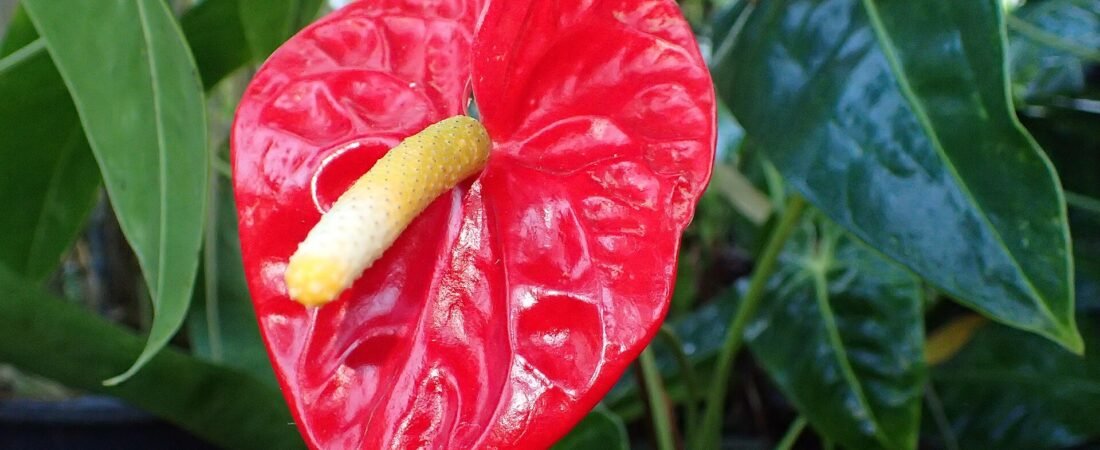
Flowering types. Anthurium andraeanum is the classic: waxy, heart-shaped red, pink, white, or coral “flowers” on tall stems. Fun fact worth knowing, because it changes how you care for it: that colorful part isn’t a flower at all. It’s a spathe, a modified leaf. The actual flowers are the tiny bumps on that little tail sticking out of the middle, called the spadix. Because the spathe is a leaf, it lasts weeks — sometimes two months on a single bloom.
Foliage types. Anthurium clarinervium (deep green, velvety, with dramatic white veining) and Anthurium crystallinum are grown purely for their leaves, and they’re worth every bit of the hype. Their care is nearly identical, with a bit more humidity demanded.
The important thing they share: in the wild, most Anthuriums are epiphytes. They grow on trees, roots gripping bark and moss, not buried in dense forest soil. That one fact explains basically every care rule below.
2. Light
Anthuriums want bright, indirect light — and they’re less flexible about it than a Pothos or a Snake Plant.
- Ideal: an east-facing window, or a few feet back from a south or west window.
- Too little light is the number one reason an Anthurium stops blooming. It’ll stay alive and green in a dim corner and just quietly never flower again.
- Too much direct sun scorches those glossy leaves into pale, bleached patches. Afternoon sun through unfiltered glass is the usual culprit.
The sweet spot: somewhere it could comfortably read a book without turning on a lamp. If your space genuinely doesn’t have that, a full spectrum LED grow light on a timer, 12 hours a day, absolutely works — we’ve rebloomed stubborn plants this way.
3. Water
Anthuriums want to stay lightly, evenly moist — never soggy, never bone dry. Those thick epiphytic roots need air as much as they need water, and sitting in wet soil suffocates them fast.
Practical rhythm:
- Water when the top 1–2 inches feel dry to the touch. In an average home that’s roughly weekly in summer, every 10–14 days in winter.
- Water thoroughly until it runs from the drainage hole, then dump the saucer. Standing water is how root rot starts.
- Anthuriums are somewhat sensitive to hard tap water and fluoride — brown leaf tips are often the tell. Filtered or overnight-sat water helps, or just collect rainwater if you’re the type.
If you’re guessing, stop guessing. A soil moisture meter takes about four seconds and has saved more Anthuriums than any other five-dollar object we own.
4. Soil
This is the part people skip, and it’s the part that matters most. Do not plant an Anthurium in straight potting soil. It holds too much water around roots that evolved to sit in open air, and the plant declines slowly enough that you won’t connect the two.
You want a chunky, airy, fast-draining mix. Either buy a ready-made aroid potting mix, or blend your own:
- 2 parts orchid bark
- 1 part perlite or pumice
- 1 part coco coir or peat-based potting mix
- a handful of horticultural charcoal if you have it
When you pour water through it, it should drain almost immediately. That’s the test. And always use a pot with a drainage hole — a pot with drainage and a cachepot over it if you want the pretty ceramic look.
5. Fertilizer
Anthuriums bloom on stored energy, so feeding is what keeps the show going.
During spring and summer, feed every 4–6 weeks with a balanced liquid houseplant fertilizer diluted to half or quarter strength. If you specifically want more blooms, a fertilizer with a higher middle number (phosphorus) nudges flowering along.
Cut back to every couple of months in fall and winter, or stop entirely if growth has paused. Over-fertilizing shows up as brown, crispy leaf edges and a white crust on the soil surface — if you see that, flush the pot with plain water a few times.
6. Temperature & Humidity
They’re tropical, and they mean it.
- Temperature: 65–80°F is ideal. Below 55°F they sulk and can suffer real damage. Keep them away from cold drafts, exterior doors in winter, and the direct blast of an AC vent.
- Humidity: 50–60% for flowering types; the velvet-leaf types like clarinervium prefer 60%+.
Most homes sit around 30–40%, especially with the heat running. A small cool mist humidifier near the plant is the fix that actually works. Grouping plants together helps a little. Misting mostly doesn’t — the effect lasts minutes, and on velvet-leaf Anthuriums, water sitting on the foliage can cause spotting. A pebble tray is a reasonable middle ground.
7. Repotting
Repot every 2–3 years, or when you see roots pushing out the drainage hole and the mix has broken down into something dense and dark. Spring is the best time.
Go up just one pot size. Anthuriums bloom better when they’re slightly snug, and an oversized pot holds a reservoir of wet soil the roots can’t use.
One quirk: Anthuriums grow aerial roots and slowly push themselves upward out of the pot over time, leaving a bare stem. When you repot, set the plant a little deeper and pack fresh chunky mix around that exposed stem — it’ll root right into it and the plant will look full again. You can also wrap the bare stem in damp sphagnum moss between repottings.
8. Propagation
Division is the reliable way. When you repot a mature plant, look for offsets — separate crowns with their own leaves and roots — at the base. Work them apart gently with your fingers (or a clean cut with pruning shears if they’re stubborn), making sure each division keeps a healthy chunk of root. Pot each into fresh aroid mix and keep it warmer and more humid than usual for a few weeks while it settles.
Stem cuttings work too, especially on a plant that’s gotten leggy. Cut a section of stem with at least one node and an aerial root, and root it in damp sphagnum moss or water. Expect 4–8 weeks.
Expect a pause after either method. New divisions often sit and do nothing for a month before pushing a leaf — that’s normal, not failure.
9. Common Problems
- Yellowing lower leaves. Almost always overwatering. Check whether the soil is staying wet and whether the mix is too dense.
- Brown, crispy leaf tips. Low humidity, hard/fluoridated tap water, or fertilizer buildup — usually in that order of likelihood.
- No blooms. Not enough light (most common), not enough feeding, or a pot that’s much too large. Fix the light first and give it a season.
- Green spathes instead of red or pink. Interesting one: blooms sometimes fade to green as they age, which is natural. But if new blooms open green, it’s typically low light or too much nitrogen.
- Mushy stem base, foul smell. Root rot. Unpot immediately, cut away every soft brown root, and repot into fresh dry chunky mix. Don’t water for several days.
- Pests. Mealybugs, thrips, and spider mites all like Anthuriums. Wipe leaves regularly (it also keeps them glossy), and treat at the first sign with neem oil or insecticidal soap.
Frequently Asked Questions
Are Anthuriums toxic to pets? Yes. Like most aroids, they contain calcium oxalate crystals, which cause mouth irritation, drooling, and vomiting if chewed. Keep them up high, away from cats and dogs.
How long do the blooms last? Two to eight weeks per bloom, and a healthy plant in good light can flower nearly year-round. That’s the whole appeal.
Should I cut off spent blooms? Yes — snip the stem near the base once a spathe browns or fades. It redirects energy into new growth and keeps the plant looking tidy.
Why is my new leaf smaller than the last one? Usually light or nutrients. Anthuriums size up gradually, and each new leaf should be equal or larger. Shrinking leaves are the plant telling you something’s short.
Can Anthuriums grow in just water or semi-hydro? They actually do beautifully in LECA and semi-hydro setups, because those airy roots love the oxygen. Transition slowly and use a proper hydroponic nutrient solution.
Quick-Start Gear Checklist
- 💧 Soil moisture meter
- 🪵 Aroid potting mix — or orchid bark + perlite
- 🪴 Pot with drainage holes
- 💨 Cool mist humidifier
- 🌿 Liquid houseplant fertilizer
- 🐛 Neem oil
If you remember nothing else: chunky mix, bright indirect light, and never let it sit in water. Do those three things and an Anthurium will hand you glossy blooms for months on end with almost no effort. It’s a showy plant with a surprisingly low-maintenance heart. Happy growing, from all of us at BloomBabe. 🌸