
Disclosure: This post contains affiliate links. If you buy through them, BloomBabe may earn a small commission at no extra cost to you. As an Amazon Associate, I earn from qualifying purchases. We only recommend gear we’d use on our own plants.
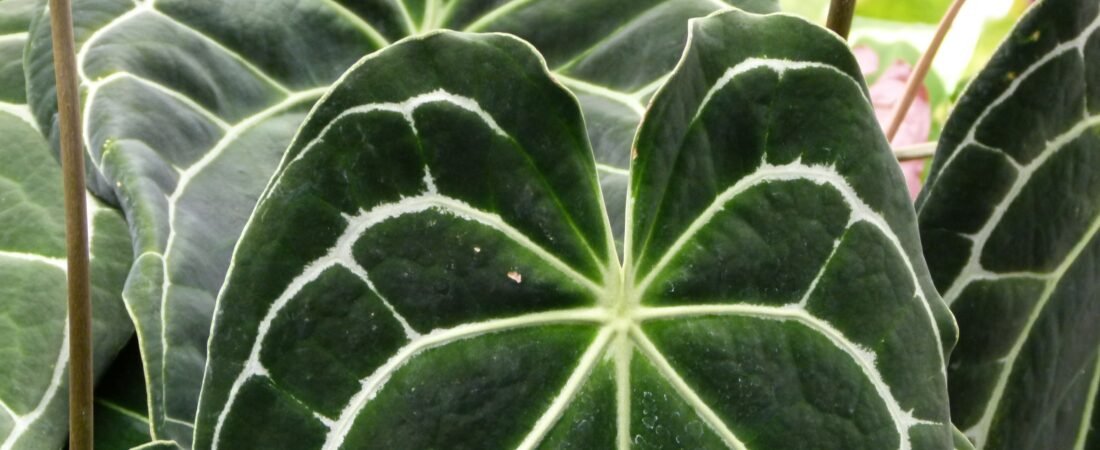
The Crystal Anthurium got its name from the way its veins catch light. On a healthy leaf, the pale veining doesn’t just contrast with the dark velvet — it glitters, faintly, as if it were dusted with something. Victorian growers noticed, and crystallinum stuck.
It’s the plant most often confused with Anthurium clarinervium, and the confusion costs people plants, because the two want different things. Clarinervium is a rock-dweller from dry-ish Mexican limestone hills. Crystallinum is a terrestrial-to-hemiepiphytic understorey plant from the humid montane forests of Panama and Colombia. Wetter, softer, faster, and a bit more forgiving — once you stop treating it like a cardboard plant.
Meet the Crystal Anthurium
Botanical name: Anthurium crystallinum
Also called: Crystal Anthurium, Crystal Hope, Velvet Anthurium, Silver-Veined Anthurium
What it looks like:
- Large, velvety, heart-shaped to oval leaves, elongated rather than round, reaching 12–20 inches long on a mature plant. The blade is thinner and more pliable than clarinervium’s — it drapes slightly instead of standing stiff.
- Colour: deep emerald to blackish-green with a soft, light-absorbing nap. New leaves emerge bronze or reddish and darken as they harden off.
- Venation: prominent white to pale silver primary veins that run cleanly from midrib to margin, with that characteristic crystalline shimmer along their length.
- Undersides: paler green, sometimes flushed pink or purple on young leaves.
- Petioles are angular in cross-section — a good ID clue against clarinervium’s round ones.
- Mature size: about 90 cm (35 in) tall and broad, with a short, thick stem that eventually shows above the mix.
- Flowers: a narrow, green spathe with a pale green spadix, produced through the year on happy plants. Modest but reliable.
A honest note on labels: a great deal of what’s sold as “Anthurium crystallinum” is actually a hybrid — with A. magnificum, A. clarinervium, or others — because the true species has been crossed for decades. Hybrids are usually vigorous and beautiful. Just don’t be surprised if yours doesn’t match a herbarium sheet.
Where Anthurium crystallinum Grows in the Wild
Kew’s Plants of the World Online gives the native range as Panama to Colombia, and describes it as an epiphytic subshrub of the wet tropical biome.
More specifically, it grows as a terrestrial to hemiepiphytic understorey plant in humid montane forest — on the forest floor in deep leaf litter, on fallen logs, and on the lower trunks of trees, sending roots into the moss and debris that collects there.
What that habitat is like:
- Humid montane forest — the mid-elevation belt on the Pacific slope of Panama and the Colombian Andes, where cloud and rain are near-daily and humidity rarely drops below 70%.
- Deep, spongy leaf litter over a well-drained forest floor: organic, constantly moist, never stagnant, with excellent airflow around the roots.
- Warm but not hot — the montane belt runs cooler than the lowlands, with mild nights.
- Dappled understorey light — bright, but always filtered by canopy.
Compared with clarinervium’s limestone crevices, this is a softer, wetter, more organic home. That’s the whole difference in care.
Reading the Habitat: The Translation
| In the wild | What it means at home |
|---|---|
| Terrestrial / hemiepiphyte in leaf litter | Chunky but organic mix — more moss and coir than clarinervium’s rubble |
| Humid montane forest, near-daily cloud | 70%+ humidity. The most humidity-hungry plant in this series so far |
| Well-drained forest floor | Consistently moist, never waterlogged; drainage still non-negotiable |
| Montane, cooler than lowland | 65–80°F; tolerates a mild night drop; dislikes real heat |
| Understorey canopy light | Bright indirect; no direct sun |
| Fast-ish grower with a visible stem | Repot more often; support the stem as it lengthens |
Light
Bright, indirect. Think of light that’s been through two layers of leaves before it reaches the floor.
- Best: an east window, or a few feet from a south/west one behind a sheer.
- Direct sun scorches the velvet quickly and leaves pale, papery patches.
- Too dim and the plant stretches, the leaves thin out, and the shimmer on the veins fades.
A grow light on a timer, 10–12 hours, is the answer to a dark room.
Water
Forest-floor leaf litter is always damp — and always draining.
- Keep the mix evenly moist. Water when the top inch is dry; don’t let it go fully dry the way you might a clarinervium. Crystallinum’s thinner leaves show thirst faster and recover from it less gracefully.
- Water thoroughly, drain completely, empty the saucer.
- Reduce slightly in winter, but keep it damp.
A soil moisture meter helps because a bark-and-moss mix dries unevenly. Use filtered or distilled water if your tap is heavily treated; brown vein-edge speckling is the usual sign of mineral buildup.
Substrate: Forest Floor, Not Cliff Face
Still chunky and airy — every anthurium needs air at the roots — but with a bigger organic, moisture-holding fraction than a lithophyte wants.
Our crystallinum mix:
- 2 parts orchid bark
- 2 parts sphagnum moss, chopped, or coco coir
- 1 part perlite
- 1 part quality aroid mix
- A handful of horticultural charcoal and a little worm castings for the leaf-litter fraction
Many growers run crystallinum in pure sphagnum in a high-humidity setup, and it loves it — just watch for the moss breaking down and going sour after a year. A pot with good drainage, one size larger than the root ball.
Humidity and Temperature
Humidity: 70–85%. This is the non-negotiable. In ordinary room air (30–40%) crystallinum’s leaves brown at the edges, new leaves unfurl damaged or stuck, and the plant slowly declines. Solutions, in order of effectiveness: a greenhouse cabinet, a humidifier running beside the plant, or grouping it tightly with other plants over a pebble tray. Measure with a hygrometer — guessing is how people lose this plant.
Temperature: 65–80°F. Montane means mild. It tolerates a modest night drop (into the low 60s) but hates real cold and dislikes sustained heat above about 85°F. Away from vents, drafts, and hot glass.
Airflow in a cabinet: yes, always. A small fan prevents the stagnant, fungal conditions that high humidity invites.
Fertilizer
Moderate. It grows faster than clarinervium and can use more.
Balanced liquid fertilizer at half strength every 2–3 weeks through spring and summer; monthly or less in winter. Flush the mix every couple of months.
Repotting and the Stem
Every 1–2 years, in spring, one size up. The plant grows a visible stem over time, with aerial roots along it. Don’t cut those roots — direct them into the mix, or tuck them into a moss pole, which the plant will happily climb. When the stem gets leggy, you can also bury the lower portion at repotting time; it’ll root along its length.
Propagation
- Stem cuttings: the most common method on a plant with a visible stem. Cut below a node with an aerial root, and set it in damp sphagnum in a warm, humid, bright spot. Roots in weeks; a new leaf in a couple of months.
- Division: on a plant that’s developed multiple crowns, tease them apart at repotting.
- Seed: the green spathes sometimes set berries; sow cleaned seed on damp sphagnum. Slow, but crystallinum is among the easier velvet anthuriums from seed.
Common Problems
- Brown, crispy leaf edges: low humidity. Fix the air, not the watering.
- New leaves stuck or torn while unfurling: same cause. Mist the emerging leaf directly while humidity is being fixed.
- Yellowing lower leaves, wet mix: root rot. Unpot, trim, rebuild with more bark.
- Faded veins, thin leaves: more light.
- Pale scorched patches: direct sun.
- Spider mites, thrips: both love velvet leaves. Check undersides weekly; treat with neem oil at the first sign.
- Sour-smelling mix, black roots: sphagnum that has broken down. Repot fresh.
Frequently Asked Questions
Is Anthurium crystallinum toxic to pets? Yes — calcium oxalate crystals cause painful irritation if chewed. Keep it away from cats, dogs, and children.
Crystallinum vs clarinervium — which do I have? Thin, larger, elongated leaf that drapes; angular petiole; strong shimmer on the veins: crystallinum. Thick, stiff, rounder, smaller leaf; round petiole: clarinervium.
Why do the new leaves come in reddish? That’s normal — new growth emerges bronze-red and darkens to velvet green as it matures. It’s a healthy sign.
Can I grow it outside a cabinet? Yes, with a humidifier running nearby and a bright spot. It’s harder than in a cabinet but very doable.
Mine flowers constantly — should I cut them? If you want the plant to put its energy into leaves, yes. It’s a personal choice; the flowers don’t hurt it.
Quick-Start Gear Checklist
- 🪴 Orchid bark + sphagnum + perlite
- 💦 Humidifier + hygrometer
- 🏠 Greenhouse cabinet (optional, but transformative)
- 💡 Grow light
- 🌿 Balanced fertilizer
- 🐛 Neem oil
Keep Reading
- Anthurium Care 101 — the genus overview
- Anthurium Clarinervium Care — the lookalike, and why it’s grown differently
- IKEA Milsbo Tall Greenhouse Cabinet — the setup that makes velvet anthuriums easy
Humid, bright, mild, and rooted in something that feels like a spongy forest floor — that’s a Panamanian cloud forest, and that’s a Crystal Anthurium that keeps pushing out leaves that glitter. Happy growing, from all of us at BloomBabe. 🌱