
Disclosure: This post contains affiliate links. If you buy through them, BloomBabe may earn a small commission at no extra cost to you. As an Amazon Associate, I earn from qualifying purchases. We only recommend gear we’d use on our own plants.
There’s a small patch of southern Mexico — a stretch of limestone hills in Chiapas, between two rivers — where every Anthurium clarinervium on earth originally came from. It grows there on rock. Not in soil beside rock, not in a pot of rock-flavoured mix: on limestone outcrops, in the moss and leaf litter that collects in the cracks.
That’s why the Velvet Cardboard Anthurium — thick, stiff, dark-velvet leaves veined in white — has a reputation for rotting in “good” potting soil and thriving in what looks like a pot of rubble. It’s not being difficult. It’s a lithophyte. Once you build it a crevice, it’s one of the easiest velvet-leaf anthuriums there is.
Meet the Velvet Cardboard Anthurium
Botanical name: Anthurium clarinervium
Also called: Velvet Cardboard Anthurium, Cardboard Plant, White-Veined Anthurium, Queen Anthurium (a mislabel — that’s A. warocqueanum), Velvet-Leaf Anthurium
What it looks like:
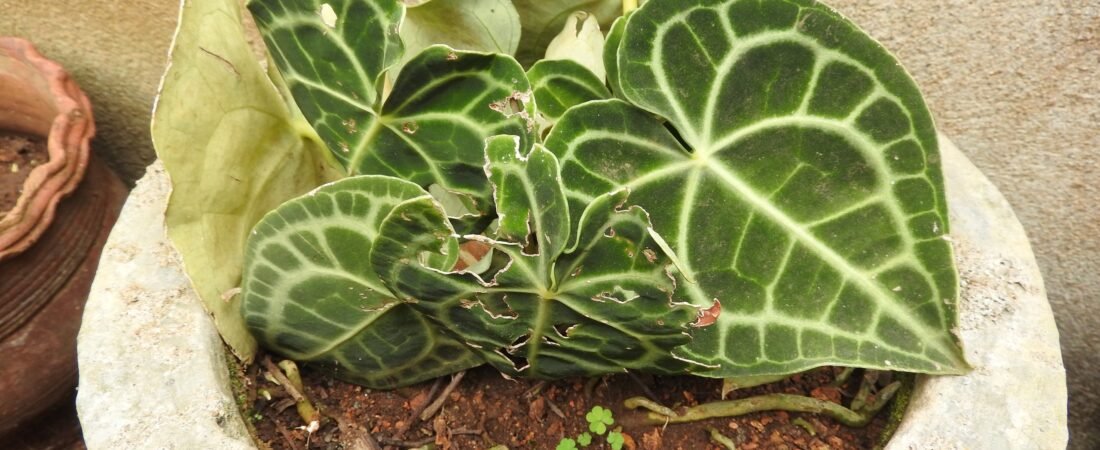
- Leaves are broadly heart-shaped (cordate), typically 6–12 inches long on a mature plant, held on stiff, rounded petioles.
- They’re thick. Genuinely thick and stiff — that’s the “cardboard” — with a matte, velvety surface in deep green to near-black.
- The venation is the signature: bold white to pale silver primary and secondary veins radiating from the midrib in a clean, almost drawn pattern. The contrast is what makes it look like a botanical illustration.
- The underside is paler, matte green, with the veins visible in relief.
- Habit: compact and slow, with short internodes, so the plant stays a tidy rosette of leaves rather than climbing. Mature plants reach about 1–2 feet tall and wide.
- Flowers: a narrow greenish spathe with a slender purplish spadix. Understated. Most growers let them be or cut them so the plant keeps its energy in leaves.
- Fruits, if pollinated, are bright orange berries — occasionally seen on mature indoor plants.
How to tell it from A. crystallinum: clarinervium’s leaves are thicker, stiffer, smaller, and more rounded; crystallinum’s are thinner, larger, more elongated, and its veins have a more “crystalline” sparkle. Clarinervium petioles are round in cross-section; crystallinum’s are more angular. If it feels like cardboard, it’s clarinervium.
Where Anthurium clarinervium Grows in the Wild
A. clarinervium is a Mexican endemic, and a narrow one. It’s known only from the limestone outcrops of Chiapas between the Río Grijalva and the Río de la Venta, north of Ocozocoautla de Espinosa, at roughly 800–1,200 m elevation.
The habitat, in detail:
- Karst. The landscape is limestone — porous, jagged, calcium-rich rock riddled with cracks, sinkholes, and ledges.
- It’s a lithophyte (and sometimes an epiphyte): it grows on the rock, with roots running through the moss, leaf litter, and organic debris that accumulates in crevices. There is no “soil” in the garden sense. Water pours through in seconds.
- The forest above it is an oak-dominated, cloud-influenced understorey — filtered light, high ambient humidity, frequent mist.
- Elevation of 800–1,200 m means warm days, noticeably cooler nights, and a climate that never gets equatorial-hot.
That last point matters. Plenty of people grow clarinervium in a hot, sealed cabinet and wonder why it sulks. It’s a hill plant, not a lowland one.
Reading the Habitat: The Translation
| In the wild | What it means at home |
|---|---|
| Lithophyte on limestone | Chunky, airy, mineral mix. Roots need air more than they need “soil” |
| Calcium-rich karst | Tolerates — even likes — a little limestone or oyster shell in the mix |
| Crevice moss and leaf litter | A modest organic fraction, but never a dense, wet one |
| Cloud-forest understorey | Bright indirect light; 60–80% humidity |
| 800–1,200 m elevation | Warm days, cool nights. 65–78°F day, low 60s at night is ideal. Not a heat lover |
| Slow, compact grower | Small pot, light feeding, patience |
Light
Bright, indirect light — the dappled brightness under an open oak canopy.
- Good: an east window; a few feet back from a south or west one; behind a sheer curtain.
- Too much: direct sun burns the velvet to a dull, bleached patch that doesn’t recover.
- Too little: the plant stalls, new leaves come in smaller, and the white veining fades. Clarinervium is not a low-light plant.
A full spectrum LED grow light on a timer for 10–12 hours fixes a dim room.
Water
A crevice on a cliff gets misted, rained on, and drained — all in the same hour. It never sits wet.
- Water when the top 1–2 inches of mix are dry, then water thoroughly and let it drain completely.
- The mix should be so open that you almost can’t overwater it — if you can, the mix is wrong, not your schedule.
- Never leave it in a saucer of water. Root rot is the single most common way to lose one.
- Slightly less in winter, but don’t let it go bone dry; the thick leaves hide thirst until they suddenly droop.
Use filtered, rain, or distilled water if your tap water is heavily softened or chlorinated. Ironically, moderately hard water suits this limestone plant fine.
Substrate: Build a Limestone Crevice
Don’t call it soil. Think of it as a pocket of rubble with some moss in it.
Our clarinervium mix:
- 3 parts orchid bark (medium grade)
- 2 parts perlite or pumice
- 1 part coco coir or a quality aroid mix
- 1 part sphagnum moss, chopped
- A handful of horticultural charcoal
- A small scoop of crushed oyster shell — the karst nod
It also does well mounted on a slab of cork bark with a moss pad, or in LECA semi-hydro. Either way: a pot with generous drainage (orchid pots are ideal), sized snug.
Humidity and Temperature
Humidity: 60–80%. It’s a cloud-influenced hill plant. Below 50%, the leaf edges brown and new leaves may unfurl damaged. A humidifier near the plant is the reliable fix; a hygrometer keeps you honest. Cabinets work, but see below.
Temperature: 65–78°F by day, ideally dipping into the low 60s at night. This is where clarinervium differs from lowland anthuriums. It comes from 800–1,200 m and it likes the swing. A room that cools overnight is a feature. Keep it above 55°F, away from vents and drafts.
Airflow: cliff faces breathe. If you grow it in a sealed cabinet, add a small circulation fan — stagnant, hot, saturated air is what rots a clarinervium in an otherwise perfect setup.
Fertilizer
Light. A crevice isn’t a rich place.
Balanced liquid fertilizer at quarter to half strength, monthly through spring and summer. Nothing from late autumn to early spring. Flush with plain water every couple of months to clear salts, which a bark-based mix accumulates.
Repotting
Every 2–3 years, or when roots fill the pot — and no sooner. Clarinervium is slow and prefers to be a little snug. Repot in spring, one size up, into fresh chunky mix. Handle the roots gently; they’re thick and brittle.
Propagation
Slow but straightforward:
- Division: mature plants develop multiple growing points at the base. In spring, unpot, tease the crowns apart with roots attached, and pot separately.
- Stem cuttings: on an older plant with a visible stem, cut below a node with an aerial root, and root it in damp sphagnum in a warm, humid spot. Slow — months — but reliable.
- Seed: if your plant sets orange berries, you can sow the cleaned seed on damp sphagnum. Slow, and fun.
Common Problems
- Yellowing lower leaves with wet mix: root rot from a mix that’s too dense. Unpot, trim, rebuild the crevice.
- Brown crispy edges: low humidity, or salt buildup.
- New leaves unfurling torn or stuck: humidity too low while the leaf was forming.
- Bleached patches: direct sun.
- Stalled for months in summer: check temperature. Constant heat with no night drop often idles this species.
- Fine webbing, stippled leaves: spider mites. Treat with neem oil and raise humidity.
- Small silvery scars on new leaves: thrips. Inspect the undersides and treat promptly.
Frequently Asked Questions
Is Anthurium clarinervium toxic to pets? Yes — calcium oxalate crystals, like all aroids. Painful if chewed. Keep it out of reach.
Clarinervium or crystallinum — which do I have? Feel the leaf. Stiff, thick, cardboard-like, rounder, smaller: clarinervium. Softer, thinner, larger, more elongated: crystallinum.
Can I grow it in a terrarium or cabinet? Yes, and it’s popular for it — just add airflow and don’t let it cook. Remember it’s a hill plant.
Why is my plant so slow? Because the species is. A few new leaves a year on a mature plant is normal. Push it with more light (not more fertilizer) if you want faster.
Does it need to be near limestone? No — but it tolerates calcium-rich conditions and a slightly alkaline mix better than most aroids, so don’t stress about water hardness.
Quick-Start Gear Checklist
- 🪴 Orchid bark + perlite + sphagnum
- 🏺 Orchid pot with drainage
- 💦 Humidifier + hygrometer
- 🌬️ Circulation fan
- 💡 Grow light
- 🐛 Neem oil
Keep Reading
- Anthurium Care 101 — the genus overview
- Anthurium Crystallinum Care — the lookalike from Panama and Colombia
- Alocasia Black Velvet Care — another limestone-cliff velvet, on the other side of the world
Build the Velvet Cardboard Anthurium a pocket of rubble and moss, keep the air humid and moving, give it a room that cools at night, and it’ll do exactly what it does on a Chiapas hillside — sit there quietly being the best-looking leaf in the room. Happy growing, from all of us at BloomBabe. 🌱