
Disclosure: This post contains affiliate links. If you buy through them, BloomBabe may earn a small commission at no extra cost to you. As an Amazon Associate, I earn from qualifying purchases. We only recommend gear we’d use on our own plants.
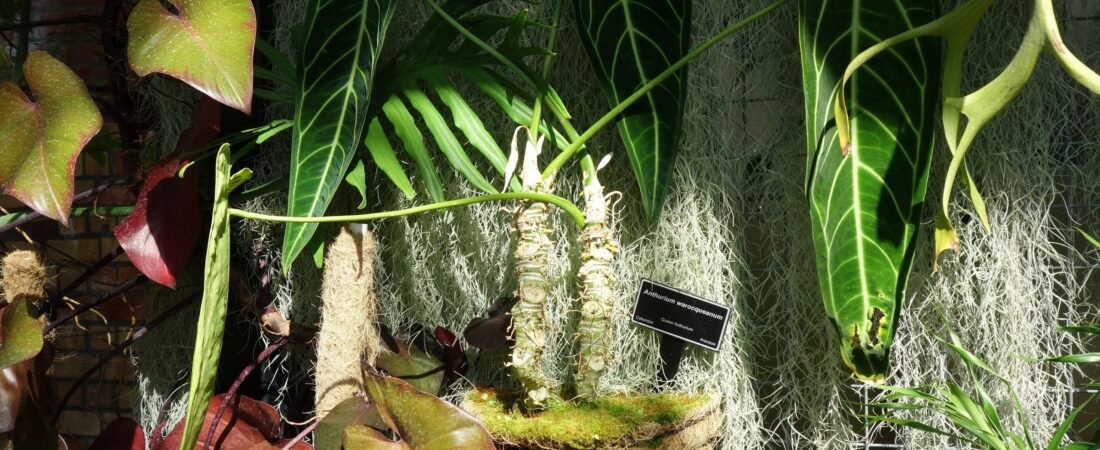
Most houseplants grow up. The Queen Anthurium grows down — long, narrow, velvet leaves that hang from the stem like banners, three or four feet from tip to base on a mature plant, dark green and drawn through with silver veins.
She is, by reputation, the most demanding anthurium a hobbyist commonly attempts. And she is, by origin, an epiphyte on moss-covered trees in the cloud-wrapped mountain forests of western Colombia. Put those two facts side by side and the demands stop looking like temperament. She wants to hang in humid, moving air with her roots in moss. Give her that and she’s a queen, not a diva.
Meet the Queen Anthurium
Botanical name: Anthurium warocqueanum
Also called: Queen Anthurium, Queen Velvet Anthurium, Warocqueanum
What it looks like:
- Leaves are the whole story: extremely elongated, narrow, lance- to strap-shaped, hanging pendent from the stem. On a mature plant, 3–4 feet long (occasionally more), only 6–10 inches wide.
- Texture: thick, velvety, matte — a nap that swallows light. Colour runs from deep green to nearly black on well-grown plants.
- Venation: silver-white primary veins running the length of the blade, with a strong pale midrib. The contrast is high and the pattern is elegant rather than busy.
- Forms: growers distinguish a “dark form” (near-black, narrow) and a “wide form” or “esmeralda” (broader, slightly greener). Both are the same species.
- Habit: a slowly elongating stem that produces one leaf at a time, each a little larger than the last, with thick aerial roots along the stem.
- Flowers: a narrow greenish-purple spathe on a long stalk. Not the point.
Discovery: the species was collected in the late 19th century by the German plant hunter Gustav Wallis in Antioquia, Colombia, and named for the Belgian industrialist and orchid collector Arthur Warocqué.
Where Anthurium warocqueanum Grows in the Wild
The Queen is a Colombian species, found in the departments of Antioquia, Chocó, and Valle del Cauca on the wet Pacific side of the Andes.
Its habitat:
- Elevation: sources range from 200 to about 1,400 m, with the core of the population commonly cited at 400–1,200 m — lower montane to montane forest. Some populations are reported higher, well into cloud forest.
- Growth form: hemiepiphyte / epiphyte. She starts life on a tree trunk or branch, sometimes sending roots down to the ground later, but essentially she lives on trees, her roots wrapped around bark and buried in the thick moss and organic debris that coats every surface in a Colombian cloud forest.
- The air: saturated. This is one of the wettest regions on earth. Humidity sits at 80–100% for much of the day; mist and cloud roll through the canopy daily.
- Air movement: constant. A trunk in a montane forest isn’t a sealed box — breezes move through, which is why the roots don’t rot despite the wet.
- Light: filtered through canopy — bright, dappled, never direct.
- Temperature: warm days, cooler nights, and never hot. At 800 m in the Colombian Andes, a 75°F day drops to a 60°F night as a matter of course.
Reading the Habitat: The Translation
| In the wild | What it means at home |
|---|---|
| Epiphyte on mossy trunks | Grow it in moss, or mounted. Never in soil |
| 80–100% humidity, daily cloud | The highest humidity need in this series. A cabinet is close to mandatory |
| Constant air movement | A fan in that cabinet, always. Stagnant + wet = rot |
| Pendent leaves | Give it height — a tall cabinet, or hang it. The leaves must be able to drop |
| 400–1,200 m, mild montane | 65–78°F day, 60–65°F night. Not a heat plant |
| One leaf at a time, slowly | Patience. Don’t push with fertilizer |
Light
Bright indirect — the light under a high canopy. An east window, a north-facing greenhouse cabinet, or a full spectrum grow light on a timer at 10–12 hours.
Direct sun scorches the velvet in an afternoon. Too little light and the new leaves come in small and the plant crawls. Most cabinet growers run a light on top and are happy.
Water
Moss on a trunk gets soaked and drains in the same breath. That’s the model: wet, then airy, then wet again, never stagnant.
- In sphagnum: keep it damp, never sopping. Water when the top of the moss feels just dry, then water thoroughly and let it drain. Squeezed moss should release a few drops, not a stream.
- Mounted: soak the mount thoroughly every few days (daily in low humidity), and let it drain completely between.
- In a chunky mix: water when the top inch is dry.
Use rain, distilled, or filtered water. Epiphytes evolved on rainwater and the Queen is sensitive to mineral buildup — it shows as brown speckling along the veins.
Substrate: Moss, Not Soil
Sphagnum is the default for warocqueanum, and for good reason — it’s what she grows in.
Option 1 — pure sphagnum: long-fibre sphagnum moss, packed loosely (not compressed) in a net or orchid pot so air reaches the roots. Replace annually before it breaks down.
Option 2 — chunky epiphyte mix:
– 2 parts sphagnum
– 2 parts orchid bark
– 1 part perlite
– A handful of horticultural charcoal
Option 3 — mounted on a cork or tree-fern slab with a sphagnum pad, hung in a cabinet. The most habitat-faithful, and the way the leaves look best.
Skip potting soil entirely, and skip anything that holds a wet mass around the roots.
Humidity, Airflow, and Temperature
Humidity: 80%+. This is the line. In ordinary room air the Queen browns, stalls, and eventually gives up — no amount of misting fixes it. Realistically, she wants a greenhouse cabinet (an IKEA Milsbo or Rudsta with the gaps sealed) or a dedicated grow tent, with a humidifier inside or feeding it. Measure with a hygrometer.
Airflow: mandatory. A small clip-on fan running inside the cabinet is what turns “wet box” into “cloud forest.” Without it, high humidity breeds fungus and rots roots. With it, the Queen thrives at humidity levels that would kill her in still air.
Temperature: 65–78°F by day, ideally dropping to 60–65°F at night. Montane means mild. She dislikes sustained heat above 85°F and will stall or drop leaves. A cabinet in a room that cools at night is ideal.
Fertilizer
Light and frequent, the way nutrients arrive on a trunk — a little in every rainfall.
Balanced liquid fertilizer at quarter strength every 2 weeks through the growing season; monthly in winter. Flush the moss with plain water regularly. Over-feeding in sphagnum burns roots fast.
Repotting
Annually if in sphagnum, because the moss decomposes; every 2 years in a bark mix. Repot in spring. Handle the thick, brittle roots gently; the Queen resents disturbance and may pause for a couple of months afterward. Give it height — a tall orchid pot or a hanging mount — so the leaves can hang without touching the ground.
Propagation
Slow and best left to patient growers:
- Stem cuttings: on a plant with a long stem, cut below a node with an aerial root and set it in damp sphagnum under high humidity. Months to a new leaf.
- Top cut / chop: the mother plant, once decapitated, often pushes new growth from a lower node — but it’s a gamble on an expensive plant. Do it only when the stem is genuinely leggy.
- Seed: if two plants flower together and you hand-pollinate, the berries yield viable seed. Slow, rewarding, and the way most of the plants in the trade were produced.
Common Problems
- Brown, crispy leaf edges and tips: humidity too low, or mineral buildup. The number-one complaint.
- New leaf stuck, torn, or emerging deformed: humidity dropped while the leaf was forming.
- Yellowing with soft, black roots: rot from stagnant, saturated moss. Add airflow; repot fresh.
- Stalled for months: heat, low light, or disturbance. Check each.
- Spider mites: the velvet is a magnet. Treat with neem oil; fix the humidity, which is the actual cause.
- Thrips: silvery streaks and black specks on the undersides. Treat promptly — they scar velvet leaves permanently.
- Leaves getting smaller each time: roots are struggling. Unpot and look.
Frequently Asked Questions
Is the Queen Anthurium toxic to pets? Yes — calcium oxalate crystals, like all aroids. Painful if chewed.
Can I grow it outside a cabinet? Some people manage it in a naturally humid bathroom with a bright window, or with a humidifier running constantly beside it. It is much harder. Honest answer: get the cabinet.
How big does it really get indoors? Leaves of 2–3 feet are realistic in a good cabinet within a few years. Wild-sized 4-foot leaves are for greenhouse growers.
Dark form or wide form — which is better? Neither. Dark form is narrower and near-black; wide form is broader and slightly greener. Grow the one you like.
Why is it so expensive? It’s slow, propagated mostly by seed, and demand is high. Prices have fallen as tissue culture has come online.
Quick-Start Gear Checklist
- 🌿 Sphagnum moss + orchid bark
- 🏺 Tall orchid pot
- 🏠 Greenhouse cabinet
- 💦 Humidifier + hygrometer
- 🌬️ Clip-on fan
- 💡 Grow light
Keep Reading
- Anthurium Care 101 — the genus overview
- Anthurium Veitchii Care — the King, from the same Colombian forests
- IKEA Milsbo Tall Greenhouse Cabinet — the setup she needs
Moss, saturated moving air, filtered light, a mild night, and room to hang — that’s a trunk in a Chocó cloud forest, and that’s a Queen who’ll keep unrolling longer leaves every season. Happy growing, from all of us at BloomBabe. 🌱