
Disclosure: This post contains affiliate links. If you buy through them, BloomBabe may earn a small commission at no extra cost to you. As an Amazon Associate, I earn from qualifying purchases. We only recommend gear we’d use on our own plants.
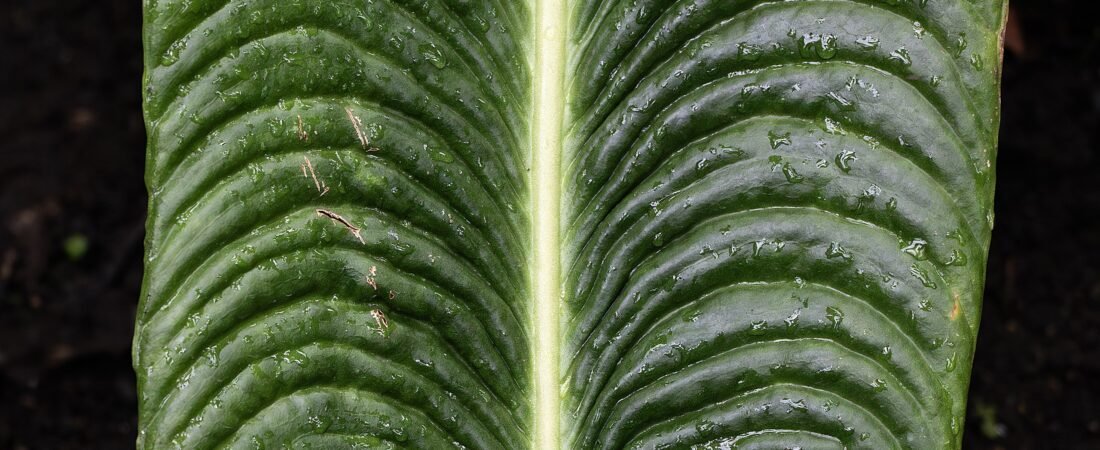
If the Queen Anthurium is velvet, the King Anthurium is armour. Its leaves are long, glossy, deep green, and corrugated — pleated between every secondary vein like a fan that never quite opened — and on a mature plant they can run five feet from tip to base.
It comes from the same wet western Colombian forests as the Queen, and it lives the same way: as an epiphyte on tree trunks, in moss, in cloud. But the King is noticeably tougher. Those pleated, leathery leaves lose water more slowly than velvet ones, which makes veitchii the rare “big scary anthurium” that a determined grower can succeed with outside a cabinet.
Meet the King Anthurium
Botanical name: Anthurium veitchii
Also called: King Anthurium, King Velvet Anthurium (a misnomer — it isn’t velvet), Corrugated Anthurium, Veitch’s Anthurium
What it looks like:
- Long, pendent, lance-shaped leaves — narrow relative to their length — reaching up to 150 cm (5 ft) on a mature plant. Indoors, 2–3 feet is a realistic goal.
- The surface is the signature: deeply pleated or “blistered” between the secondary veins, which are pronounced and closely spaced, giving the whole blade a ribbed, quilted, almost sculptural texture. In the trade you’ll hear “narrow form” and “wide form”; the wide form has broader blades and shallower ribbing.
- Finish: glossy to semi-glossy, a deep green with faint metallic highlights — not the light-absorbing nap of the velvet species.
- New leaves emerge a bronze-red and harden to green.
- Habit: a slowly extending stem with thick aerial roots, producing one long leaf at a time. The leaves hang, so the plant needs height.
- Flowers: a modest greenish spathe on a long stalk.
The name: it honours Veitch Nurseries, the great Victorian plant-hunting firm in England, whose collectors brought it into cultivation in the 1870s.
Where Anthurium veitchii Grows in the Wild
The King is endemic to Colombia, recorded from the departments of Chocó and Antioquia — the same drenched Pacific-slope forests that produce the Queen.
Its ecology:
- Elevation: roughly 300–1,500 m, from lowland foothill forest up into cloud forest. Some sources extend the upper range higher. That’s a wide band, which partly explains why the King is more adaptable than the Queen.
- Growth form: epiphyte. It grows on tree trunks and large branches, its roots wrapped in the moss, lichen, and organic debris that carpets everything in these forests.
- The air is saturated — this is Chocó, one of the rainiest places on earth — but always moving through the canopy.
- Light: filtered through canopy; bright, but never full sun.
- Temperature: warm days and cooler nights, moderating with elevation; never hot.
Kew’s Plants of the World Online summarises it as an epiphytic subshrub of the wet tropical biome, which is exactly what it is.
Reading the Habitat: The Translation
| In the wild | What it means at home |
|---|---|
| Epiphyte on trunks, in moss | Moss- or bark-based mix, or a mount. Never soil |
| Saturated, moving air | High humidity (60–80%) with a fan; more forgiving than the Queen |
| Wide elevation band | Tolerates a wider temperature range: 60–82°F |
| Pendent 5-foot leaves | Height. A tall cabinet, a hanging basket, or a high shelf |
| Leathery, pleated leaves | Better drought and humidity tolerance than velvet species |
| One leaf at a time | Slow. Don’t push it with heavy feeding |
Light
Bright indirect. Under the canopy, the King gets a lot of light — just none of it direct.
- Best: an east window; a north-facing greenhouse cabinet with a light; a few feet from a south/west window behind a sheer.
- Direct sun bleaches and scorches those glossy blades.
- Low light produces small, weakly ribbed leaves.
A grow light on a timer for 10–12 hours makes the difference between a plant that survives and one that produces properly corrugated leaves.
Water
Wet-then-airy, like moss on a trunk after rain.
- In sphagnum or a chunky mix: water when the top layer is just dry; water thoroughly; let it drain completely.
- Never leave it saturated — the thick roots rot in stagnant wet.
- Never let it fully desiccate either; the leaves tolerate it better than velvet species, but the roots don’t.
- Mounted: soak every few days, daily in dry air.
Rain, distilled, or filtered water — epiphytes evolved on rainwater, and mineral buildup shows as tip browning.
Substrate: Trunk Moss
Our King mix:
- 2 parts orchid bark
- 2 parts sphagnum moss, long-fibre, loosely packed
- 1 part perlite or pumice
- A handful of horticultural charcoal
Pure sphagnum works too, refreshed annually. So does a cork mount with a moss pad, hung so the leaves can drop — the most natural presentation and the way the King looks most regal. Whatever you use, a container with excellent drainage — a net or orchid pot — and no soil.
Humidity, Airflow, and Temperature
Humidity: 60–80%. The King is noticeably more tolerant than the Queen — those leathery, pleated leaves hold water better — and many growers keep it outside a cabinet with a humidifier running nearby. It still won’t be happy at 30%, and a greenhouse cabinet produces the best leaves. Track it with a hygrometer.
Airflow: in a cabinet, a small fan is non-negotiable. In a room, ordinary air movement is enough.
Temperature: 60–82°F. The King’s wide elevation range translates to real tolerance — it copes with cooler nights than most tropical aroids and with warm days, but not with heat above 85°F for long, and not with cold drafts. A room that cools overnight suits it well.
Fertilizer
Light and steady.
Balanced liquid fertilizer at quarter to half strength every 2–3 weeks in spring and summer; monthly in winter. Flush the moss regularly. Over-feeding in sphagnum burns the roots and browns the tips.
Repotting and Height
Every 1–2 years, in spring, refreshing the moss. The King’s leaves hang, so as the plant matures you’ll need to raise it — a tall orchid pot, a hanging planter, or a high shelf in the cabinet. A 3-foot leaf folded on a pot rim creases and browns at the fold.
Don’t cut the aerial roots. Tuck them into the moss or let them hang; they’re doing their job.
Propagation
- Stem cuttings: cut below a node with an aerial root; root in damp sphagnum under high humidity. Slow — expect months.
- Top cut: on a leggy plant, the stem below the cut usually pushes a new growth point. Only on a plant that genuinely needs it.
- Seed: hand-pollinate two flowering plants, wait for berries, sow cleaned seed on damp sphagnum. Slow, and how much of the trade is produced.
Common Problems
- Brown tips and edges: low humidity or mineral buildup. Switch to rainwater and raise the air moisture.
- New leaf creased or stuck: it hit the pot, the shelf, or a dry spell while unfurling. Give it room and humidity.
- Yellowing, soft black roots: stagnant wet moss. Add airflow, repot fresh.
- Small, weakly ribbed leaves: not enough light.
- Bleached patches: direct sun.
- Spider mites, thrips: less prone than velvet species but not immune. Neem oil at first sign.
- Leaves getting shorter with each new one: root trouble. Unpot and inspect.
Frequently Asked Questions
Is the King Anthurium toxic to pets? Yes — calcium oxalate crystals, like all aroids. Keep it from being chewed.
Narrow form or wide form? Narrow form has slimmer, more deeply corrugated leaves; wide form has broader blades and shallower ribs. Both are A. veitchii. Care is identical.
Can I grow it without a cabinet? More realistically than the Queen, yes — a bright spot with a humidifier running nearby. Expect slightly smaller leaves than cabinet-grown plants.
Why is it called “King Velvet”? Marketing. Veitchii isn’t velvet — it’s glossy and pleated. The “king” half stuck because it pairs with the Queen.
How long until I get big leaves? Each new leaf is a little longer than the last. From a small plant, expect 2–3 years to reach 2-foot leaves under good conditions.
Quick-Start Gear Checklist
- 🌿 Sphagnum moss + orchid bark
- 🏺 Tall orchid pot or hanging planter
- 💦 Humidifier + hygrometer
- 🌬️ Small fan
- 💡 Grow light
- 🐛 Neem oil
Keep Reading
- Anthurium Care 101 — the genus overview
- Anthurium Warocqueanum Care — the Queen, from the same forests
- Anthurium Regale Care — the other giant, from Peru
Moss, moving humid air, filtered light, and enough height for the leaves to hang — that’s a trunk in a Chocó rainforest, and that’s a King that will keep unrolling longer, more corrugated leaves for years. Happy growing, from all of us at BloomBabe. 🌱