
Disclosure: This post contains affiliate links. If you buy through them, BloomBabe may earn a small commission at no extra cost to you. As an Amazon Associate, I earn from qualifying purchases. We only recommend gear we’d use on our own plants.
Some plants photograph well. Alocasia cuprea photographs like jewelry — thick leaves with a metallic coppery sheen, veins pressed so deeply into the surface that the whole blade looks hammered out of sheet metal. Victorian collectors called this group the jewel Alocasias, and it’s a fair description.
It’s also the Alocasia most often killed with kindness by people who did their homework on the wrong Alocasia. Because unlike lowland species such as the Zebra Plant, A. cuprea comes from 1,000 to 1,500 metres up a Bornean mountainside. It doesn’t want your warmest, most tropical corner. It wants a cool night.
Here’s the plant, the mountain, and the translation.
Meet the Jewel Alocasia
Botanical name: Alocasia cuprea
Also called: Jewel Alocasia, Mirror Plant, Copper Alocasia, Living Jewel, Red Secret (the common cultivar)
What it looks like:
- Leaves reach about 60 cm (24 in) long and are held on relatively short petioles, so the plant reads as a low mound of leaves rather than a tall stem plant like A. zebrina.
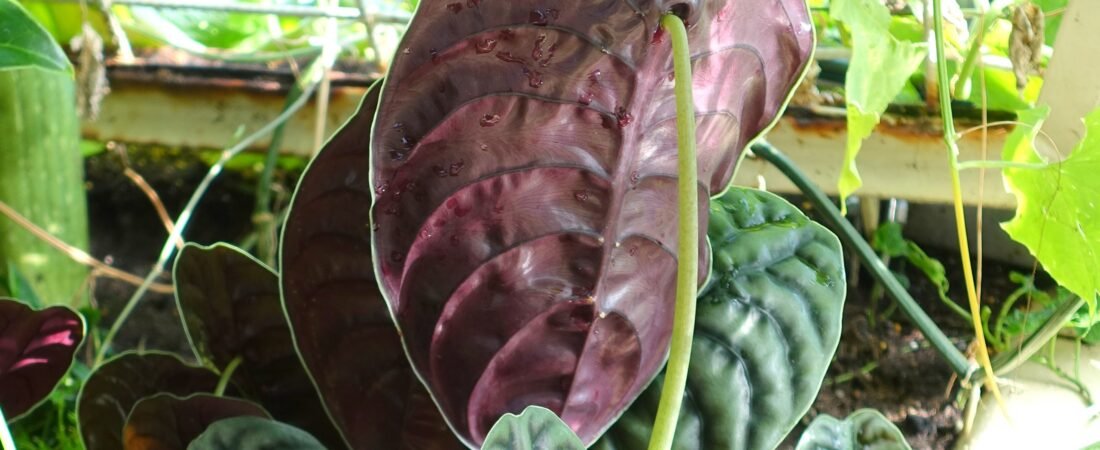
- The surface is the signature. Thick and stiff, with a metallic coppery-bronze finish and dramatically impressed primary veins that quilt the blade into raised sections. Light moves across it as you walk past — this is where “mirror plant” comes from.
- The undersides are a deep purple, sometimes almost maroon.
- A greener form occurs naturally alongside the coppery one, so a less bronzed plant isn’t necessarily mislabeled.
- Overall size stays modest indoors — usually 18–24 inches tall and wide.
- It grows from a corm, holding a small number of leaves at a time.
A little history: A. cuprea was introduced to Europe in the 1850s by the collector Thomas Lobb, working for the famous Veitch Nurseries. It has been coveted and comparatively rare in cultivation ever since — the tissue-culture boom of the last few years is the first time it’s been genuinely easy to buy.
Where Alocasia cuprea Grows in the Wild
A. cuprea is a Bornean endemic. It was long considered restricted to Sabah, in Malaysian Borneo, and has more recently been recorded in Sarawak as well.
The field details are unusually useful for a houseplant:
- Elevation: roughly 1,000–1,500 m. This is a montane species. At that altitude in Borneo, days are warm but nights drop appreciably — and that daily swing is part of the plant’s normal life, not a stress.
- Habitat: slopes in rainforest, in shaded, humid conditions, frequently on steep slopes above streams. Some populations occur in kerangas (heath forest), a distinctly nutrient-poor, sandy, acidic forest type.
- Substrate: it doesn’t care. This is the genuinely interesting part. A. cuprea has been recorded over ultramafic rock, sandstone, and limestone alike, and the taxonomic literature notes the species appears to be essentially unaffected by substrate chemistry.
- Light: shaded forest understory on a slope — filtered, indirect, never harsh.
Put those together and you get a portrait: a plant living on a steep, shaded, well-drained mountain slope, in thin mineral soil it isn’t fussy about, in constantly humid air near running water, going through a warm day and a cool night, every day.
Reading the Habitat: The Translation
| In the wild | What it means at home |
|---|---|
| 1,000–1,500 m montane | Cool nights help. 60–68°F overnight, 70–80°F by day. Not a hot-corner plant |
| Steep slopes above streams | Sharp drainage plus high ambient humidity — wet air, never wet feet |
| Indifferent to substrate | Don’t overthink the mix. Structure matters far more than chemistry |
| Kerangas / nutrient-poor soils | Light feeder. Heavy fertilizer burns it |
| Shaded understory | Bright indirect only. Direct sun dulls and scorches the metallic finish |
| Corm-forming | Expect dormancy; expect a small leaf count |
That temperature row is the one worth tattooing somewhere. A lot of “my cuprea is sulking” stories are simply a montane plant parked in a 78°F room, day and night, all year.
Light
Bright indirect light, consistently. Think of the light a few metres inside a forest edge — plenty of it, but all of it bounced and filtered.
- Good: east window, or 3–6 feet back from a south or west window, or behind a sheer curtain.
- Bad: direct midday sun. It flattens the coppery iridescence to a dull olive and burns the raised vein ridges first.
- Also bad: genuine gloom. Unlike Black Velvet, A. cuprea isn’t a low-light specialist, and in a dark corner it stalls and loses its metallic quality.
A grow light on a timer at 10–12 hours makes this plant much easier in a north-facing home.
Water
A slope above a stream drains fast and never dries out completely. That’s the target.
- Water when the top inch or so is dry. Don’t let it fully desiccate; don’t let it stay saturated.
- Water thoroughly and let it drain freely. Empty the saucer without fail.
- Reduce noticeably in winter, when growth slows and the corm is resting.
- Use filtered, rain, or distilled water if your tap water is hard. This species is more sensitive to mineral buildup than most, and it shows as brown vein-edge speckling.
A soil moisture meter is worth having — thick-leaved plants hide thirst well and hide root rot even better.
Soil: A Mountain Slope in a Pot
Since the wild plant grows happily over three completely different rock types, stop worrying about the recipe’s chemistry and focus on its structure. You want something water pours straight through, holding moisture in the particles rather than between them.
Our cuprea mix:
- 2 parts orchid bark
- 2 parts perlite or pumice
- 1 part coco coir or aroid mix
- A handful of horticultural charcoal
Some growers run A. cuprea in straight sphagnum moss or in LECA semi-hydro, and it does very well in both — again, because structure and air at the roots matter more than what the particles are made of. Whatever you choose, use a pot with drainage and keep it snug.
Humidity and Temperature — the Part That Matters Most
Humidity: 65–80%. This is a cloud-influenced mountain plant and it shows: in dry room air the leaf edges crisp and the thick blades develop dull patches. A humidifier running nearby is the practical answer, and a hygrometer keeps you honest. Greenhouse cabinets suit this species extremely well.
Temperature: aim for a day–night swing. Roughly 70–80°F by day and 60–68°F at night mimics its montane home. If you can put it somewhere that cools off overnight — a room you don’t heat as hard, a spot near a window that isn’t drafty — you’ll see better colour and steadier growth than in a uniformly warm room.
Keep it above 55°F, and away from vents. A swing is good; a draft is not.
Fertilizer
Remember kerangas — nutrient-poor sandy heath forest. This plant is adapted to lean conditions.
Feed a balanced liquid fertilizer at quarter to half strength, roughly monthly through spring and summer. Nothing in winter. Flush the pot with plain water every few months — mineral salts are a real problem for a species this sensitive to water quality.
Repotting and Dormancy
Repot every 1–2 years in spring, moving up one size only. Check the corm while you’re in there: firm and pale is healthy.
Dormancy is normal. Cooler months, shorter days, and this plant may drop everything and sit as a bare corm. Keep it barely damp and warm-ish, stop feeding, and it typically pushes new growth in spring. Losing every leaf in December is not a diagnosis.
Propagation
Corm division, in spring, the same as its relatives:
- Unpot and rinse the roots so you can see the base.
- Detach firm offset corms by hand or with a clean blade.
- Either pot straight into gritty mix, or sprout them first in a covered container of damp sphagnum — the higher humidity gets a better strike rate.
- Keep warm and bright-indirect, and be patient. Weeks to months is normal.
A. cuprea also hybridises readily — it’s a parent of several popular crosses, which is why you’ll see so many bronze-and-quilted plants under trade names.
Common Problems
- Dull, flat colour: too much direct sun, or not enough light overall. Both cost you the shine, from opposite directions.
- Brown crispy margins: humidity too low, or mineral buildup from hard water.
- Yellowing with soggy mix: overwatering and the beginning of root rot. Unpot, trim, repot gritty.
- Stalled all summer in a warm room: consider temperature. A montane plant in constant heat with no night drop often simply idles.
- Spider mites: the classic Alocasia pest, and dry air invites them. Treat with neem oil and raise humidity, which is the real fix.
- Leaf edges curling upward: usually thirst or heat stress; check the mix before assuming.
Frequently Asked Questions
Is Alocasia cuprea toxic to pets? Yes — insoluble calcium oxalate crystals, like all Alocasia. Painful if chewed. Keep it out of reach.
Is ‘Red Secret’ the same plant? ‘Red Secret’ is the cultivar name under which A. cuprea is most commonly sold. Same species, selected for strong coppery colour.
Why is my cuprea greener than the photos? Either it’s the naturally occurring greener form, or it’s a light issue — usually not enough. Both are fine; only one is fixable.
Can I grow it in LECA or semi-hydro? Yes, and it’s one of the better candidates. The wild plant is essentially growing in mineral rubble already.
Is it hard to grow? It’s demanding about humidity and happier with cool nights, but it isn’t fragile. Get the air right and it’s no harder than any other Alocasia.
Quick-Start Gear Checklist
- 🪴 Orchid bark + perlite + aroid mix
- 💧 Moisture meter
- 💦 Humidifier + hygrometer
- 💡 Grow light
- 🪨 LECA, if you want to try semi-hydro
- 🐛 Neem oil
Keep Reading
- Alocasia Care 101 — the genus overview
- Alocasia Zebrina Care — the lowland cousin that wants the opposite temperature treatment
- Alocasia Black Velvet Care
Give the Jewel Alocasia humid air, a gritty mix that drains like a mountain slope, filtered light, and a room that cools off at night, and it rewards you with the best-looking leaf in the house. Happy growing, from all of us at BloomBabe. 🌱