
Disclosure: This post contains affiliate links. If you buy through them, BloomBabe may earn a small commission at no extra cost to you. As an Amazon Associate, I earn from qualifying purchases. We only recommend gear we’d use on our own plants.
There’s a plant on almost every houseplant shelf in the country whose entire wild population, as far as anyone has been able to confirm, lives on shaded limestone cliffs inside one wildlife reserve in Malaysian Borneo.
That’s Alocasia Black Velvet — Alocasia reginula, the “little queen.” It’s small, slow, nearly black, and famously touchy. It’s also one of the clearest examples we know of a plant whose reputation for being difficult is really just a mismatch between where it’s from and how we tend to pot it.
Because once you know it grows in humus caught in the cracks of a shaded karst cliff, “why does it keep rotting in my potting soil?” answers itself.
Meet the Little Queen
Botanical name: Alocasia reginula
Also called: Black Velvet, Alocasia Black Velvet, Little Queen, Black Velvet Elephant Ear, Black Alocasia
The name reginula means “little queen,” and it fits — this is a genuinely dwarf Alocasia, not a juvenile of something larger.
What it looks like:
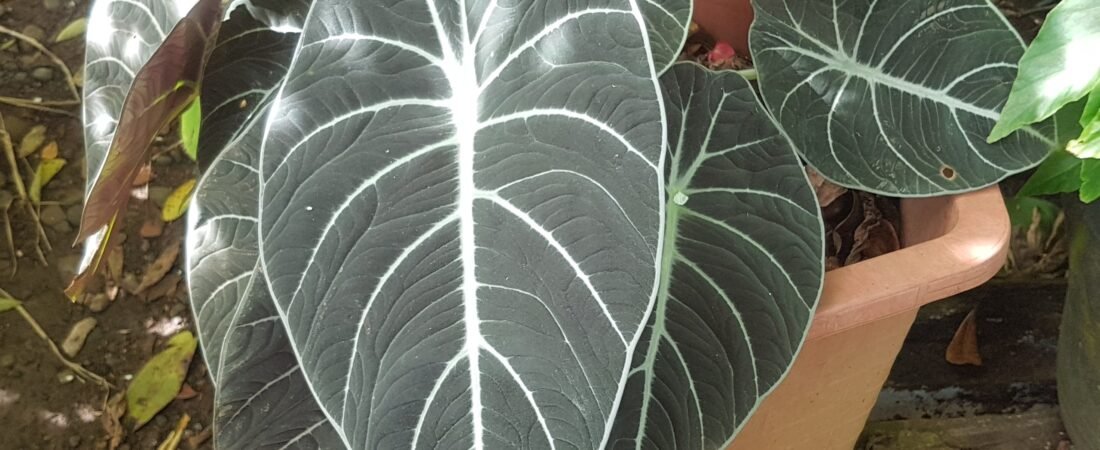
- Leaves are broadly ovate to heart-shaped, thick, held nearly horizontal, and typically 4–8 inches long. The whole plant tops out around 12–18 inches.
- The texture is the thing. The upper surface is a deep blackish-green with a matte, velvety nap that absorbs light rather than reflecting it. Under that: crisp silver-white primary veins fanning out from the midrib, drawn like they were inked on.
- The underside is a dusky reddish-purple — worth turning a leaf over to see.
- Growth is slow and compact. It grows from a small corm and holds only a handful of leaves at once. A Black Velvet with five good leaves is a thriving Black Velvet.
- Flowers are the standard aroid spathe-and-spadix, pale and unremarkable. Most growers cut them off so the plant puts its energy into leaves instead.
Where Alocasia reginula Grows in the Wild
Here’s the strange part: for over twenty years, nobody knew.
When the species was formally described in 1998, its distribution was recorded as “?Borneo” — with the question mark — and its habitat simply as “Unknown.” It had entered cultivation without a confirmed wild origin, which is rarer than it sounds for a plant this widely sold.
Work published in 2021 finally placed it: Alocasia reginula appears to be endemic to the Tabin Wildlife Reserve in Sabah, Malaysian Borneo, where it grows on heavily shaded karst limestone cliffs and rocky slopes.
Sit with that habitat for a second, because every word of it is a care instruction:
- Karst limestone — the rock is calcium carbonate, weathering into sharp, porous, mineral-rich rubble. Not soil.
- Cliffs and rocky slopes — the plant is a lithophyte. Its roots run through pockets of humus and leaf litter caught in crevices, over stone. Water never pools there; it drains through in seconds.
- Heavily shaded — this is a low-light specialist even by Alocasia standards. It lives against a rock face, under canopy, in gloom.
- Cliff air — humid, but constantly moving. Stagnant air isn’t part of the picture.
One honest note on sourcing: a species with a wild range that small is fragile by definition. Fortunately, essentially every Black Velvet in the trade is nursery-propagated by corm division, and they’re widely available. There’s no reason to ever want a wild-collected one.
Reading the Habitat: The Translation
| In the wild | What it means at home |
|---|---|
| Humus in limestone crevices | Gritty, chunky, fast-draining mix — never straight potting soil |
| Calcium-rich karst rock | Tolerates and even appreciates a little limestone or oyster shell grit |
| Lithophyte on rock, not in soil | Small, snug pot. Roots want contact and air, not volume |
| Heavily shaded cliff face | Low to medium indirect light. It does not want a bright window |
| Exposed cliff, moving air | Good airflow matters as much as humidity — stagnant damp is what rots it |
| Slow-growing dwarf species | Feed lightly. It cannot use a heavy feeding schedule |
Light
This is the Alocasia you can put in a dimmer spot — medium to low indirect light, several feet back from a window, or beside a north-facing one. It evolved against a shaded rock wall and its near-black leaves are built to harvest what little light gets there.
What it can’t take is direct sun. An hour of afternoon sun through glass will bleach the velvet to a flat, washed olive, and the damage doesn’t reverse.
If your only available spot is genuinely dark, a small LED grow light set well back — or dimmed — keeps it ticking without scorching.
Water
Overwatering kills more Black Velvets than everything else combined, and it’s easy to see why: a crevice on a cliff drains instantly, and a plastic nursery pot full of peat doesn’t.
- Water when the top inch is dry, and check with your finger or a moisture meter rather than by schedule.
- Water thoroughly, then let it drain completely. Never leave it sitting in a saucer.
- Cut back hard in winter. Cold wet mix around a small corm is exactly how you lose one.
- Bottom watering works well here — it wets the root zone evenly without saturating the crown.
The plant is small, so the margin for error is small too. When in doubt with a Black Velvet, wait a day.
Soil: Build a Limestone Crevice
Skip the bagged potting soil entirely as a base, or cut it heavily. You’re building rubble with some organic matter in it, not soil with some grit in it.
Our Black Velvet mix:
- 2 parts orchid bark or fine bark chips
- 2 parts perlite or pumice
- 1 part coco coir or quality aroid mix for the humus fraction
- A handful of horticultural charcoal
- Optional, and a nice nod to the karst: a small scoop of crushed oyster shell or garden lime
Use a small pot with drainage — a terracotta pot is a genuinely good choice here, because it wicks moisture out of the mix between waterings the way porous rock would.
Humidity, Airflow, and Temperature
Humidity: 60–70%. Below 50% the leaf margins crisp and spider mites move in. A humidifier nearby is the reliable fix; a hygrometer tells you whether you actually have a problem.
Airflow is the half of this that gets forgotten. A cliff face is humid and breezy. Black Velvet sealed in a still, damp propagation box is a rot risk, not a spa. If you grow it in a cabinet or terrarium, add a small clip-on circulation fan. It makes a bigger difference than any other single change we’ve made with this plant.
Temperature: 65–80°F, above 60°F at all times, away from vents and drafty glass.
Fertilizer
Feed lightly — this is a slow, small plant that cannot process a heavy schedule.
A balanced houseplant fertilizer at quarter to half strength, once a month in spring and summer only. Nothing at all from late autumn through winter. Flush the pot with plain water every couple of months to clear salt buildup, which those fine roots resent.
Repotting and Dormancy
Repot every two years at most, in spring, and go up only one small size. Black Velvet genuinely prefers to be snug; a big pot is a rot trap.
Like other corm-forming Alocasia, it may go dormant — dropping leaves in autumn or winter and looking, convincingly, dead. Don’t bin it. Keep the mix barely damp, keep it warm, stop feeding, and wait for spring. Tip it out and squeeze the corm if you need reassurance: firm is alive.
Propagation
By corm division only. Leaf cuttings will not root; they’ll rot.
- In spring, unpot and rinse the root ball so you can see the base clearly.
- Look for small, firm offset corms — often pea-to-marble sized, sometimes with a root or two.
- Twist or cut them free cleanly.
- Pot into small containers of the same gritty mix, or start them in damp sphagnum in a covered container until they root, then pot up.
Be patient. Weeks to months before a first leaf is completely normal for this species.
Common Problems
- Yellow leaf, soggy mix: overwatering. The most common Black Velvet failure by a wide margin.
- Brown crispy edges: low humidity, or salt buildup from tap water and fertilizer.
- Faded, olive-toned leaves: too much light. Move it back from the window.
- Fine webbing, stippled leaves: spider mites. They love this plant and love dry air more. Treat with neem oil and fix the humidity.
- Total leaf loss in winter: dormancy. Wait.
- No new growth for months in summer: check the roots. If they’re fine, it may simply be light — nudge it slightly brighter, but slowly.
Frequently Asked Questions
Is Alocasia Black Velvet toxic to pets? Yes. Insoluble calcium oxalate crystals cause painful mouth and throat irritation if chewed. Keep it away from cats, dogs, and small children.
Why is mine so slow? Because it’s a dwarf species that grows slowly by nature. One new leaf every few weeks in the growing season is a healthy pace.
Can I grow it in a terrarium? Yes — it’s one of the better Alocasia for a cabinet, given the humidity. Add air movement, and don’t let the mix stay saturated.
Is ‘Black Velvet’ a cultivar or the species? In practice, the plants sold as Black Velvet are Alocasia reginula itself. You’ll also see variegated and pink-variegated selections, which are far pricier and generally weaker growers.
Mine came in a peat-heavy nursery pot. Repot now or wait? Wait until it settles in — two to four weeks — unless the mix is staying wet, in which case repot straight away into something gritty. Peat is the wrong material for a cliff plant.
Quick-Start Gear Checklist
- 🪴 Orchid bark + perlite + aroid mix
- 🏺 Small terracotta pot
- 💧 Moisture meter
- 💦 Humidifier + hygrometer
- 🌬️ Small circulation fan
- 🐛 Neem oil
Keep Reading
- Alocasia Care 101 — the genus overview
- Alocasia Silver Dragon Care Guide — another compact, rock-loving Bornean
- Alocasia Cuprea Care
Treat the Little Queen like what she is — a small cliff plant living in a pocket of grit, in the shade, with air moving past her — and she stops being difficult. Gritty mix, small pot, dim corner, gentle hand on the watering can. Happy growing, from all of us at BloomBabe. 🌱