
Disclosure: This post contains affiliate links. If you buy through them, BloomBabe may earn a small commission at no extra cost to you. As an Amazon Associate, I earn from qualifying purchases. We only recommend gear we’d use on our own plants.
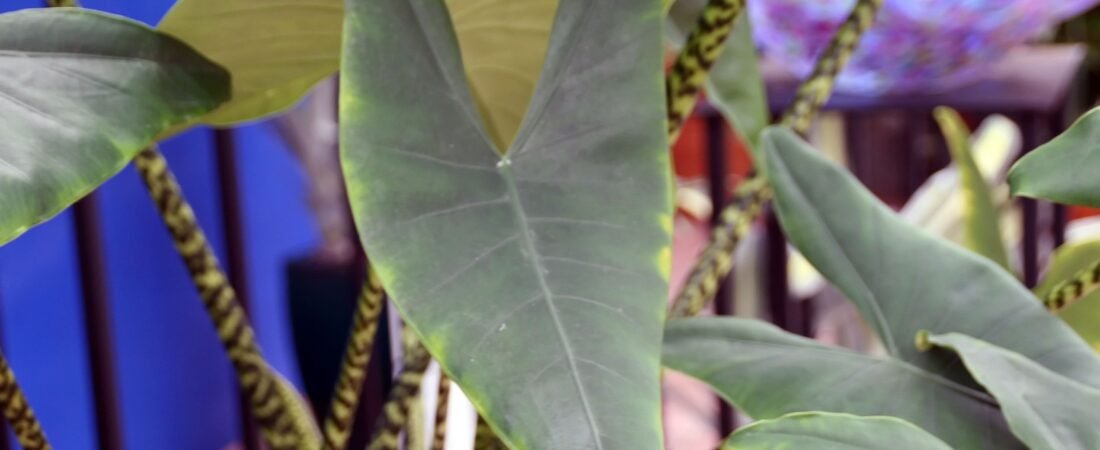
Most Alocasia are grown for their leaves. The Zebra Plant is the one you grow for its stems — tall, pale, striped like an animal, holding arrowhead leaves up over everything else on the shelf.
It also has a reputation for being dramatic. Ours was, until we stopped guessing and looked up where it actually comes from. Once you know that Alocasia zebrina is a lowland Philippine forest-floor plant that grows in wet leaf litter beside boulders, in deep shade, at a steady tropical temperature, the care instructions stop feeling arbitrary. They’re just a description of home.
Here’s the plant, the place, and the translation between them.
Meet the Zebra Plant
Botanical name: Alocasia zebrina
Also called: Zebra Plant, Zebra Alocasia, Zebrina Alocasia, Tiger Taro, Elephant Ear
⚠️ A naming heads-up: “Zebra Plant” is one of the most overloaded common names in the hobby. It’s also used for Aphelandra squarrosa (a glossy-leaved, yellow-flowering shrub) and Haworthiopsis fasciata (a small striped succulent). Three completely unrelated plants, three completely different care routines. If you’re shopping or troubleshooting, use the botanical name — this is one of the times it genuinely saves a plant.
What it looks like:
- The petioles are the whole point. They reach around 1.1 m (roughly 3½ feet) on a mature plant, pale green and streaked irregularly with darker green to brown bands. No two are marked the same way. On young plants the striping is faint; it strengthens with maturity.
- Leaves are sagittate — arrow-shaped — from about 45 cm to 100 cm (18–40 in) long on a well-grown specimen, split at the base into two triangular lobes. The blade is glossy, leathery, and a plain mid-green. It’s a deliberately understated leaf; the plant is putting its money into the stem.
- Mature size runs to about 1.8 m (6 ft) tall, and specimens near 2.9 m have been recorded. Indoors, expect 2–4 feet.
- Growth habit: it grows from an underground corm, sending up a small number of leaves at a time. Old leaves are shed as new ones open — a Zebra Plant holding four or five leaves is doing well, not failing.
- Flowers appear in pairs, around 16 cm, in the typical aroid spathe-and-spadix arrangement, followed by orange fruits. Indoors, blooming is uncommon and not worth chasing.
Where Alocasia zebrina Grows in the Wild
This is a Philippine endemic — it grows naturally nowhere else on earth. Wild populations occur on Luzon, Mindanao, Leyte, Samar, Biliran, and Alabat.
The specifics matter more than the map:
- Elevation: roughly 100–400 m above sea level. This is a lowland plant, not a montane one. That single fact separates it from Alocasias like A. cuprea, which live at 1,000–1,500 m and want cool nights. Zebrina doesn’t.
- Habitat: primary rainforest understory, in wet, humus-covered soil immediately adjacent to boulders, in the shade of the canopy. One studied population sits at 300 m on a patch of secondary forest on the northeastern slope of the Makiling Forest Reserve.
- Root zone: deep, spongy leaf litter and decomposed organic matter lying over and around rock. Constantly damp, constantly draining, never stagnant. Nothing about that root zone resembles a dense pot of peat.
- Light: filtered and low, under a closed tropical canopy, with brief moving flecks of sun.
Conservation note, and it’s a real one: Alocasia zebrina is listed as threatened on the Philippines’ national list of threatened species, and collecting it from the wild is illegal — penalties run to six to ten years’ imprisonment and fines of ₱100,000 to ₱1,000,000. Every Zebra Plant you should ever buy is nursery-propagated from corms, and there are plenty of them. If a seller markets a plant as “wild collected,” that isn’t a selling point. Walk away.
Reading the Habitat: What Each Wild Fact Tells You
This is the part most care guides skip. Every line above converts directly into something you do at home:
| In the wild | What it means for your plant |
|---|---|
| Lowland, 100–400 m elevation | Wants steady warmth, 65–85°F. No cool-night trick needed — and no tolerance for cold. |
| Under closed rainforest canopy | Bright indirect light. Direct midday sun scorches the leaves fast. |
| Wet humus over and beside boulders | Chunky, organic, sharply draining mix. Damp always, soggy never. |
| Primary rainforest air | 60%+ humidity is the target; below 40% you’ll see crispy margins. |
| Grows from a corm | It can and will go dormant. Bare soil in winter is usually rest, not death. |
| Sheds old leaves as new ones open | A modest leaf count is normal. Don’t panic-fertilize. |
Light
Bright, indirect light — an east-facing window, or a few feet back from a south or west one. Under the canopy it evolved in, this plant never sees hours of unfiltered sun, and unfiltered sun bleaches and scorches those glossy blades within days.
That said, don’t overcorrect into gloom. Petioles that stretch unusually long, lean hard toward the window, and flop under the weight of their own leaves are telling you they need more light, not more water. If your brightest spot still isn’t enough, a full spectrum LED grow light on a timer running 10–12 hours does the job.
Rotate the pot a quarter turn each week. Zebra Plants lean noticeably, and a lopsided one never quite recovers its posture.
Water
Think of that forest floor: leaf litter that’s always damp because rain passes through it constantly — and always draining, because it’s sitting on rock.
- Water when the top 1–2 inches are dry. Don’t run it bone dry like a Snake Plant, and don’t keep it wet like a fern.
- Water thoroughly until it runs from the drainage hole, then empty the saucer. Alocasia roots rot faster than almost anything else we grow.
- Cut back in winter when growth slows. This is when most Zebra Plants die — same schedule, colder soil, less light, and the roots simply sit wet.
A soil moisture meter removes the guesswork entirely, and with this plant it’s genuinely worth the few dollars.
Sensitive to hard tap water and chlorine? Some are. If you see stubborn brown edging despite good humidity, try filtered or distilled water for a month and see if the new growth comes in clean.
Soil: Build the Boulder-and-Litter Mix
Standard potting soil out of the bag is the single most common reason a Zebra Plant fails. It holds water like a sponge, which is the opposite of wet litter over rock.
Our mix, straight from the habitat description:
- 2 parts chunky aroid potting mix (or quality potting soil as the base)
- 1 part orchid bark — this is the “boulder” structure
- 1 part perlite or pumice
- A handful of horticultural charcoal to keep it sweet
- Optional: a scoop of worm castings for the humus component
You want a mix you could pour water through and see it run out the bottom almost immediately. Always use a pot with a drainage hole, and don’t oversize it — a corm swimming in wet mix is a corm rotting in wet mix.
Humidity and Temperature
Humidity: 60%+ is the goal. Below about 40% you’ll get brown, crisp leaf margins that never green back up. Misting doesn’t move the needle — the water evaporates in minutes. What works is a cool mist humidifier running nearby, or grouping it with other plants. Track it honestly with a hygrometer rather than guessing.
Temperature: 65–85°F. This is a lowland tropical plant with no cold adaptation at all. Keep it above 60°F, and keep it well away from AC vents, drafty winter windows, and radiators — the swings do more damage than a steady imperfect temperature would.
Fertilizer
Light feeder during growth, nothing during rest.
Use a balanced liquid houseplant fertilizer diluted to half strength, every 3–4 weeks from spring through early autumn. Stop completely in late fall and winter — feeding a dormant corm just burns roots and builds up salt.
If you’ve been feeding regularly, flush the pot with plain water every few months to wash accumulated mineral salts out.
Repotting and That Alarming Winter Dormancy
Repot every 1–2 years, in spring, going up only one pot size. Zebra Plants flower and grow better slightly snug, and an oversized pot holds a dangerous amount of wet mix around the corm.
On dormancy: if your plant drops most or all of its leaves in autumn or winter, don’t throw it out. That’s normal corm behavior, especially in a cooler or darker home. Move it somewhere warm, cut watering back to barely damp, stop fertilizing entirely, and wait. Most plants push new growth when the light returns in spring. Tip the plant out and check the corm if you want reassurance: firm means alive, mushy means it rotted.
Propagation
Zebra Plants propagate by corm division, not by leaf or stem cuttings — a cut leaf will simply rot.
- Unpot in spring and gently wash the root ball so you can see what you’re doing.
- Look for small, firm offsets — little corms attached at the base, some already with their own roots.
- Separate them by hand, or with a clean cut if they’re stubbornly joined.
- Pot each into a small container of the same chunky mix, keep warm and humid, and be patient. Corms can take weeks to a couple of months to show a first leaf.
A bit of rooting hormone on the cut surfaces is optional but doesn’t hurt.
Common Problems
- Yellowing lower leaves, one at a time: usually normal shedding as the plant funds new growth. Yellowing several at once, with soggy soil, is overwatering.
- Brown crispy edges: low humidity, or mineral buildup from tap water.
- Drooping despite moist soil: root rot. Unpot immediately, cut away black mushy roots, repot into fresh gritty mix.
- Stretched, floppy petioles: not enough light.
- Fine webbing under the leaves: spider mites, and Alocasia are magnets for them in dry indoor air. Treat promptly with neem oil and raise the humidity, which is the actual root cause.
- Sudden total leaf drop in autumn: dormancy. See above — wait it out.
Frequently Asked Questions
Is the Zebra Plant toxic to pets? Yes. Like all Alocasia, it contains insoluble calcium oxalate crystals that cause intense mouth and throat irritation if chewed. Keep it out of reach of cats, dogs, and toddlers.
Why does mine only have three leaves? Because that’s how it grows. Alocasia hold a small number of leaves and shed the oldest as new ones open. Steady replacement is the sign of health, not leaf count.
Can I grow it in a terrarium or greenhouse cabinet? Yes, and it thrives there — the humidity is exactly right. Just give it headroom, because those petioles get long fast.
Why are the stripes faint on my plant? Young plants and low-light plants both show weaker banding. Maturity and better light typically bring it in stronger.
Is it the same as Alocasia ‘Tiger’? Similar look, different plant. Various striped-petiole Alocasia hybrids and cultivars circulate under trade names. Check the tag for A. zebrina if that’s what you want.
Quick-Start Gear Checklist
- 🪴 Chunky aroid mix + orchid bark + perlite
- 💧 Soil moisture meter
- 💦 Humidifier + hygrometer
- 💡 Grow light
- 🌿 Balanced fertilizer
- 🐛 Neem oil
Keep Reading
- Alocasia Care 101 — the whole genus, start to finish
- Alocasia Cuprea Care — its montane Bornean cousin, and why it wants cooler nights
- Alocasia Polly Care Guide
Give the Zebra Plant lowland warmth, filtered light, and a mix that drains like leaf litter over rock, and those striped stems will keep climbing. And if it drops everything one November — let it sleep. It’s not gone, it’s just doing what corms do. Happy growing, from all of us at BloomBabe. 🌱