
Disclosure: This post contains affiliate links. If you buy through them, BloomBabe may earn a small commission at no extra cost to you. As an Amazon Associate, I earn from qualifying purchases. We only recommend gear we’d use on our own plants.
Most of the Alocasia we write about are collector plants — small, slow, particular, grown for a metallic sheen or a velvet nap. Giant Taro is the opposite of all of that. It’s an agricultural crop that happens to be beautiful, it’s been feeding people for tens of thousands of years, and it will fill a corner of your house faster than anything else in the genus.
It’s also the plant that teaches you the single most useful ID trick in this whole family: Alocasia leaves point up. Colocasia leaves point down. Once you can see that, half the “elephant ear” confusion at the garden centre disappears.
Meet Giant Taro
Botanical name: Alocasia macrorrhizos
Also called: Giant Taro, Giant Elephant Ear, Upright Elephant Ear, Elephant Ear Taro, ʻApe (Hawaiian), Biga (Philippines), Pia (parts of Polynesia)
What it looks like:
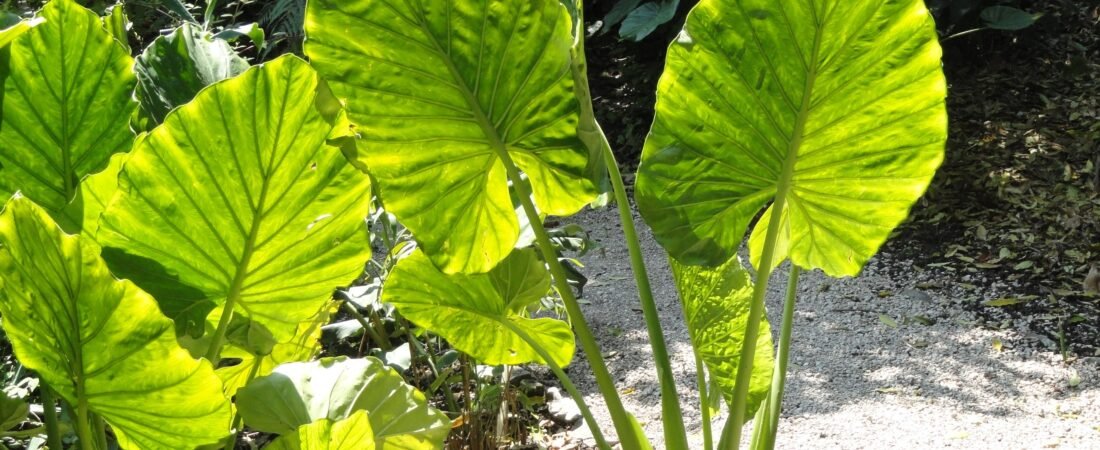
- Enormous heart- to arrow-shaped leaves, glossy and mid-green with strongly marked veins. In the tropics they’re famously large enough to serve as an improvised umbrella in a downpour — that isn’t a figure of speech, it’s what people actually do with them.
- Leaves are held upright, on thick, sturdy, vertical petioles that attach at the notch of the leaf. This is the diagnostic feature. Compare a Colocasia, whose leaves droop downward from a petiole attached in the middle of the blade.
- Mature size is genuinely large: 6–12 feet tall in tropical ground, forming a visible above-ground trunk-like stem over time. In a big indoor pot, expect 4–6 feet.
- Underground it forms a starchy rhizome — the part that’s been cultivated as food.
- Flowers are the usual aroid spathe and spadix, pale green to cream, followed by red-orange fruits on mature plants.
Its history is remarkable. Giant Taro was originally domesticated in the Philippines and has been cultivated across South Asia, the Philippines, and the Pacific Islands for tens of thousands of years — early Austronesian peoples knew it from wild stands in Taiwan, and it became one of the staple crops carried across the Pacific.
⚠️ A note on eating it: the rhizome, stems, and leaves are edible only when thoroughly cooked. Raw, every part contains needle-like calcium oxalate crystals called raphides that cause severe irritation to skin, mouth, and throat. There’s a Hawaiian saying about it: the eater of ʻape will have an itchy mouth. Treat your houseplant as an ornamental, not a vegetable — preparing it safely is a genuine skill.
Where Alocasia macrorrhizos Grows in the Wild
Giant Taro is native to the rainforests of Maritime Southeast Asia, New Guinea, and the Murray Islands in Australia’s Torres Strait — a range that runs from Borneo in the west to the Solomon Islands in the east, taking in Sulawesi, the Philippines, the Maluku Islands, and the Bismarck Archipelago.
Because it’s been cultivated for so long and so widely, the line between “wild” and “carried by people” is genuinely blurry across much of that range. But the ecology is consistent:
- Warm lowland tropical rainforest, with high rainfall and no cold season at all.
- Forest margins, clearings, streamsides, and disturbed ground rather than deep closed canopy. This matters: unlike its shade-dwelling relatives, Giant Taro is an edge and gap species, which is exactly why it tolerates far more light than any other Alocasia you’ll grow.
- Rich, wet, well-drained soil with abundant organic matter — the fertile ground of a tropical valley bottom.
- Constant humidity and heat, year-round.
Reading the Habitat: The Translation
| In the wild | What it means at home |
|---|---|
| Forest edges and clearings | Tolerates real sun — the one Alocasia you can give a bright window or a patio |
| Lowland tropics, no cold season | 65–85°F. Absolutely no frost; bring it in below 50°F |
| High rainfall, wet valley soil | Water generously — this is a thirsty plant, unlike its cliff-dwelling cousins |
| Rich organic ground | Heavy feeder. Feed it properly or the leaves come in small |
| Fast-growing gap coloniser | Big pot, big growth, fast. Plan for the size |
| Starchy rhizome | Goes dormant in cool conditions; overwinters as a rhizome |
That first row is the one that surprises people. If you’ve learned Alocasia care on a Black Velvet, you’ve learned “shade, small pot, go easy on water and food.” Giant Taro wants the opposite of all four.
Light
Bright light, and it will take some direct sun — a few hours of morning sun is genuinely good for it, and outdoors in summer it handles considerably more, provided it’s watered to match.
Indoors, put it in the brightest spot you have: right at a south or west window, or an unobstructed east one. In low light it stretches, produces smaller leaves, and leans badly.
If you move it outdoors for summer, acclimate it gradually over a week or two — a plant grown in a living room will scorch if it goes straight into full afternoon sun.
Water
This is the thirstiest Alocasia in common cultivation, and the least likely to punish generosity.
- Keep the soil consistently moist. Water when the top inch is dry, and in a bright warm spot in summer that may mean every few days.
- Big leaves lose a lot of water. A wilting Giant Taro on a hot afternoon is usually just thirsty, not sick.
- It still needs drainage. Wet is fine; stagnant is not. Use a pot with a drainage hole and empty the saucer.
- Cut back sharply in winter when growth slows.
Because the pots are large and the demand is high, a self-watering planter genuinely suits this species better than most.
Soil: Rich Tropical Valley Bottom
Forget the gritty, lean mixes the collector Alocasia want. Giant Taro grows in fertile, moisture-retentive ground.
Our mix:
- 3 parts quality potting soil or aroid mix
- 1 part perlite for drainage
- 1 part compost or worm castings
Go up in pot size as it grows — a root-bound Giant Taro simply stops making big leaves, which defeats the entire purpose of owning one.
Humidity and Temperature
Humidity: 60%+ preferred, but this species is noticeably more forgiving of average room humidity than the velvet-leaved Alocasia. You’ll still get better leaves with a humidifier running.
Temperature: 65–85°F. No frost tolerance whatsoever. If you summer it outdoors, bring it in well before nights approach 50°F.
In USDA zones 9–11 it can stay in the ground year-round. In colder zones, gardeners commonly lift the rhizome after the first frost blackens the foliage, store it somewhere cool and dry over winter, and replant in spring — the same routine as dahlias or cannas.
Fertilizer
Feed it properly. This is the one Alocasia where under-feeding is a more common mistake than over-feeding.
- Balanced liquid fertilizer every 2 weeks through spring and summer, at full or three-quarter strength.
- Or a slow-release granular fertilizer worked into the pot at the start of the season.
- Stop entirely in autumn and winter.
Small leaves on a well-watered plant in good light almost always means it’s hungry.
Repotting and Overwintering
Repot annually in spring while it’s young and growing hard — it will outgrow pots fast. Move up one or two sizes; this is not a plant that wants to be snug.
Dormancy: in cool or dim conditions, expect it to die back. Reduce water to almost nothing, stop feeding, and keep the rhizome above 50°F. New shoots come with spring warmth.
Propagation
Easy, by offsets and rhizome division:
- In spring, unpot and look for pups around the base — Giant Taro produces them freely.
- Separate them with a clean knife, keeping roots attached where you can.
- Pot into rich mix, keep warm and moist, and they establish quickly.
You can also divide the main rhizome into sections, each with at least one growth point. Let cut surfaces dry for a few hours before potting to reduce rot risk.
Wear gloves. The sap contains those calcium oxalate raphides and it will irritate your skin — a pair of gardening gloves is not optional with this species.
Common Problems
- Small new leaves: underfeeding, too little light, or a pot that’s too small. Usually all three.
- Dramatic afternoon wilting: thirst. Water it; it recovers within hours.
- Yellowing lower leaves: normal shedding, or overwatering if the mix is soggy and several go at once.
- Brown crispy edges: low humidity or inconsistent watering.
- Scorched pale patches after a move outdoors: sunburn from skipping acclimation.
- Collapse after a cold night: cold damage. Move it in and cut away the mush.
- Spider mites: less prone than velvet-leaved Alocasia, but check leaf undersides and treat with neem oil.
Frequently Asked Questions
Is Giant Taro toxic to pets? Yes — raw, every part is. Calcium oxalate raphides cause intense irritation. Keep it away from cats, dogs, and children, and wear gloves when handling cut tissue.
Alocasia or Colocasia — how do I tell? Leaf direction. Alocasia point their leaves up and attach the petiole at the leaf’s notch. Colocasia droop their leaves down, with the petiole attached in the middle of the blade. It works from across a room.
Can I actually eat it? It is a genuine food crop, but only after thorough, correct cooking to break down the oxalates — and that’s a real culinary skill with a real margin for error. Don’t experiment with your houseplant.
Can I grow it outside? In zones 9–11, year-round. Elsewhere, treat it as a summer container plant and overwinter the rhizome indoors.
Why is mine so much smaller than the photos? Pot size, food, light, water — in that order. Give it all four and it grows astonishingly fast.
Quick-Start Gear Checklist
- 🪴 Large pot with drainage + potting soil + perlite
- 🌱 Compost or worm castings
- 🌿 Balanced fertilizer or slow-release granules
- 💧 Self-watering planter
- 🧤 Gardening gloves
- 🐛 Neem oil
Keep Reading
- Alocasia Care 101 — the genus overview
- Colocasia Care 101 — the drooping-leaf side of the elephant ear family
- Colocasia Esculenta Care — true taro, and how it differs from this one
Giant Taro is the Alocasia that rewards generosity — big pot, bright spot, plenty of water, real food. Give it those and it’ll hand you leaves you can hide behind. Happy growing, from all of us at BloomBabe. 🌱