
Disclosure: This post contains affiliate links. If you buy through them, BloomBabe may earn a small commission at no extra cost to you. As an Amazon Associate, I earn from qualifying purchases. We only recommend gear we’d use on our own plants.
Every “elephant ear” you’ve ever seen in a garden centre — ‘Black Magic’, ‘Illustris’, ‘Mojito’, ‘Coffee Cups’, the plain green one in the pond section — is almost certainly a form of one species: Colocasia esculenta, better known as Taro.
It’s one of the oldest cultivated plants on earth. It’s a staple food across the Pacific, Asia, and Africa. And it’s the single easiest elephant ear to grow well, provided you understand one thing about it: in the wild, it lives with its feet in the water.
That’s the whole secret. Everything else follows from it.
Meet Taro
Botanical name: Colocasia esculenta
Also called: Taro, Elephant Ear, Kalo (Hawaiian), Dasheen, Eddoe, Cocoyam, Arbi (Hindi), Gabi (Filipino), Wild Taro
What it looks like:
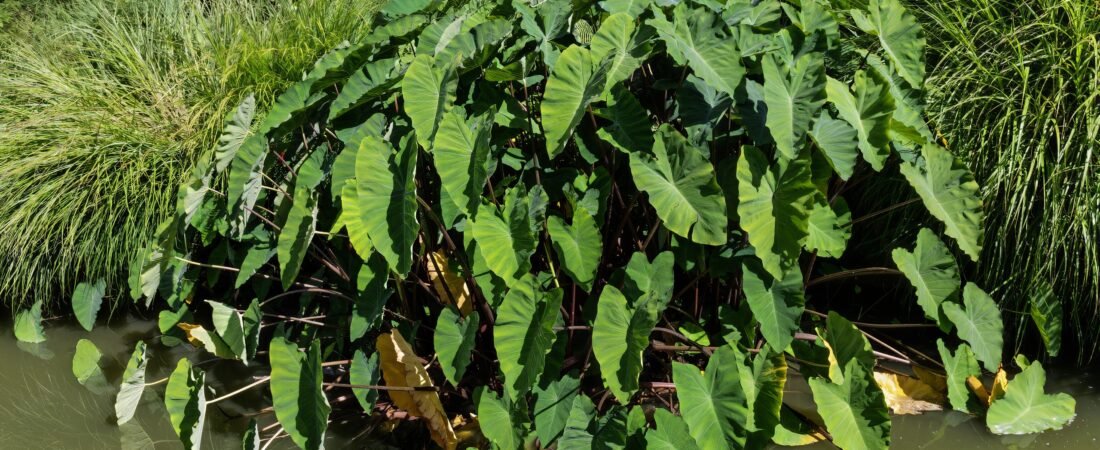
- Large heart-shaped leaves, typically 1–2 feet long, in shades from bright green through deep purple-black depending on the cultivar. The surface has a matte, water-shedding quality — rain beads and rolls straight off, which is the same reason “taro leaf” is a classic umbrella in the tropics.
- The leaves hang downward, tips pointing at the ground. This is the fastest way to tell a Colocasia from an Alocasia, whose leaves point up.
- The petiole attaches inside the leaf blade, not at the notch — botanically the leaf is peltate. Look at the back of a leaf: the stem joins a little way in from the edge, like an umbrella handle. Alocasia petioles join right at the notch.
- Mature size: 3–6 feet tall in ideal conditions; dwarf cultivars stay under 2 feet.
- It grows from a corm — a swollen underground stem — and many forms also send out runners (stolons) that produce new plants a foot or two from the parent.
- Flowers are a pale yellow spathe around a spadix, faintly fragrant, and not the reason anyone grows it.
Popular cultivars, all the same species: ‘Black Magic’ (dusky purple-black), ‘Illustris’ (green with black between the veins), ‘Mojito’ (green splashed with black), ‘Coffee Cups’ (leaves cup upward and hold water), ‘Hawaiian Punch’, ‘Pink China’, ‘Black Coral’.
⚠️ On eating it: Taro is a genuine staple food — poi, dasheen, arbi, taro chips — but only after thorough cooking. Raw, every part contains sharp calcium oxalate crystals that cause intense irritation of the skin, mouth, and throat. Ornamental cultivars aren’t selected for eating. Enjoy yours as a plant.
Where Colocasia esculenta Grows in the Wild
Kew’s Plants of the World Online gives the native range as India to southern China and Sumatra — with the wider core region generally cited as Bangladesh, India, Nepal, Myanmar, Thailand, Malaysia, China, and Taiwan. Taro has been cultivated for so long that the boundary between wild and feral is blurry; genetic work shows cultivated taro is polyphyletic, with separate tropical and temperate lineages both arising in Southeast Asia in the broad sense.
What it’s doing in that range is the useful part:
- It’s an emergent aquatic or semi-aquatic plant. Wild taro grows partially submerged in freshwater wetlands and riparian zones — marshes, the edges of slow-flowing rivers and streams, low-lying ground that floods.
- The climate is warm and humid, tropical to subtropical, with heavy rainfall.
- The soil is saturated, silty, and rich — river-bottom mud with a constant supply of nutrients washing through it.
- Light is open. Wetland margins aren’t shaded by closed forest canopy. Wild taro takes plenty of sun, with water keeping the roots cool.
It’s adaptable enough that it’s now naturalised (and in places invasive) across the southeastern United States, South Africa, and elsewhere — which tells you how forgiving it is once its one non-negotiable is met.
Reading the Habitat: The Translation
| In the wild | What it means at home |
|---|---|
| Emergent aquatic, feet in water | You cannot overwater it in summer. Saucers of water are fine. Ponds are better |
| Wetland margin, open sky | Full sun to part shade outdoors; brightest window indoors |
| Rich river silt, nutrients always flowing | Heavy feeder. Feed generously through the growing season |
| Warm subtropical-to-tropical | 70–85°F for real growth; dormant or dead below 45–50°F |
| Corm plus runners | Spreads; overwinters as a corm in cold climates |
| Naturalised widely | Tough and forgiving — the best beginner elephant ear |
Light
Outdoors: full sun to partial shade. In hot-summer climates, afternoon shade keeps the leaves from bleaching; in cooler ones, give it all the sun you have. Dark-leaved cultivars hold their colour best with more light.
Indoors: the brightest spot you have. A south or west window, or a strong grow light running 12+ hours. In dim light it stretches, the leaves shrink, and it eventually gives up. Taro is genuinely a better patio and garden plant than a houseplant, and it’s fine to treat it that way — summer outside, corm inside for winter.
Water: The Rule That Matters
This is a bog plant. Treat it like one.
- Keep the soil wet — not moist, wet — all through the growing season. In a container, that means watering daily in summer heat, and a saucer that stays full is a feature, not a problem.
- It will grow in standing water. Sink the pot in a pond, a half barrel, or a large pond planter basket with the crown just above the waterline. This is the easiest way to grow it and the way it looks best.
- A self-watering planter is the practical compromise for a patio — big reservoir, constant moisture.
- In winter dormancy, stop. A dormant corm in cold wet soil rots. Dry and cool is the overwintering rule.
The one time “wet” goes wrong is cold: warm and wet is a wetland, cold and wet is rot.
Soil: River Mud, Pot Edition
Taro wants a heavy, rich, water-holding mix — the opposite of what its cliff-dwelling Alocasia relatives need.
Our container mix:
- 3 parts rich potting soil
- 1 part compost or worm castings
- A little coco coir for water retention
Skip the perlite and bark — you’re not trying to drain this one. For pond culture, a heavy loam or an aquatic planting soil topped with gravel to keep it from clouding the water.
Use a big pot — 5 gallons or more for a full-size cultivar. Root room is leaf size.
Humidity and Temperature
Humidity: high is ideal, but outdoors with wet soil this mostly takes care of itself. Indoors, run a humidifier or accept slightly crisper edges.
Temperature: 70–85°F for active growth. Growth slows below 65°F and stops below about 50°F. Frost kills the foliage instantly, though the corm survives if it’s lifted or the ground doesn’t freeze.
Hardiness: reliably perennial in USDA zones 8–11 (some cultivars to 7b with mulch). Elsewhere, treat it like a canna or dahlia — lift and store the corm.
Fertilizer
Wetland silt is a nutrient conveyor belt, and taro is built to use it.
- Balanced liquid fertilizer every 2 weeks at full strength through spring and summer, or
- Slow-release granules worked into the pot at planting, topped up midsummer.
- For pond-grown plants, aquatic fertilizer tabs pushed into the mud every few weeks.
Small, pale leaves on a well-watered taro in good sun is hunger, every time.
Overwintering and Dormancy
In cold climates, the routine is simple and reliable:
- After the first frost blackens the leaves, cut the foliage back to a few inches.
- Lift the corm, brush off soil, and let it dry for a few days.
- Store it somewhere cool (45–55°F), dark, and dry — a paper bag in a garage or basement.
- Pot it up indoors 6–8 weeks before your last frost, or plant straight out once nights are reliably above 55°F.
Container plants in mild climates can simply be moved somewhere frost-free and kept nearly dry until spring.
Propagation
The easiest elephant ear to multiply:
- Runners: many cultivars send out stolons that root a foot or more away. Cut the runner and pot up the new plant once it has a few leaves.
- Corm division: in spring, cut the corm into sections, each with at least one bud, let the cuts dry for a day, and plant.
- Offsets: small cormels form around the parent; twist them off and pot them.
Wear gloves — the sap irritates skin.
Common Problems
- Small leaves, slow growth: underfeeding, too small a pot, or too little light. Usually all three.
- Wilting despite wet soil: unlikely, unless the roots have rotted from cold wet conditions. Check the temperature.
- Wilting in the afternoon sun with damp soil: thirst. This plant drinks more than you expect.
- Brown crispy edges: dry air indoors, or a plant that dried out between waterings.
- Spider mites: on indoor plants in dry air. Treat with neem oil, and get the humidity up.
- Pale washed-out colour on dark cultivars: not enough light.
- Taro spreading where you didn’t plant it: runners. Contain it in a pot if that’s a problem — in warm climates it can naturalise.
Frequently Asked Questions
Is taro toxic to pets? Yes, raw — like all aroids, calcium oxalate crystals cause painful irritation if chewed. Keep it away from curious pets and children.
Colocasia vs Alocasia — which do I have? Leaves that hang down with the stem joining inside the blade: Colocasia. Leaves that point up with the stem joining at the notch: Alocasia.
Can I keep it as a houseplant year-round? You can, in a very bright window with a big pot and constant water, but it will never be what it is outdoors. Most people do better treating it as a summer patio or pond plant.
Does ‘Black Magic’ need different care? No. Same species, same rules. It just holds its colour better in stronger light.
Can I grow it in a pond? Yes — it’s one of the best marginal plants there is. Crown at or just above the waterline.
Quick-Start Gear Checklist
- 🪴 Large pot or pond planter basket
- 🌱 Potting soil + compost
- 💧 Self-watering planter
- 🌿 Balanced fertilizer or slow-release granules
- 🧤 Gardening gloves
- 🐛 Neem oil
Keep Reading
- Colocasia Care 101 — the genus overview
- Alocasia Macrorrhizos Care — Giant Taro, the upright cousin it’s always confused with
- Colocasia Gigantea Care — the one elephant ear that doesn’t want wet feet
Taro is the elephant ear for people who worry about overwatering — you almost can’t. Warm, wet, fed, and in the sun, it will out-grow everything else on the patio. Happy growing, from all of us at BloomBabe. 🌱