
Disclosure: This post contains affiliate links. If you buy through them, BloomBabe may earn a small commission at no extra cost to you. As an Amazon Associate, I earn from qualifying purchases. We only recommend gear we’d use on our own plants.
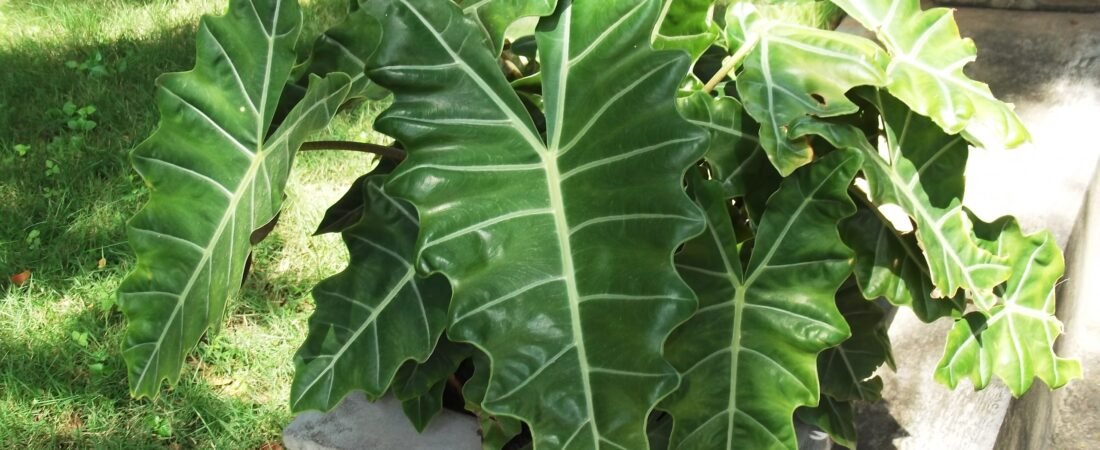
The Kris Plant is named after a weapon. The kalis — anglicised as kris — is a Southeast Asian sword with a wavy, flame-shaped blade, and one look at the deeply scalloped edge of an Alocasia sanderiana leaf tells you exactly how it earned the name.
It’s also the plant behind one of the hobby’s most persistent mix-ups. There’s a very good chance the “Alocasia sanderiana” on your shelf is actually a hybrid called Polly. We’ll sort that out, then get into what the real species needs — which is genuinely different from what its Bornean cousins want, because A. sanderiana comes from damp low-elevation ravines in Northern Mindanao, not a mountain or a cliff.
Meet the Kris Plant
Botanical name: Alocasia sanderiana
Also called: Kris Plant, Sander’s Alocasia, Kris Alocasia
What it looks like:
- Leaves are sagittate — arrow-shaped — ranging from oblong-ovate to broadly lanceolate-ovate, roughly 12–16 inches long by 6–8 inches wide on a mature plant.
- Colour is deep, glossy dark green to nearly blackish-green, marked with broad white to yellowish veins, and a matching pale band running right around the leaf edge.
- The undersides are reddish to purple.
- The margins are the signature: deeply undulate to sub-pinnatifid — waving in and out so strongly that the leaf edge looks cut. That’s the kris blade.
- Venation: three to four primary veins arranged opposite one another, with secondary veins branching off at wide angles.
- Habit: a tropical perennial around 2 feet tall, holding its leaves distinctly upright, usually just one to a few at a time, with papery cataphylls (dried sheaths) between them. Those papery remnants are normal and not a disease.
The Polly problem
Most plants sold in garden centres as “Alocasia sanderiana” are not the species. They’re Alocasia × amazonica ‘Polly’ — a compact nursery hybrid that has A. sanderiana somewhere in its ancestry and looks like a smaller, tidier version of it.
How to tell them apart:
- Size: Polly stays around 12–18 inches with leaves to roughly 8 inches. True sanderiana is bigger and more elongated.
- Leaf shape: Polly’s blade is broader and more triangular; sanderiana is narrower and more distinctly arrow-shaped.
- Margins: sanderiana‘s scalloping is deeper and more pronounced.
- Price and availability: true A. sanderiana is uncommon and priced accordingly. If it was inexpensive on an endcap, it’s Polly.
None of this is a problem — Polly is a lovely, tougher plant, and we have a whole guide to it. Just know which one you’re caring for.
Where Alocasia sanderiana Grows in the Wild
A. sanderiana is endemic to Northern Mindanao in the Philippines, recorded from Misamis Occidental and Bukidnon provinces.
Its habitat, specifically:
- On the forest floor and in damp ravines, in both primary and secondary forest.
- At low elevation — this is a lowland plant, like A. zebrina and unlike the montane A. cuprea. No cool-night requirement; a steady warm tropical temperature is what it knows.
- Deep shade under canopy, in a sheltered ravine where air is still, humid, and cool relative to open ground.
- Root zone: rich, constantly moist forest-floor humus, in a landform where water drains downhill and keeps moving rather than pooling.
And a serious conservation note. The IUCN lists Alocasia sanderiana as Critically Endangered in the wild. Harvesting wild specimens in the Philippines is illegal, with penalties of six to ten years’ imprisonment and fines of ₱100,000 to ₱1,000,000.
This one matters more than the usual boilerplate: a Critically Endangered species with a tiny range is exactly the kind of plant that wild collection can finish off. Buy tissue-cultured or nursery-divided stock, from sellers who can say where it came from. There is no acceptable “wild collected” sanderiana.
Reading the Habitat: The Translation
| In the wild | What it means at home |
|---|---|
| Damp ravine, low elevation | Steady warmth, 65–82°F. No cool-night trick; no cold tolerance either |
| Sheltered ravine floor | Still, humid air. It hates drafts and dry heat more than most Alocasia |
| Rich forest-floor humus | A more organic mix than the cliff-dwelling species want |
| Sloped ravine, water always moving | Evenly moist, but free-draining. Never a saucer of standing water |
| Deep canopy shade | Bright indirect light only |
| Holds few leaves, sheds old ones | Papery cataphylls and a low leaf count are normal |
Light
Bright, indirect light. An east-facing window is close to perfect; a north-facing one works if it’s unobstructed; a south or west window needs a sheer curtain or several feet of distance.
Direct sun scorches the dark blades and washes out the white venation that’s the whole point of the plant. Too little light, and the petioles stretch and the leaves come in smaller with weaker markings.
Supplement with a full spectrum grow light if your best window still isn’t much.
Water
A ravine floor is moist essentially all the time — but it’s a slope, so water keeps moving through.
- Keep it evenly moist, watering when the top inch is dry. This species is less drought-forgiving than the corm-heavy cliff Alocasias.
- Never let it sit in water. Water thoroughly, drain fully, empty the saucer.
- Never let it dry out completely either — a bone-dry sanderiana drops leaves quickly and sulks for months.
- Reduce in winter, but don’t let it go arid.
That narrow band between “moist” and “wet” is where a soil moisture meter earns its keep.
Hard water shows up on this plant as brown speckling along the pale veins. Distilled or filtered water fixes it.
Soil: Forest-Floor Humus, Not Cliff Rubble
Because it’s a ravine-floor plant rather than a lithophyte, A. sanderiana wants a more organic mix than A. reginula or A. cuprea — but still one that drains freely.
Our Kris Plant mix:
- 2 parts quality aroid potting mix or good potting soil
- 1 part orchid bark
- 1 part perlite
- A scoop of worm castings for the humus fraction
- A handful of horticultural charcoal
Use a pot with drainage holes, sized so the root ball is snug rather than swimming.
Humidity and Temperature
Humidity: 60–80%. A sheltered ravine is one of the most humid places in a tropical forest, and this plant is built for it. Below 50%, expect crisping edges and spider mites. Run a humidifier nearby and check it with a hygrometer.
Temperature: 65–82°F, and above 60°F at all times. Unlike A. cuprea, it has no use for a cold night — steady lowland warmth is what it evolved with.
Draft sensitivity is high. Ravines are still places. A Kris Plant near a door, an AC vent, or a rattling winter window will keep dropping leaves for reasons that look mysterious until you notice the airflow.
Fertilizer
Feed a balanced liquid houseplant fertilizer at half strength every 3–4 weeks in spring and summer. Nothing in winter.
A humus-rich forest floor is fertile but gentle — steady low-level nutrition, not spikes. Flush the pot with plain water every couple of months to prevent salt buildup.
Repotting and Dormancy
Repot every 1–2 years in spring, one size up. Handle the roots gently; this species resents disturbance and often sulks for a few weeks after.
Like other Alocasia, it can go dormant in low light and cool temperatures, dropping leaves entirely. Keep the mix just barely damp, hold it warm, stop feeding, and wait for spring. Check the rhizome is firm if you need proof of life.
Propagation
Division of offsets, in spring:
- Unpot and rinse enough soil away to see the base.
- Identify pups — small plantlets with their own roots — attached at the rhizome.
- Separate cleanly, with as many roots intact as possible.
- Pot into small containers of the same mix; keep warm, humid, and out of direct light.
Cover the new divisions with a clear bag or dome for the first couple of weeks to hold humidity while they establish. Rooting hormone on cut surfaces is optional.
Common Problems
- Leaf drop after a move: almost always drafts or a humidity crash. Both are common right after bringing a plant home.
- Brown crispy margins: low humidity, or hard-water minerals.
- Yellow leaves with wet mix: overwatering; check for root rot.
- Yellow leaves with bone-dry mix: it went too dry. This species punishes that harder than most.
- Faded venation, small new leaves: more light needed.
- Spider mites and thrips: both love Alocasia. Inspect leaf undersides regularly and treat early with neem oil.
- Papery brown sheaths at the base: cataphylls. Completely normal — pull them off when they’re fully dry if you like the look tidier.
Frequently Asked Questions
Is the Kris Plant toxic to pets? Yes. Insoluble calcium oxalate crystals cause severe mouth and throat irritation if chewed. Keep away from cats, dogs, and children.
How do I know if mine is really A. sanderiana? Size and leaf shape are the giveaways — true sanderiana is larger, narrower, more deeply scalloped. If it was cheap and compact, it’s almost certainly Alocasia × amazonica ‘Polly’.
Is it endangered — should I not buy one? The wild population is Critically Endangered. Cultivated plants are a different matter entirely, and buying nursery-propagated stock doesn’t harm wild populations. Just never buy wild-collected material.
Why does mine only hold two or three leaves? That’s the growth pattern for the species — it sheds an old leaf for each new one. Steady turnover is health.
Can it live in a greenhouse cabinet? Yes, and it does very well — the humidity suits it, and cabinets are naturally draft-free.
Quick-Start Gear Checklist
- 🪴 Aroid mix + orchid bark + perlite
- 🌱 Worm castings
- 💧 Moisture meter
- 💦 Humidifier + hygrometer
- 🌿 Balanced fertilizer
- 🐛 Neem oil
Keep Reading
- Alocasia Care 101 — the genus overview
- Alocasia Polly Care Guide — the hybrid you may actually own
- Alocasia Zebrina Care — the other Philippine lowlander
Warm, still, humid, evenly moist, out of the sun — that’s a Mindanao ravine, and that’s a happy Kris Plant. Get the drafts away from it and most of the drama stops. Happy growing, from all of us at BloomBabe. 🌱