Disclosure: This post contains affiliate links. If you buy through them, BloomBabe may earn a small commission at no extra cost to you. As an Amazon Associate, I earn from qualifying purchases. We only recommend gear we’d use on our own plants.
Aloe is the plant almost everyone’s grandmother kept on a windowsill, and there’s a reason it never went out of style. It asks for very little, it looks sculptural in a plain clay pot, and when you nick your hand on the oven rack, the fix is growing three feet away.
It’s also, quietly, one of the most commonly killed houseplants — not from neglect, but from kindness. Aloe is a succulent from dry, rocky places, and nearly everything that goes wrong traces back to too much water, too little light, or a pot that holds both. Get those three right and an aloe will sit happily in the same corner for a decade, sending up pups the whole time.
Meet the Plant
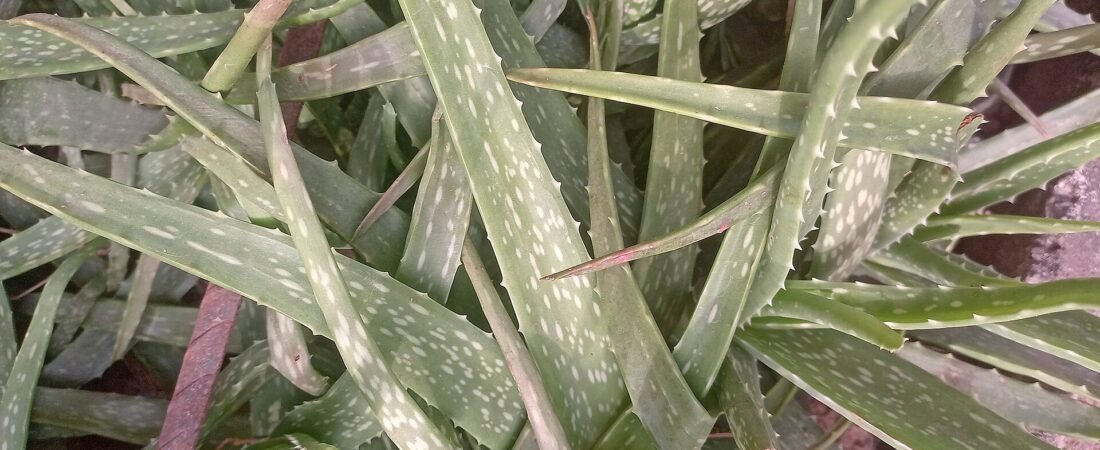
Aloe vera (Aloe barbadensis miller) grows in a rosette — thick, tapered leaves spiraling out from a central base, edged with soft teeth that look sharper than they are. Cut one open and it’s full of clear gel, which is the part everyone’s after.
“Aloe” at the garden center covers a lot of ground, so it’s worth knowing what you’re buying:
- Aloe vera is the medicinal one — grayish-green, upright, leaves that can reach a foot or more indoors.
- Aloe aristata (lace aloe) is small, dark, and covered in white bumps. Charming, not medicinal.
- Aloe juvenna (tiger tooth) stays tiny and stacks its leaves like a tower.
If you specifically want the gel, check the label for Aloe barbadensis. And if the white speckles on your young plant fade as it grows, nothing’s wrong — that happens with age.
Light
This is where most indoor aloes go wrong, and the symptom is easy to misread.
Aloe wants bright light — the brightest spot you have. A south or west window, right up against the glass. Six or more hours of sun is ideal; several hours of direct sun is fine and encourages that compact, chunky rosette shape.
An under-lit aloe doesn’t die dramatically. It stretches — leaves grow thin, pale, and floppy, leaning toward the window instead of standing up. People read the flopping as a watering problem and give it more water, which is exactly the wrong move. Floppy plus pale means more light. Floppy plus mushy means stop watering immediately.
If your brightest window still isn’t much, a LED grow light running eight to ten hours a day genuinely fixes this.
One caution: moving an aloe outdoors for summer should happen gradually, over a week or two. Going from a dim room to full patio sun in one afternoon burns the leaves reddish-brown and papery.
Water
The rule: soak it thoroughly, then let it dry out completely, then wait a little longer.
In practice that’s roughly every two to three weeks in spring and summer, and as little as once a month — sometimes less — in winter. But don’t run on a calendar. Stick a finger two inches into the soil, and if you feel any moisture at all, come back in a week. A soil moisture meter takes the argument out of it, especially in a deep pot where the surface lies to you.
When you do water, water properly: run it through until it drains freely out the bottom, then dump the saucer. Aloe hates sitting in a puddle more than it hates being dry.
Reading the leaves:
- Thin, curling, slightly wrinkled leaves — thirsty. Water it. This is a totally normal, fully reversible state.
- Soft, squishy, water-logged leaves, often yellowing near the base — overwatered. Stop. Let it dry.
- A base that’s brown and mushy, and leaves pulling away at a touch — root rot. Act now (see Common Problems).
An underwatered aloe is a mild inconvenience. An overwatered one is an emergency. When you’re genuinely unsure, wait.
Soil
Regular potting soil holds far too much water for an aloe. Use a fast-draining cactus and succulent soil, which is built to drain in seconds rather than minutes.
We push it further and cut that mix with a couple of big handfuls of perlite or coarse pumice — roughly two parts mix to one part grit. It’s almost impossible to make aloe soil too fast-draining.
The pot matters as much as what’s in it. Drainage hole, always — a decorative pot with no hole is a slow-motion root rot machine. Terracotta is our default because the porous clay pulls moisture out of the soil between waterings. If you’re a chronic overwaterer, it’ll quietly cover for you.
Go slightly small on size, too. A big pot holds a big volume of wet soil that a small root system can’t drink through fast enough.
Fertilizer
Aloe barely eats. In its native ground it grows in gravel.
Feed once or twice total across spring and summer, using a succulent and cactus fertilizer diluted to half the label strength. Skip fall and winter entirely — the plant isn’t growing, and unused salts just build up in the soil.
Over-fertilizing shows up as soft, oddly fast growth or brown tips from salt burn. Flush the pot with plain water a few times and stop feeding for the season.
Temperature & Humidity
Easy plant, easy range. 55–80°F covers it, which is most homes most of the year.
Aloe is not frost-hardy. Below about 50°F it starts to suffer, and a freeze will turn it to mush overnight — so if yours summers outdoors, bring it in well before the first cold night.
Humidity is a non-issue. Aloe prefers dry air and dislikes damp, still conditions — it’s one of the very few houseplants where the answer to “should I get a humidifier?” is no. Just don’t crowd it against a wall.
Repotting
Repot every two to three years, or sooner if pups have filled the pot or roots are coming out the drainage hole.
Spring is the best time. The method:
- Let the soil dry out fully first — a dry root ball slides out clean and breaks less.
- Brush the old soil off so you can see the roots. Healthy ones are firm and pale; brown, stringy, or smelly roots get cut off.
- Move up one pot size. Only one.
- Pot it in fresh gritty mix, and here’s the part people skip: don’t water for about a week. Roots nicked in the process need time to callus over, and watering into fresh wounds is how repotting turns into rot.
Garden gloves help — the leaf edges are more scratchy than sharp, but a mature aloe is heavier and more awkward than it looks.
Propagation
Aloe propagates by pups — baby plants that appear around the base of a happy adult. It’s the easiest propagation in the houseplant world, and unlike many plants, aloe does not root from a leaf cutting. A cut leaf just rots. Pups are the only route.
- Wait until a pup is a few inches tall with three or four of its own leaves.
- Unpot the whole plant so you can see where the pup connects.
- Separate it with clean pruning shears, taking as many of the pup’s own roots as you can. A rootless pup still works, just slower.
- Let the cut surface callus for one to two days on a paper towel. Don’t skip this.
- Pot in dry cactus mix, wait about a week, then water normally.
One mature aloe keeps producing pups for years. It’s the plant you end up giving away.
Common Problems
Mushy base, leaves falling away, sour smell. Root rot. Unpot it right now, cut away every soft root and any rotted stem tissue with sterile shears, let the whole plant air-dry for a day or two, and repot in dry, fast-draining mix. If the crown is still firm, there’s a real chance. If the base is gone, take healthy pups and start over.
Brown, papery, or reddish leaves. Usually sunburn from a sudden light change, occasionally cold damage. Move it to gentler light; damaged tissue won’t turn green again, but new growth comes in normal.
Brown, crispy tips. Often underwatering, sometimes salt buildup or hard tap water. Water more deeply, less often, and flush the pot occasionally.
Thin, stretched, leaning leaves. Not enough light. Move it, or add a grow light.
Bugs. Aloe is fairly pest-resistant, but mealybugs love the tight crevices where leaves meet the base — check there. Dab them off with a cotton swab dipped in alcohol, then treat with neem oil. Scale shows up as small brown bumps; same treatment, more patience.
Frequently Asked Questions
Can I use the gel straight from the plant? For minor skin stuff, yes — cut an outer leaf near the base, stand it upright for ten minutes to let the yellow latex drain (that’s the part that irritates skin and upsets stomachs), then rinse, peel, and use the clear gel. Fresh gel doesn’t keep; refrigerate what’s left and use it within about a week. Please don’t eat it or use it on anything serious without talking to an actual professional — we grow plants, we don’t give medical advice.
Is aloe toxic to pets? Yes. The ASPCA lists aloe as toxic to cats and dogs — the latex can cause vomiting and lethargy. Put it somewhere they can’t reach, which is usually easy since it wants a high, bright windowsill anyway.
Why is my aloe turning red or purple? Stress coloring, usually from intense sun or drought. Some growers chase it on purpose. If the plant is otherwise firm and growing, it’s fine.
Will it flower indoors? Rarely. Aloe blooms on a tall stalk of tubular orange flowers, but it needs to be mature, root-snug, and getting outdoor-level light. A bonus, not a goal.
How do I fix a leggy, floppy aloe? Light first. If it’s badly stretched, behead the rosette, let the cut callus for several days, and root the top in dry mix. The stump often pushes out new pups, so you end up with more plants than you started with.
Quick-Start Gear Checklist
- 🏺 Terracotta pot with a drainage hole
- 🪴 Cactus & succulent soil + perlite or pumice
- 💧 Soil moisture meter
- ☀️ LED grow light for dim rooms
- 🌿 Succulent fertilizer
- ✂️ Pruning shears for pups
- 🧤 Garden gloves
- 🐛 Neem oil
Put your aloe in the sunniest window in the house, in a clay pot full of grit, and then mostly leave it alone. That’s the whole guide. It’ll reward you with pups to give away and a leaf to snap open the next time you burn yourself on a sheet pan — which, if our kitchen is any indication, will be Tuesday. Happy growing, from all of us at BloomBabe. 🌱