
Disclosure: This post contains affiliate links. If you buy through them, BloomBabe may earn a small commission at no extra cost to you. As an Amazon Associate, I earn from qualifying purchases. We only recommend gear we’d use on our own plants.
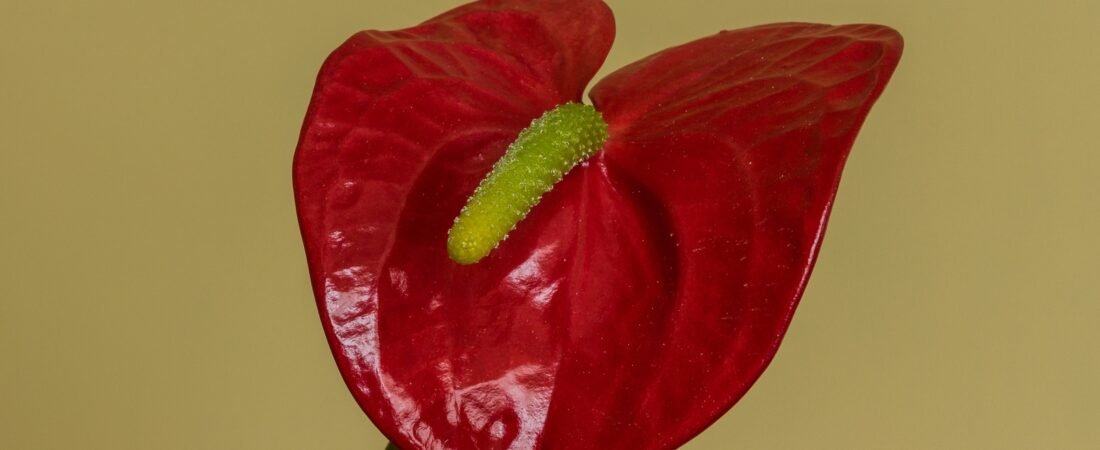
This is the anthurium everyone has seen — the glossy heart-shaped leaves, the waxy red “flower” with the yellow spike, sitting in a foil-wrapped pot at the supermarket. Flamingo Flower. It’s so familiar that people forget it’s a real species from a real place.
It is. Anthurium andraeanum grows wild as an understorey epiphyte in the wet forests of the Andean foothills, from northern Ecuador into southern Colombia, at 400–1,200 m. Almost every red, pink, white, or black flamingo flower in the trade descends from it. And the reason so many of them decline on a windowsill is the same reason the collector species do: nobody told the owner it’s a rainforest epiphyte.
Treat it like one and it blooms for years.
Meet the Flamingo Flower
Botanical name: Anthurium andraeanum
Also called: Flamingo Flower, Flamingo Lily, Painter’s Palette, Oilcloth Flower, Laceleaf, Tailflower, Red Anthurium
What it looks like:
- Leaves: glossy, leathery, heart-shaped (cordate), 8–12 inches long on a mature plant, deep green, held on long petioles. Simple and handsome, not velvet or ribbed.
- The “flower”: what looks like a single waxy petal is actually a spathe — a modified leaf — surrounding a spadix, the pencil-like spike that carries the actual tiny flowers. On the wild species the spathe is scarlet-red with a puckered, lacquered surface and the spadix is yellow to cream, ageing green.
- Cultivars now come in white, pink, salmon, purple, green, near-black, and bicolours, in sizes from 6-inch minis to 3-foot cut-flower plants. Many are hybrids with A. scherzerianum and others. Same care.
- Habit: a slowly elongating stem that produces leaves and flower stalks in alternation, with aerial roots along its length. Mature plants reach 12–24 inches indoors.
- Flowers last for weeks — often 6–8 — which is why it’s the world’s most popular flowering aroid.
Where the name comes from: discovered in Colombia in 1876 by the French botanist Édouard André, who described it and lent it his name.
Where Anthurium andraeanum Grows in the Wild
The species is native to Colombia and Ecuador, specifically the wet forests at approximately 400–1,200 m elevation in northern Ecuador and southern Colombia — the western foothills and lower slopes of the Andes, on the Pacific-influenced side, where rain is constant.
Its habitat:
- Humid, shaded rainforest understorey. It grows as an epiphyte on tree trunks and low branches, and sometimes terrestrially in deep leaf litter at the base of trees.
- Constant moisture without waterlogging — roots in moss and debris on bark, drenched daily and drained immediately.
- High humidity, typically 70–90%, with mist and rain most days.
- Warm, mild temperatures — the foothill belt runs roughly 65–80°F with modest night cooling and no cold season.
- Filtered light — bright under a tall canopy, but never direct.
The florist’s plant is a lot tougher than the collector species, because it’s been bred for shelf life. But its bones are still those of an Andean-foothill epiphyte.
Reading the Habitat: The Translation
| In the wild | What it means at home |
|---|---|
| Epiphyte on trunks and in litter | Chunky, airy mix — not the dense peat it’s usually sold in |
| Daily rain, instant drainage | Evenly moist, never soggy; empty the saucer every time |
| 70–90% humidity | 50%+ keeps it happy; below 40% browns the edges |
| Filtered understorey light | Bright indirect — enough light to bloom, never direct sun |
| Warm foothills, no cold season | 65–80°F; stalls below 60°F |
| Blooms year-round in the wild | Feed lightly but consistently; light is the bloom trigger |
Light
Bright, indirect light — and this is the most common reason a flamingo flower stops flowering. In a dim corner it lives, but it won’t bloom.
- Best: an east window; a couple of feet from a south or west window; behind a sheer curtain.
- Direct sun scorches the leaves and bleaches the spathes.
- Not enough light: no flowers, long petioles, small leaves. Move it brighter or add a grow light.
Water
Wet, then drained — a trunk after rain.
- Water when the top inch of mix is dry. Thoroughly, until it runs through; then drain completely and empty the saucer.
- Don’t let it dry out fully — the leaves droop and the flowers fade early.
- Don’t keep it wet — root rot is the classic supermarket-anthurium death, usually because it’s sitting in a decorative pot with no drainage.
- Slightly less in winter.
Use filtered or distilled water if your tap is hard; brown leaf tips are the usual tell.
A soil moisture meter is a cheap fix for the “is it dry yet?” problem.
Substrate: Get It Out of the Peat
Supermarket anthuriums come in dense peat that stays wet for weeks. It’s the single biggest thing working against the plant. Repot into something airy once it’s settled in.
Our flamingo flower mix:
- 2 parts orchid bark
- 1 part perlite
- 1 part quality aroid mix or coco coir
- A handful of sphagnum and horticultural charcoal
A pot with drainage holes — if you like the decorative cachepot, keep the plant in a nursery pot inside it and lift it out to water.
Humidity and Temperature
Humidity: 50%+ ideal. The florist strain tolerates ordinary room air far better than the velvet species, but below about 40% the leaf edges brown and flowers are shorter-lived. A humidifier nearby, a pebble tray, or grouping with other plants all help. A bathroom with a bright window is a genuinely good home.
Temperature: 65–80°F. Andean foothills, no cold season. Below 60°F it stalls; below 50°F it’s damaged. Keep it away from drafts, AC vents, and radiators — all three kill flowers early.
Fertilizer: The Bloom Question
Consistent, light feeding through the growing season keeps it flowering.
- Balanced liquid fertilizer at half strength every 3–4 weeks from spring to early autumn.
- Some growers switch to a bloom-formula fertilizer (higher phosphorus) in spring; it can help, but light is the real trigger.
- Nothing in winter. Flush the mix every couple of months.
If it won’t bloom: it’s almost always light. Then check that it isn’t root-bound in exhausted peat, and that the temperature hasn’t dropped.
Repotting
Every 2 years, in spring, one size up, into fresh chunky mix. Trim any black, mushy roots. If the stem has grown tall and bare with aerial roots along it, you can bury the lower portion — it’ll root along the buried stem and the plant will look full again.
Propagation
The easiest anthurium to multiply:
- Division: mature plants develop multiple crowns. At repotting, tease them apart with roots and pot separately.
- Stem cuttings: cut a section of stem with at least one node and an aerial root; root it in damp sphagnum or chunky mix, warm and humid. Weeks to root.
- Seed: possible if you hand-pollinate, but slow and the offspring vary. Division is faster.
Common Problems
- No flowers: not enough light. Nine times out of ten.
- Brown leaf tips: low humidity or mineral buildup.
- Yellowing leaves, wet peat: root rot from the nursery mix and a drainless pot. Repot into chunky mix.
- Green spathes: normal ageing — spathes fade to green as they mature. Cut them off at the base once they look tired.
- Pale, bleached leaves: direct sun.
- Drooping with dry mix: thirst. Water; it recovers in hours.
- Aphids on new flower stalks, mealybugs in leaf axils, spider mites in dry air: treat with neem oil.
Frequently Asked Questions
Is the Flamingo Flower toxic to pets? Yes — like all aroids, calcium oxalate crystals cause painful mouth irritation if chewed. Keep it away from cats, dogs, and children.
Is the red part the flower? No — it’s the spathe, a modified leaf. The actual flowers are tiny and cover the yellow spadix.
How do I get it to bloom again after the supermarket flowers fade? Bright indirect light, a repot into chunky mix, steady watering, and light feeding. New flowers typically follow within a few months.
Why are the new “flowers” green instead of red? Usually low light. Sometimes it’s just an ageing spathe. Brighter light fixes the former.
Can I keep it in the bathroom? If the bathroom has a bright window, it’s one of the best rooms in the house for it.
Quick-Start Gear Checklist
- 🪴 Orchid bark + perlite + aroid mix
- 🏺 Pot with drainage
- 💧 Moisture meter
- 💦 Humidifier or pebble tray
- 🌿 Balanced fertilizer
- 🐛 Neem oil
Keep Reading
- Anthurium Care 101 — the genus overview
- Anthurium Clarinervium Care — the velvet-leaf species, if you want to go deeper
- Peace Lily Care 101 — the other flowering aroid everyone owns
Bright filtered light, an airy mix, water that drains, and a bit of humidity — that’s an Andean foothill trunk, and that’s a Flamingo Flower that keeps blooming long after the supermarket ones have been thrown away. Happy growing, from all of us at BloomBabe. 🌱