
Disclosure: This post contains affiliate links. If you buy through them, BloomBabe may earn a small commission at no extra cost to you. As an Amazon Associate, I earn from qualifying purchases. We only recommend gear we’d use on our own plants.
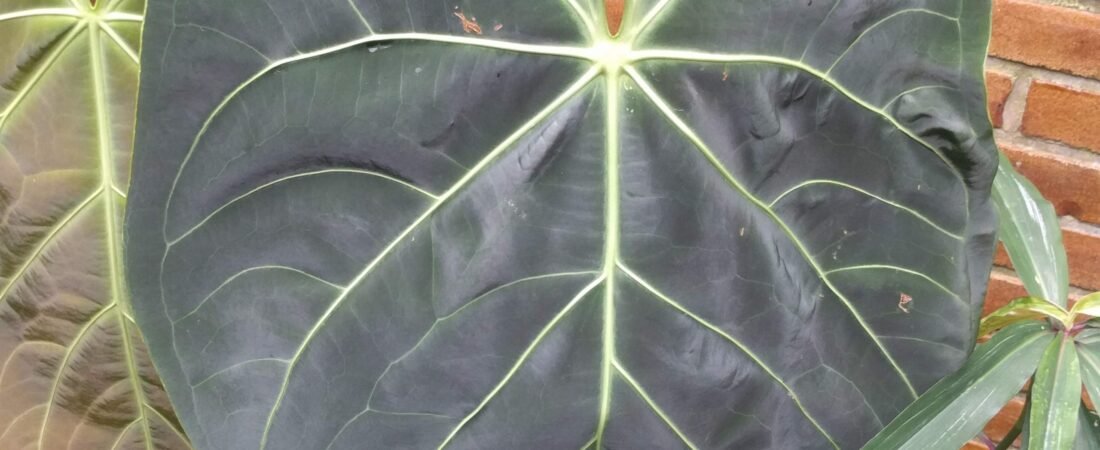
Of all the velvet-leaf anthuriums, Anthurium regale is the one that stops people in a greenhouse. The leaves are enormous — heart-shaped, matte, dark, and drawn through with pale veins — and on a mature plant a single blade can be four feet long. It’s the species collectors mean when they say “the big one.”
Unlike the Queen and King, which hang from Colombian trees, the Regal is terrestrial. It grows on the forest floor of the Huallaga River valley in northern Peru, on the eastern flank of the Andes, in deep leaf litter, in steady humidity, at temperatures that stay mild all year. That difference — floor, not trunk — changes how you pot it, and it’s why regale is more forgiving in a mix than its epiphytic cousins.
Meet the Regal Anthurium
Botanical name: Anthurium regale
Also called: Regal Anthurium, Royal Anthurium, Velvet Anthurium
What it looks like:
- Huge, heart-shaped (cordate) leaves with deep, rounded basal lobes. On a young plant, 8–12 inches; on a mature one, 2–4 feet long, held out and slightly downward on long, stout petioles.
- Texture: thick, velvety, matte, with a subtle sheen — the nap is softer and the blade is more substantial than crystallinum’s, though not as stiff as clarinervium’s.
- Colour: deep olive-green to blackish-green, with pale silver-white primary veins that fan out from the midrib and branch cleanly to the margin. The venation is bold but fine-lined.
- Petioles are the ID clue: distinctly sharp-edged and quadrangular in cross-section — run a finger along one and you’ll feel the corners. Most look-alikes have round or only slightly ridged petioles.
- Undersides: paler, matte, with the veins in relief.
- Habit: a short, thick, upright stem producing one huge leaf at a time. Mature plants indoors reach 3–5 feet across — plan for it.
- Flowers: a greenish spathe with a slender spadix. Modest.
Look-alikes: A. magnificum (Colombian; similar quadrangular petioles but generally smaller, rounder leaves), A. crystallinum (smaller, thinner, angular but not sharply four-sided petioles), and various magnificum × regale hybrids that circulate as “regale.” True regale has the largest, most elongated heart and the sharpest petiole edges.
Where Anthurium regale Grows in the Wild
A. regale is a Peruvian species. It’s recorded from the Huallaga River valley in the departments of Huánuco and San Martín, roughly north of Tingo María and Juanjuí — the humid eastern slopes where the Andes drop toward the Amazon basin.
Its ecology:
- Terrestrial. It grows on the forest floor and lower slopes in deep, spongy leaf litter over well-drained ground — not on trees.
- Elevation: sources disagree more than usual here. Some place it low, near the valley floor; others put it at 500–1,000 m along the cool Andean edge. Either way, it’s a plant of the humid foothill forest, not the hot lowland Amazon proper.
- Humidity: consistently high, with reports that it’s found where ambient humidity rarely drops.
- Temperature: notably mild and stable — commonly cited as staying between about 15°C and 27°C (59–80°F) year-round. No heat spikes, no cold snaps.
- Light: dappled, filtered understorey light, under a tall canopy.
The combination — floor-dwelling, mild, humid, evenly moist — is why regale is often called the most “forgiving” of the giant velvet anthuriums. It isn’t easy, but it isn’t hanging off a cloud-forest trunk either.
Reading the Habitat: The Translation
| In the wild | What it means at home |
|---|---|
| Terrestrial in deep leaf litter | Chunky but organic mix — tolerates more coir/moss than the epiphytes |
| Well-drained foothill floor | Evenly moist, never waterlogged; drainage still matters |
| Humidity consistently high | 65–80% target; a humidifier or cabinet while young |
| 59–80°F, stable | Mild and even. Avoid heat above 85°F and drafts below 55°F |
| Huge leaves, one at a time | Space — it grows wide, not tall. Slow; don’t push it |
| Filtered understorey light | Bright indirect; no direct sun on the velvet |
Light
Bright, indirect. Under a tall Peruvian canopy, the floor gets plenty of filtered light all day.
- Best: an east window; a few feet back from a south or west one; a cabinet with a light on top.
- Direct sun burns the velvet and leaves permanent pale patches.
- Too dim and the leaves come in smaller and paler, and the plant crawls.
A full spectrum grow light on a timer for 10–12 hours makes a real difference to leaf size.
Water
Leaf litter on a foothill floor: damp all the time, draining always.
- Water when the top inch is dry. Thoroughly, until it runs out; then drain completely.
- Keep it evenly moist — regale dislikes drying out fully; the big leaves droop and the margins crisp.
- Never waterlogged. Even a terrestrial anthurium rots in stagnant mix.
- Slightly less in winter.
Distilled, rain, or filtered water is worth it for a plant this valuable — mineral buildup shows as brown speckling along the pale veins, which is exactly where you don’t want it. A moisture meter helps in a big pot.
Substrate: Forest Floor
Because regale is terrestrial, it takes a more organic, moisture-holding mix than the Queen or King — but it still needs air at the roots.
Our regale mix:
- 2 parts orchid bark
- 2 parts coco coir or quality aroid mix
- 1 part sphagnum moss, chopped
- 1 part perlite or pumice
- A handful of horticultural charcoal and a scoop of worm castings for the litter fraction
A wide, stable pot with drainage — regale gets top-heavy as the leaves grow, and a narrow pot will tip.
Humidity and Temperature
Humidity: 65–80%. High, but regale tolerates a little less than the Queen — those thick leaves lose water slowly. Young plants do best in a greenhouse cabinet; mature plants outgrow cabinets and usually move to a bright room with a humidifier running beside them. A hygrometer tells you where you actually are.
Temperature: 60–80°F, and steady. This is the plant’s defining preference. A Huallaga valley forest floor barely changes temperature from month to month, and regale reacts to swings — heat above 85°F stalls it; drafts below 55°F damage the leaves. Pick a spot away from vents, doors, and hot glass, and leave it there.
Airflow in a cabinet: a small fan, as always.
Fertilizer
Moderate and steady — a leaf-litter floor is fertile but gentle.
Balanced liquid fertilizer at half strength every 2–3 weeks through spring and summer; monthly in winter. Flush every couple of months. A plant building four-foot leaves needs consistent nutrition, but a heavy dose burns the roots and browns the vein edges.
Repotting
Every 1–2 years, in spring, one size up, into fresh mix. The roots are thick and brittle — go gently. Because the plant gets wide rather than tall, choose a wide, heavy pot over a deep one, and expect the leaves to need clear space on every side. A mature regale is furniture.
Propagation
Slow, and mostly for patient growers:
- Stem cuttings: on a plant with a visible stem, cut below a node with an aerial root; root in damp sphagnum under high humidity. Months.
- Division: occasional on old plants with multiple crowns.
- Seed: hand-pollinate two flowering plants; the berries yield seed that germinates readily on damp sphagnum. It’s how most regale in cultivation were produced, and it’s the reason so many “regale” are actually hybrids — parents get mixed.
Common Problems
- Brown speckling along the veins: mineral buildup or over-feeding. Switch to distilled water; flush the mix.
- Crispy margins: humidity too low, or it dried out.
- New leaf torn or stuck: humidity dipped during unfurling.
- Yellowing, black roots: waterlogged mix. Rebuild with more bark.
- Stalled for months: temperature swings, or a recent repot. Give it stability and time.
- Small new leaves after big ones: root problems, or not enough light. Check both.
- Spider mites, thrips: velvet magnets. Weekly checks, neem oil at first sign.
Frequently Asked Questions
Is Anthurium regale toxic to pets? Yes — calcium oxalate crystals, like all aroids. Keep it from being chewed.
Regale or magnificum — which do I have? Feel the petiole. Sharply four-cornered, on a plant with a large, elongated heart: regale. Rounder leaf, less sharply ridged petiole, smaller overall: magnificum. Many plants sold as regale are hybrids between the two; they’re beautiful and grow the same way.
How big will it get indoors? Leaves of 2–3 feet within a few years under good conditions, on a plant 3–5 feet wide. Plan the space before you buy.
Does it need a cabinet? While small, a cabinet gives it the best start. Once it outgrows one, a bright room with a humidifier works well — regale is one of the more room-tolerant giants.
Is it terrestrial or epiphytic? Terrestrial — it grows on the forest floor in Peru. That’s why it takes a richer, more organic mix than the Queen or King.
Quick-Start Gear Checklist
- 🪴 Orchid bark + coco coir + perlite
- 🏺 Wide pot with drainage
- 💦 Humidifier + hygrometer
- 💡 Grow light
- 💧 Moisture meter
- 🐛 Neem oil
Keep Reading
- Anthurium Care 101 — the genus overview
- Anthurium Warocqueanum Care — the Queen, and how an epiphyte differs
- Anthurium Crystallinum Care — the smaller velvet species to start with
A rich, airy forest-floor mix, steady mild warmth, humid air, filtered light, and room to spread — that’s a Huallaga valley understorey, and that’s a Regal Anthurium that will eventually hand you a leaf the size of a doormat. Happy growing, from all of us at BloomBabe. 🌱