
Disclosure: This post contains affiliate links. If you buy through them, BloomBabe may earn a small commission at no extra cost to you. As an Amazon Associate, I earn from qualifying purchases. We only recommend gear we’d use on our own plants.
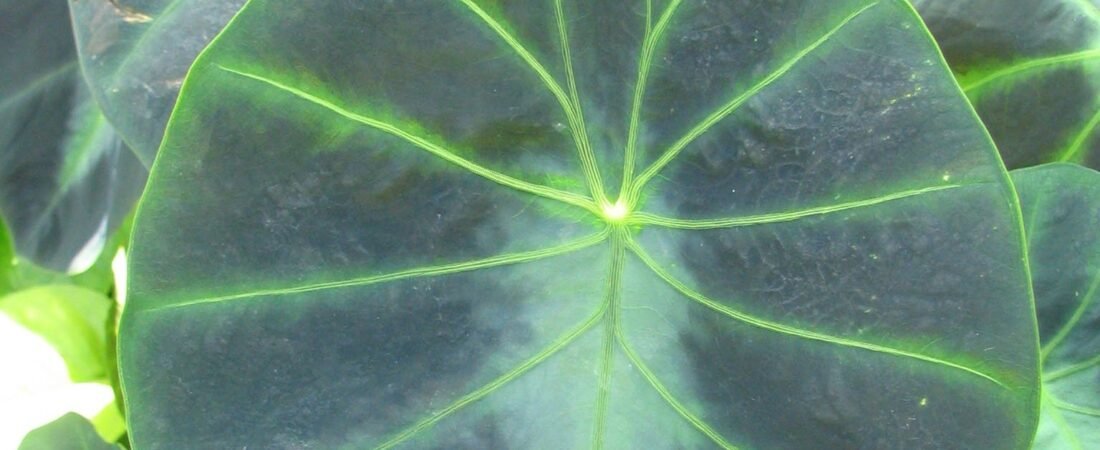
If Silver Dollar is the bright, spreading groundcover of the dwarf elephant ears, Colocasia affinis is its moody sibling. The selection everyone grows — ‘Jenningsii’ — has small, arrow-shaped leaves in a velvety charcoal-black, each one lit by a single silver-grey blaze down the centre. It looks like something that should be difficult and expensive. It’s neither.
It’s native to the eastern Himalaya, where it grows in swampy ground — which puts it, for water, closer to taro than to its stream-bank cousin C. fallax. And it goes into a deep, genuine winter dormancy that catches new growers off guard every single autumn. Both of those come straight from home.
Meet Jennings’ Dwarf Elephant Ear
Botanical name: Colocasia affinis
Also called: Jennings’ Dwarf Elephant Ear, ‘Jenningsii’, East-Himalayan Decorated Taro, Dwarf Taro, Black Dwarf Elephant Ear
What it looks like:
- Small, arrow-shaped leaves, 6–10 inches long — more pointed and sagittate than the rounded hearts of C. fallax.
- The colour: on ‘Jenningsii’, a lustrous, velvety charcoal to blackish-green, with the primary veins darker still, and a silver-grey central blotch that lights the leaf from within. Even the straight species carries a pale central zone; ‘Jenningsii’ just makes it theatrical.
- The nap: the leaf surface has a soft, velvet sheen, not the matte water-shedding finish of taro.
- Mature height: around 18 inches, forming a compact clump that spreads slowly.
- Growth habit: a tuberous geophyte. It produces a small tuber and, in a good season, offsets around it. It’s less of a runner than C. fallax.
- Leaves droop downward, the petiole joining inside the blade — a true Colocasia.
- Flowers: small, pale spathes, seldom noticed under the foliage.
Where Colocasia affinis Grows in the Wild
Kew records the native range as Assam, Bangladesh, the Eastern Himalaya, India, Myanmar, Nepal, and south-central China. The common name “East-Himalayan Decorated Taro” is a literal description.
Its habitat: swampy areas — wet, low-lying ground in the foothills, in the humid, monsoon-driven subtropical belt that runs along the southern flank of the Himalaya.
That places it in an interesting middle ground:
- Water: like taro, it’s a plant of saturated ground. Its roots are used to a lot of moisture — more than C. fallax, which prefers a draining bank.
- Light: the foothills are forested, so it grows in filtered light and light shade, not open marsh sun.
- Seasons: it’s subtropical Himalayan, so it lives through a warm wet summer and a cooler, drier winter — which is why it has such a decisive dormancy.
- Soil: rich, organic, silty, and constantly moist.
Reading the Habitat: The Translation
| In the wild | What it means at home |
|---|---|
| Swampy ground | Keep it wet in summer. More water than fallax; a full saucer is fine |
| Forested foothills | Light shade — it burns in full sun, fades in deep shade |
| Subtropical seasonal cycle | Real dormancy. It dies back completely and returns — don’t discard it |
| Rich silty wetland soil | Organic, moisture-holding mix; moderate feeding |
| Compact tuberous clump | Ideal container plant; doesn’t run everywhere |
| Foothills, cool winters | Reasonably cold-tolerant; zones 8–10 in the ground, tuber-stored elsewhere |
Light
Light shade to part shade. Morning sun with afternoon shade, or bright dappled light all day.
Full sun bleaches the velvet finish to a dull grey and scorches the edges. Deep shade leaves it lanky and the leaves lose their depth of colour — the charcoal turns to a flat dark green. The silver centre is at its brightest in that middle band of good filtered light.
Indoors, a bright east window is close to right; a grow light on a timer through winter keeps it from stretching if it stays awake.
Water: Think Swamp, Not Stream
This is the one dwarf Colocasia you can water like a taro.
- Keep the soil consistently wet through the growing season. Water before the surface dries. In hot weather that’s daily in a container.
- A saucer that stays full is fine in summer. It will also grow happily at the edge of a pond or bog garden with the crown at the waterline.
- A self-watering pot suits it perfectly.
- In dormancy, the opposite: nearly dry. A dormant tuber in cold wet soil rots.
Warm and wet is a Himalayan monsoon. Cold and wet is a dead tuber. Same soil, different season.
Soil: Wetland Silt
Rich and moisture-retentive. This isn’t a drainage-first plant.
Our mix:
- 3 parts quality potting soil
- 1 part compost or worm castings
- A little coco coir for water-holding
Skip the perlite. For bog or pond-edge planting, a heavy loam or aquatic planting soil works well.
A modest pot — 2–3 gallons — suits its size, and it still needs a drainage hole so you can dry it down properly in autumn.
Humidity and Temperature
Humidity: high preferred. Those velvet leaves crisp at the margins in dry indoor air; a humidifier nearby is worth it if you grow it inside.
Temperature: 65–80°F for growth. It’s foothill-adapted, so it copes with cooler nights than taro does. Foliage dies at frost; the tuber is hardy in zones 8–10 in the ground with mulch, and worth trying in 7b.
Fertilizer
Moderate — it’s a small plant.
Balanced liquid fertilizer at half strength every 3 weeks through spring and summer. Nothing from the first sign of autumn slowdown until it re-emerges.
Dormancy: The Part That Alarms Everyone
Every autumn, C. affinis does something that looks like dying. Leaves yellow, the plant collapses, and within a couple of weeks there’s nothing above the soil. This is normal. It’s an eastern Himalayan plant reacting to shorter days and cooler nights exactly the way it does at home.
- In the ground, zones 8–10: cut back the dead foliage, mulch 3–4 inches deep, and wait. It re-emerges in late spring, sometimes not until early summer.
- In pots: move the pot somewhere cool and frost-free and let it go nearly dry. Or lift the tuber after the foliage dies, dry it a few days, and store it cool and dry in paper. Pot up in spring.
- Indoors: it often goes dormant anyway, even in a warm room, because day length drops. Reduce water and wait; don’t try to force it awake.
The tuber is small — don’t lose it in the pot. Mark where it is.
Propagation
- Offsets / tuber division: in spring, as growth begins, lift the clump and separate any small tubers with buds. Pot each into wet mix.
- Occasionally it produces short runners that root nearby; treat those the same way.
Gloves on — the sap contains calcium oxalate and irritates skin.
Common Problems
- Complete collapse in autumn: dormancy, not death. See above.
- Faded grey leaves, crisp edges: too much sun, or too little humidity.
- Flat dark-green leaves, stretched petioles: too little light.
- Wilting with dry soil: it dried out. It hates that in a way taro doesn’t.
- Tuber rot in winter: stored wet, or overwintered in a cold wet pot. Dry it down in autumn.
- Slugs and snails: they find velvet leaves delicious. Handpick, or use a pet-safe bait.
- Spider mites indoors: treat with neem oil and raise humidity.
Frequently Asked Questions
Is Colocasia affinis toxic to pets? Yes — calcium oxalate crystals, like all aroids. Painful if chewed. Keep it out of reach.
Is it the same as Colocasia fallax? No — a different species with a different look and different water needs. C. fallax has rounded leaves, a silver wash, and likes a draining stream bank. C. affinis ‘Jenningsii’ has arrow-shaped velvet-black leaves and likes swampy ground. Both are Himalayan dwarfs, and both go dormant.
Why is it called ‘Jenningsii’? It’s an old horticultural selection that circulated for well over a century under names like Alocasia jenningsii and Colocasia ‘Jenningsii’ before botanists placed it under C. affinis. The cultivar name stuck.
Did I kill it? There’s nothing in the pot. Almost certainly not. Tip the pot out gently in spring and look for a small firm tuber. Repot it and wait.
Can I grow it indoors year-round? You can keep it as a houseplant, but expect a winter rest regardless. It’s happiest as a summer container plant with a stored tuber.
Quick-Start Gear Checklist
- 🪴 Self-watering pot
- 🌱 Potting soil + compost + coco coir
- 💦 Humidifier
- 💡 Grow light
- 🌿 Balanced fertilizer
- 🐛 Neem oil
Keep Reading
- Colocasia Care 101 — the genus overview
- Colocasia Fallax Care — the other Himalayan dwarf, silver and spreading
- Alocasia Black Velvet Care — for the same velvet-black look with the opposite watering rule
Wet summer, dry winter, dappled light, and a bit of faith when it vanishes in October — that’s an eastern Himalayan swamp, and that’s a Jennings’ Dwarf that comes back darker every year. Happy growing, from all of us at BloomBabe. 🌱