
Disclosure: This post contains affiliate links. If you buy through them, BloomBabe may earn a small commission at no extra cost to you. As an Amazon Associate, I earn from qualifying purchases. We only recommend gear we’d use on our own plants.
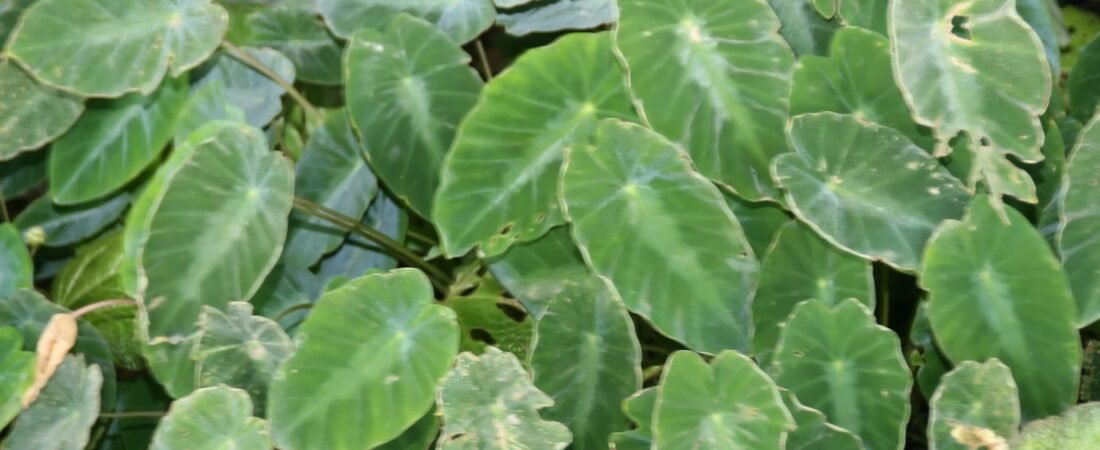
Not every elephant ear wants to be eight feet tall. Colocasia fallax stays knee-high, spreads into a soft groundcover of rounded leaves, and carries a silver wash down the centre of each one that catches light in a shady bed. The popular selection ‘Silver Dollar’ turns that silver up to full volume.
It’s also the toughest plant in this whole series, and the reason is where it comes from: not the steamy lowlands, but the foothills of the Himalaya, along moist stream banks in forests from Uttarakhand to Yunnan, where winters are genuinely cool. That origin is why it’s the Colocasia most likely to come back in your garden year after year — and why it’s happy in a shadier, cooler spot than any taro.
Meet Silver Dollar
Botanical name: Colocasia fallax
Also called: Silver Dollar (the cultivar ‘Silver Dollar’), Dwarf Elephant Ear, Silver Leaf Dwarf Elephant Ear, Silver Dollar Taro, Himalayan Dwarf Taro
What it looks like:
- Small, rounded, heart-shaped leaves, typically 6–10 inches long — noticeably more circular than the elongated hearts of taro. Rich mid-green, with a matte finish.
- The silver: narrow silver veins and a broad silver blotch running down the centre of the blade. On ‘Silver Dollar’, that central wash is wide and bright enough to read from across a garden; on the straight species it’s subtler.
- Petioles are a warm cinnamon-brown on ‘Silver Dollar’, which sets off the silver nicely.
- Mature height: 12–18 inches, spreading wider than tall.
- Growth habit: a tuberous geophyte — it grows from a small tuber and spreads by runners, gradually forming a colony. In a good spot it makes a genuine groundcover.
- Flowers are small, yellowish spathes tucked among the leaves, faintly fragrant, and easy to miss.
- Leaves hang downward and the petiole joins inside the blade — the Colocasia signature.
Where Colocasia fallax Grows in the Wild
The native range, per Kew, runs from Uttarakhand (in the Indian Himalaya) east through Nepal, Tibet, and Yunnan in southwest China, and south into mainland Southeast Asia.
Its habitat:
- Dense forests, valley scrub, and moist stream banks — shaded ground with constant moisture nearby, but on banks rather than in the water itself.
- The subtropical biome, in the Himalayan foothills — warm, humid, monsoon-fed summers followed by cool, drier winters. This is a plant that experiences a real seasonal cycle, unlike taro in the equatorial lowlands.
- Rich forest soil under canopy, with heavy leaf litter, that stays moist but drains downhill.
- Filtered light through the forest, not open sun.
That cool-winter origin is the whole personality of the plant. It goes properly dormant, it tolerates chill, and it’s rated hardy in USDA zones 8–10 — with reports of it returning from zone 7b under mulch.
Reading the Habitat: The Translation
| In the wild | What it means at home |
|---|---|
| Himalayan foothills, cool winters | Hardiest Colocasia you can buy. Zones 8–10 in the ground; overwinter as a tuber elsewhere |
| Dense forest, stream bank | Shade to part shade. The one elephant ear that prefers less sun |
| Moist bank, not in the water | Consistently moist, well-drained. Not a pond plant |
| Runners, colony-forming | Spreads into a groundcover. Give it room, or contain it |
| Subtropical seasonal cycle | Expect a full dormancy — it dies to the ground and returns |
| Small stature, dwarf | Perfect for containers, front-of-border, and under taller plants |
Light
Shade to part shade — and this is where C. fallax is the odd one out among Colocasias. Taro wants sun; Silver Dollar comes from a forest floor.
- Outdoors: dappled shade, or morning sun with afternoon shade. In deep shade it still grows, just slower and with slightly less silver. In hot afternoon sun the leaves scorch and fade.
- Indoors: a bright east window or a spot near (not in) a south or west one. It’s one of the better elephant ears for indoor life precisely because it doesn’t demand blazing light — a small LED grow light helps through winter.
Water
A stream bank is moist all the time, but it drains — water runs past the roots, not around them.
- Keep the soil evenly moist through the growing season. Water when the top inch is dry.
- Don’t let it dry out fully — the small leaves wilt fast and the plant sulks.
- Don’t keep it waterlogged either. Unlike taro, it will rot in standing water.
- In dormancy, keep it barely damp if in a pot, or leave it alone if in the ground.
A soil moisture meter is handy; the leaves are less dramatic about thirst than the giants.
Soil: Forest Floor by a Stream
Rich, organic, moisture-holding but free-draining.
Our mix:
- 2 parts quality potting soil
- 1 part compost or worm castings — the leaf-litter fraction
- 1 part perlite for drainage
In the garden, plant in a bed enriched with compost, and top with a bark mulch to keep the surface moist and cool the way leaf litter would.
Use a wide, shallow pot rather than a deep one — it spreads sideways.
Humidity and Temperature
Humidity: enjoys it, as all elephant ears do, but tolerates ordinary garden air well. Indoors in winter, a humidifier keeps the edges from crisping.
Temperature: 60–80°F for growth, and — the important part — tolerant of cool weather in a way no other Colocasia in this series is. It shrugs off nights in the 40s, goes dormant with frost, and returns from the tuber in spring in zones 8–10 (and often 7b with a deep mulch).
Foliage still dies at the first hard frost. That’s normal; the plant is underground and fine.
Fertilizer
Moderate. It’s a small plant and it doesn’t want to be pushed.
Balanced liquid fertilizer at half strength every 3–4 weeks in spring and summer, or a light application of slow-release granules in spring. Nothing in dormancy.
Dormancy and Overwintering
This species goes fully dormant — it’s built for a Himalayan winter — and that’s not a problem to solve, just a cycle to respect.
- In zones 8–10 (and often 7b): leave it in the ground. Cut back the dead foliage after frost and pile on 3–4 inches of mulch. It returns in late spring, often later than you’d expect — be patient into May or June.
- Colder zones: lift the tubers after frost, let them dry a few days, store cool and dry, and replant in spring. Or bring the whole pot into a cool garage and keep it nearly dry.
- Indoors: it may slow down or drop leaves in winter without going fully dormant. Reduce water and wait.
Propagation
The easiest of the lot, because it does it for you:
- Runners: the colony spreads by stolons. Dig up a rooted offset with a few leaves and replant. Do this in spring or early summer.
- Tuber division: in spring, lift and split the clump, each section with a bud and some roots.
A colony that’s happy will need thinning every couple of years — free plants for the rest of the bed.
Common Problems
- Scorched, faded leaves: too much direct sun. Move it into shade.
- Wilting with dry soil: it dried out. Small leaves, small buffer.
- Rot with wet soil: standing water, or a cold wet winter in a pot. Improve drainage.
- Slow to emerge in spring: normal. This species wakes late — give it until early summer before assuming loss.
- Spreading beyond its bed: runners. Edge it, or grow it in a container.
- Slugs and snails: they love the tender leaves in a shady, moist bed. Handpick or use a pet-safe slug bait.
- Spider mites indoors: treat with neem oil and raise humidity.
Frequently Asked Questions
Is Colocasia fallax toxic to pets? Yes — calcium oxalate crystals, like all aroids. Keep it from being chewed.
‘Silver Dollar’ vs the species — what’s the difference? ‘Silver Dollar’ is a selected cultivar with a much wider, brighter silver centre and cinnamon petioles. The straight species is greener with narrow silver veining. Care is identical.
Will it survive winter in my garden? Zones 8–10, yes, reliably. Zone 7b, usually, with heavy mulch. Colder than that, lift the tubers.
Can I grow it indoors year-round? Yes, and it’s one of the better elephant ears for it — modest size, modest light needs. Give it a bright window and reasonable humidity.
How fast does it spread? In a good spot, a single plant can fill a square yard in two or three seasons. It’s a groundcover, not a thug — easy to edit.
Quick-Start Gear Checklist
- 🪴 Wide pot with drainage
- 🌱 Potting soil + compost + perlite
- 🍂 Bark mulch
- 💧 Moisture meter
- 🌿 Balanced fertilizer
- 🐌 Pet-safe slug bait
Keep Reading
- Colocasia Care 101 — the genus overview
- Colocasia Affinis Care — the other Himalayan dwarf, with velvet charcoal leaves
- Colocasia Esculenta Care — full-size taro
Shade, moisture, rich soil, and a real winter rest — that’s a Himalayan stream bank, and that’s why Silver Dollar is the elephant ear that keeps coming back. Happy growing, from all of us at BloomBabe. 🌱