
Disclosure: This post contains affiliate links. If you buy through them, BloomBabe may earn a small commission at no extra cost to you. As an Amazon Associate, I earn from qualifying purchases. We only recommend gear we’d use on our own plants.
If you want the biggest leaf you can legally grow in a suburban garden, this is it. Thailand Giant produces pale, powdery, blue-green leaves the size of a dining table, on a plant that can top eight feet in a single season from a corm the size of a fist.
It’s sold as Colocasia gigantea, and that’s the name you’ll find it under everywhere. But botanists have recently moved it into its own genus — it’s now formally Leucocasia gigantea — and that reclassification isn’t just paperwork. It reflects the fact that this plant lives differently from true taro. Taro grows in the water. Thailand Giant grows on moist, well-drained, limestone-influenced slopes in valley forests, and treating it like a bog plant is how people rot it.
Meet Thailand Giant
Botanical name: Leucocasia gigantea (widely sold and still commonly listed as Colocasia gigantea)
Also called: Thailand Giant, Giant Elephant Ear, Indian Taro, Laos Giant, Giant Colocasia, Thai Giant Elephant Ear
What it looks like:
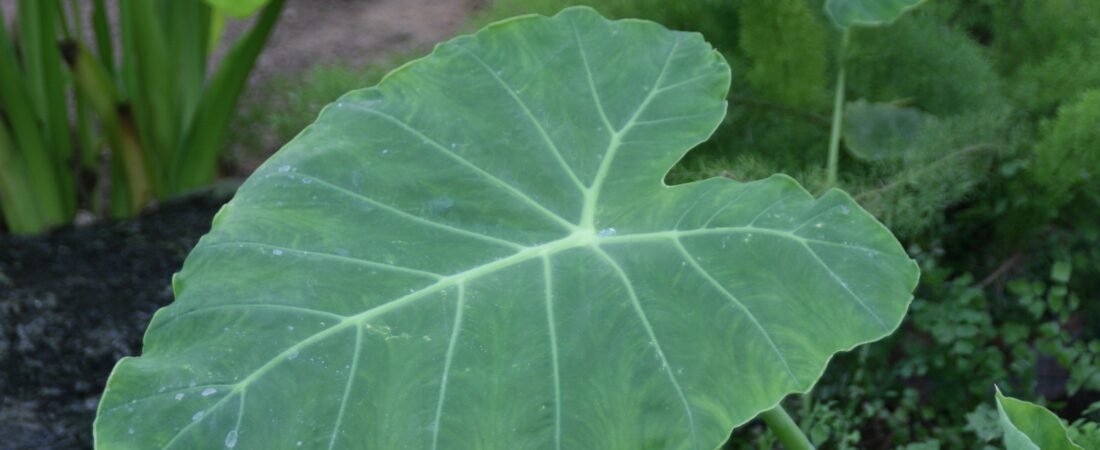
- Leaves are huge — 4–5 feet long on a mature plant, sometimes larger — and unlike taro they’re a soft, glaucous grey-green, with a powdery bloom that gives them a matte, almost chalky finish.
- The blade is broadly heart-shaped and slightly wavy, carried more horizontally than taro’s downward droop, on thick, pale, upright petioles.
- Mature height: 6–9 feet, occasionally more in tropical ground; 4–6 feet in a large container.
- Flowers are actually worth noticing. Clusters of large, creamy-white spathes appear in summer and are pleasantly fragrant — unusual in this family.
- It grows from a corm but is not stoloniferous: it doesn’t run and spread the way taro does. It builds one large clump.
‘Thailand Giant Strain’ is the cultivar name you’ll most often see, selected for maximum size. Same species.
A regional food note: in Thailand and across Indochina, the peeled, sliced petioles are cooked into soups and curries. Like every aroid, the raw plant contains calcium oxalate crystals — it’s a vegetable only after proper preparation. Keep the houseplant as a houseplant.
Where Leucocasia gigantea Grows in the Wild
The native range runs from southern China and Indochina to western Malesia — recorded from southern China, Bangladesh, Myanmar, Laos, Cambodia, Vietnam, Malaysia, and Indonesia.
Its habitat is the key, and it’s not a wetland:
- Lower mountain regions, at elevations up to about 700 m in southern China and up to 1,000 m across its range.
- Shady, moist sites — but in valley forests, often limestone-associated, on ground that is described in the Chinese flora as moist but well-drained.
- Sheltered valley bottoms and slopes: humid, protected from wind, with dappled to bright filtered light rather than full open sun.
- Substrate: organically rich forest soil over limestone — mineral-rich, calcium-rich, and, again, draining.
Contrast that with true taro’s marshes and river margins and you can see why the taxonomists split them, and why the care differs.
Reading the Habitat: The Translation
| In the wild | What it means at home |
|---|---|
| Moist but well-drained valley slope | Consistently moist, never waterlogged. No standing water, no pond |
| Limestone-influenced soil | Neutral to slightly alkaline is fine; a little garden lime doesn’t hurt |
| Shaded, sheltered valley | Part shade outdoors; wind protection matters — those leaves shred |
| Lower montane, up to ~1,000 m | Warm days, tolerates cooler nights than taro; still frost-tender |
| Rich forest soil | Heavy feeder — feed it like the giant it is |
| Single large clump, no runners | Give it one big pot and let it build |
Light
Part shade to bright filtered light. This is a valley-forest plant, not a marsh plant in open sun.
Outdoors, morning sun and afternoon shade is close to ideal, or dappled light under high trees all day. In full hot afternoon sun the huge leaves scorch and wilt dramatically, even with wet soil — the leaf simply can’t move water fast enough.
Indoors, it’s an enormous plant for a house, but in a bright room away from direct glass, with a strong grow light if the winter is dark, it’ll hold on. Realistically, most people grow it as a summer statement plant and overwinter the corm.
Water: Moist, Not Wet
This is the line that separates Thailand Giant from taro, so it’s worth being precise.
- Keep the soil evenly moist through the growing season. Water when the top inch or two is dry — in summer heat with leaves that size, that may be daily in a container.
- Do not let it sit in water. No full saucer, no pond basket. The corm rots in stagnant conditions that taro would shrug off.
- Drainage is non-negotiable. A pot with good drainage holes and a mix that lets excess through.
- Nearly dry in dormancy.
A soil moisture meter for a container this big is genuinely useful — surface dryness tells you little about a 10-gallon pot.
Soil: Limestone Valley Floor
Rich, structured, draining. Something between taro’s river mud and an Alocasia’s gritty rubble.
Our mix:
- 3 parts quality potting soil
- 1 part compost or worm castings
- 1 part perlite or coarse bark for drainage
- Optional: a small handful of garden lime, a nod to its limestone home — especially if your potting mix or water is on the acidic side
Pot size: big. 10 gallons or more for a full-size plant. Leaf size tracks root room directly.
Humidity, Temperature, and Wind
Humidity: high preferred, as with all elephant ears, but outdoors in a sheltered spot with moist soil it’s rarely a limiting factor.
Temperature: 65–85°F for active growth. It handles cooler nights than taro — it comes from lower mountain valleys, after all — but it is not frost-hardy. Foliage dies at the first frost. Reliably perennial in zones 8b–11 with mulch; treat as a lift-and-store plant elsewhere.
Wind is the one people forget. A sheltered valley has no wind, and a 5-foot leaf on a 4-foot stem is a sail. In an exposed spot, leaves tear, petioles snap, and the plant looks ragged all season. Plant it against a wall, a fence, or a hedge, out of the prevailing wind, and it stays magnificent.
Fertilizer
Feed generously. It’s building a leaf the size of a table every few weeks.
- Balanced liquid fertilizer every 2 weeks at full strength through the season, or
- Slow-release granules at planting, topped up in midsummer.
- Stop as growth slows in autumn.
Overwintering and Dormancy
Same routine as taro, with one difference — this corm is more rot-prone, so dry is the priority:
- After frost blackens the leaves, cut the stems back to a few inches.
- Lift the corm, brush it clean, and let it cure somewhere airy for a week.
- Store cool (45–55°F), dark, and dry — dry peat, sawdust, or a paper bag.
- Pot up in spring, indoors, 6–8 weeks before last frost, and plant out once nights are above 55°F.
In containers in mild climates, move it somewhere frost-free and let it go nearly dry.
Propagation
- Corm division in spring: cut into sections, each with a growing point, let the cuts dry a day or two, and plant shallowly in moist mix.
- Offsets, when they form around the base — less freely than taro, but they do appear on mature plants.
- Seed, if your plant flowers and sets fruit — slow, but it’s how the ‘Thailand Giant’ strain was originally selected.
Gloves on. Sap irritates.
Common Problems
- Corm rot / collapse: overwatering or cold wet soil. The number-one killer of this species, precisely because people treat it like taro.
- Torn, shredded leaves: wind. Move it or shelter it.
- Scorched patches, dramatic midday wilt: too much direct sun.
- Small leaves: underfeeding, small pot, or a plant that was potted up too late in the season.
- Yellowing lower leaves, one at a time: normal shedding as new leaves open.
- Spider mites, aphids: occasional. Hose off, treat with neem oil if persistent.
Frequently Asked Questions
Is Thailand Giant toxic to pets? Yes, raw — calcium oxalate crystals, like every aroid. Keep pets and children from chewing it and wear gloves when cutting.
Is it really not a Colocasia? Botanically it’s now Leucocasia gigantea, a genus of one. Commercially it will be sold as Colocasia gigantea for years yet. Same plant either way.
Can I grow it in a pond like taro? No — that’s the one thing it won’t tolerate. Moist and draining, always.
How big will it really get? In a 10-gallon pot, fed and sheltered: 5–6 feet with leaves 3–4 feet long in a single season. In warm ground with years to establish: 8 feet plus.
Why did it rot in storage? Stored damp. The corm must be cured and kept dry over winter.
Quick-Start Gear Checklist
- 🪴 Very large pot with drainage
- 🌱 Potting soil + compost + perlite
- 💧 Soil moisture meter
- 🌿 Slow-release fertilizer
- 🧤 Gardening gloves
- 🐛 Neem oil
Keep Reading
- Colocasia Care 101 — the genus overview
- Colocasia Esculenta Care — true taro, the one that does want wet feet
- Alocasia Macrorrhizos Care — the other giant
Sheltered, part-shaded, moist but never soggy, and fed like a giant — that’s a valley slope in Laos, and that’s a Thailand Giant that will make your neighbours stop and stare. Happy growing, from all of us at BloomBabe. 🌱