Disclosure: This post contains affiliate links. If you buy through them, BloomBabe may earn a small commission at no extra cost to you. As an Amazon Associate, I earn from qualifying purchases. We only recommend gear we’d use on our own plants.
There’s a moment every plant person hits where the little pots on the windowsill stop feeling like enough and you want presence — something with a trunk, something that fills the empty corner by the sofa. That’s the Rubber Plant’s whole job. Big paddle leaves, a glossy finish that looks almost fake, and a growth habit that will take it to the ceiling if you let it.
Its reputation for drama is only half-earned. Rubber Plants aren’t fussy so much as opinionated. Get the light and watering rhythm right, stop moving it around, and it’s one of the easiest big statement plants you can own.
Meet the Rubber Plant
The Rubber Plant (Ficus elastica) is a tropical tree from South and Southeast Asia, where it grows enormous — 100 feet and up in the wild, with aerial roots dropping from the branches. Indoors it stays a very manageable 6–10 feet, and you can keep it much shorter with pruning.
It’s a fig, which puts it in the same family as the Fiddle Leaf Fig and the Weeping Fig. Good news: it’s noticeably more forgiving than either of those cousins.
The varieties you’ll actually find at the shop:
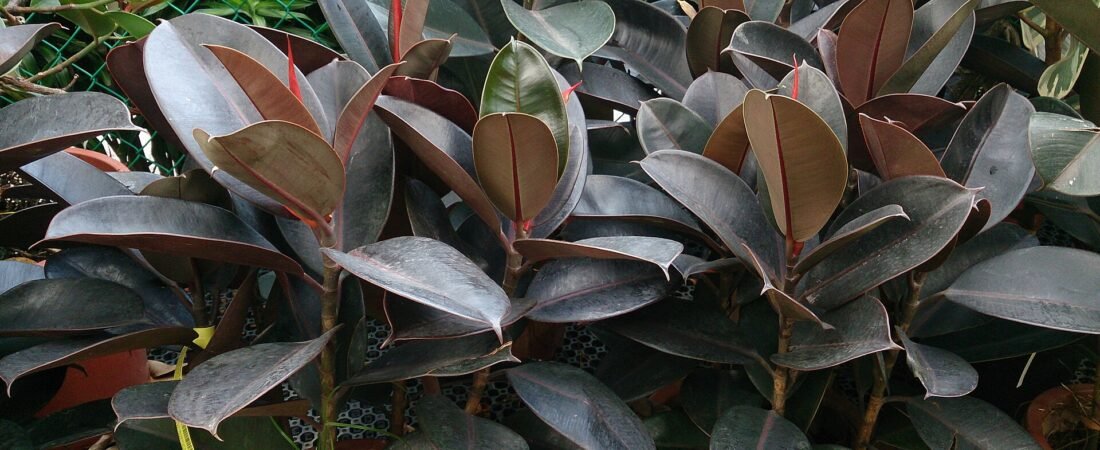
- Burgundy (or ‘Abidjan’) — near-black leaves with deep red new growth and a pink midrib. The most popular by a mile.
- Robusta — plain deep green, wide leaves, the sturdiest and most forgiving of the bunch.
- Tineke — creamy white and green variegation with pink stems. Stunning, and needs more light than the green types.
- Ruby — pink, cream, and green all at once. Gorgeous, slowest growing, most light-hungry.
One thing to know before you buy: the milky white sap is a latex-based irritant. It’s sticky, it stains fabric, and it can irritate skin. Wear gloves when you prune and keep a rag handy.
Light
Bright, indirect light. That’s the sweet spot, and it’s not negotiable if you want tight, full growth.
- Ideal: a few feet back from an east-facing window, or near a south or west window filtered by a sheer curtain.
- Tolerates: medium light, with slower growth and more space between leaves.
- Variegated types (Tineke, Ruby) need noticeably more light than green ones. In dim conditions the white and pink sections fade out, and since those parts can’t photosynthesize, low light hits them twice as hard.
- Avoid: hours of unfiltered direct sun on the leaves, which scorches pale patches on the surface.
The classic sign your Rubber Plant wants more light is a stretched, leggy stem with big gaps between leaves, all of them leaning one direction. If your best window is genuinely dim — north-facing, or blocked by a building — a full spectrum LED grow light on a timer makes a real difference, especially for the variegated ones.
Rotate the pot a quarter turn every couple of weeks so it grows straight instead of reaching.
Water
This is where most Rubber Plants die, and it’s almost always too much water rather than too little.
The rule: let the top 1–2 inches of soil dry out completely, then water thoroughly until it runs out the drainage hole. Dump whatever collects in the saucer. Never let the pot sit in standing water.
In practice that’s roughly every 7–10 days in spring and summer, and every 2–3 weeks in winter when growth slows. But don’t run on a calendar — the same plant needs wildly different amounts depending on the season, your heating, and how much light it’s getting. Stick a finger in the soil, or use a soil moisture meter if you’d rather not guess.
Reading the leaves:
- Yellow leaves, usually starting at the bottom, soft to the touch — overwatered. Back off and check the roots.
- Drooping, curling, slightly limp leaves that perk back up after a drink — thirsty.
- Brown crispy edges — underwatered, or the air is very dry.
Rubber Plants can be sensitive to fluoride and salts in tap water, which shows up as brown leaf tips over time. If you’re seeing that and your watering is otherwise dialed in, try leaving water out overnight or switching to filtered.
Soil
A well-draining, chunky mix. Straight bagged potting soil holds too much water for a plant this prone to root rot.
Our go-to blend is about two parts indoor potting mix to one part perlite, plus a handful of orchid bark for structure. That gives roots air pockets to breathe in and lets water move through instead of sitting.
The pot matters as much as the mix. Drainage hole, always. A terracotta pot breathes and helps the soil dry evenly, which is a nice safety net if you tend to overwater. Plastic or glazed ceramic works fine too — you’ll just water less often.
Fertilizer
Rubber Plants are moderate feeders and grow fast when they’re happy, so they’ll use what you give them during the growing season.
Feed with a diluted balanced liquid houseplant fertilizer every 4–6 weeks from spring through early fall. Half the strength on the label is plenty. Stop feeding entirely in late fall and winter — the plant isn’t growing much, and unused fertilizer salts build up in the soil and burn roots.
If you prefer set-and-forget, slow release fertilizer pellets mixed into the top layer at the start of spring will carry it through the season.
Temperature and Humidity
Comfortable in normal home conditions: 60–80°F. Keep it above 55°F, and away from cold drafts, exterior doors in winter, and the direct blast of heating or AC vents. Sudden temperature swings are a leading cause of unexplained leaf drop.
Humidity of 40–50% is ideal, but average household air is usually fine. If your winter air gets very dry and you’re seeing crispy edges everywhere, a small cool mist humidifier nearby helps more than misting does.
One genuinely important habit: wipe the leaves. Those big glossy paddles collect dust fast, and dust blocks light. A damp microfiber cloth once a month, supporting each leaf from underneath, keeps them shining and photosynthesizing properly. Skip commercial leaf shine sprays — they clog the pores the leaf breathes through.
Repotting
Repot every 2–3 years, or when you see roots circling the surface or pushing out the drainage hole. Spring is the right time.
Go up one pot size only — about 2 inches wider. A too-large pot holds a huge volume of wet soil around a small root ball, and that’s a fast track to rot. Tease the outer roots loose, set the plant at the same depth it was before, and fill in with fresh mix.
Expect a couple of sulky weeks after repotting. Some leaf drop is normal. Don’t fertilize for about a month afterward, and resist the urge to fix it by watering more.
For a mature tree that’s simply too big to move, top-dress instead: scrape off the top 2 inches of old soil and replace it with fresh mix each spring.
Propagation
Rubber Plants propagate readily, and pruning gives you the cuttings anyway.
Stem cuttings. In spring or summer, cut a 6-inch tip with at least 3–4 leaves using clean pruning shears. The cut end will ooze white sap — rinse it under water or blot it until it stops, or it’ll seal over and block rooting. Remove the lower leaves, dip in rooting hormone, and put it in water or straight into moist soil. Roots in 3–6 weeks. Water propagation is slower but you get to watch, which is half the fun.
Air layering. The better method for a tall, leggy plant you want to shorten. Nick the stem where you’d like new roots, pack the wound with damp sphagnum moss, wrap it in plastic, and secure both ends. In 6–8 weeks roots fill the moss and you cut below them — instantly a full-sized second plant, no rooting phase.
Common Problems
Dropping leaves. The signature Rubber Plant complaint, and usually a stress response to change: a move to a new spot, a cold draft, a sudden shift in watering, or the seasonal light drop in fall. Pick a good location, leave it there, and be patient.
Lower leaves yellowing and falling. Overwatering, nine times out of ten. Check whether the soil is staying soggy and whether the roots smell sour or look brown and mushy.
Leggy stem with bare gaps. Not enough light. More light going forward, and prune the top to force branching — cut just above a node and it’ll push two new stems from below the cut.
Brown crispy edges. Dry air, underwatering, or mineral buildup from tap water.
Pests. Spider mites (fine webbing where leaves meet the stem, stippled yellow dots), mealybugs (white cottony fluff), and scale (small brown bumps that scrape off). Wipe them off, then treat every 7 days for a few weeks with neem oil or insecticidal soap until it’s clear. Check the undersides of leaves — that’s where they hide.
Frequently Asked Questions
Is the Rubber Plant toxic to pets? Yes, mildly. The sap can cause mouth irritation, drooling, and stomach upset if a cat or dog chews the leaves, and it irritates skin on contact. Not usually a serious poisoning risk, but worth keeping out of reach of pets and small kids. Call your vet if your pet eats a good amount.
How do I make mine bushy instead of one tall stick? Prune it. Cut the main stem back to the height you want in spring, and it’ll branch from the nodes below the cut. Enough light is the other half of the equation — a leggy plant in a dim room will stay leggy no matter how much you prune.
Why did my new plant drop leaves right after I brought it home? Adjustment shock. The greenhouse it came from had far better light and humidity than your living room. Set it in a good spot, water normally, and don’t panic — it should settle within a month.
Can it live in a bathroom? Yes, if the bathroom has a real window with bright indirect light — it’ll enjoy the humidity. A windowless bathroom is too dark.
Quick-Start Gear Checklist
- 💧 Soil moisture meter
- 🪴 Indoor potting mix + perlite + orchid bark
- 🏺 Terracotta pot with drainage
- 🌿 Balanced liquid fertilizer
- ✂️ Pruning shears + rooting hormone
- 🐛 Neem oil
Find your Rubber Plant a bright spot, let the top couple of inches of soil dry between waterings, and then — this is the hard part — leave it alone. It rewards consistency more than attention. Give it a year in the same corner and you’ll have a small tree you’re genuinely proud of. Happy growing, from all of us at BloomBabe. 🌱